Department of Ecology and Evolutionary Biology, University of Arizona, Tucson, Arizona, United States of America.
PLoS Biol. 2010 Nov 16;8(11):e1000546. doi: 10.1371/journal.pbio.1000546.
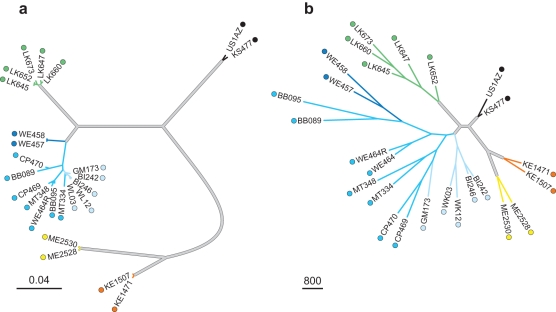
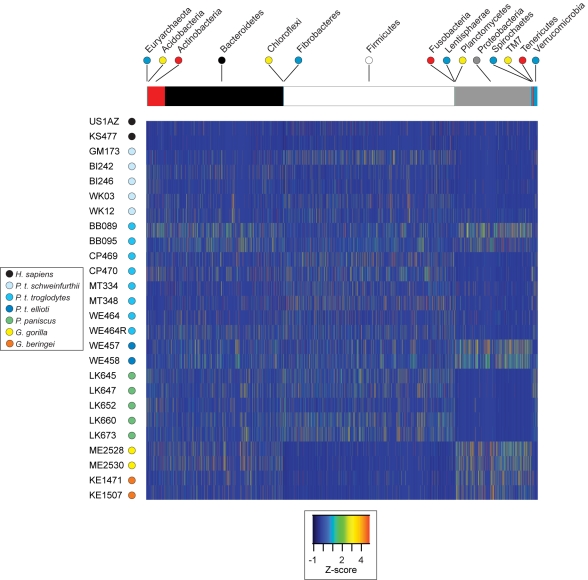
Multiple factors over the lifetime of an individual, including diet, geography, and physiologic state, will influence the microbial communities within the primate gut. To determine the source of variation in the composition of the microbiota within and among species, we investigated the distal gut microbial communities harbored by great apes, as present in fecal samples recovered within their native ranges. We found that the branching order of host-species phylogenies based on the composition of these microbial communities is completely congruent with the known relationships of the hosts. Although the gut is initially and continuously seeded by bacteria that are acquired from external sources, we establish that over evolutionary timescales, the composition of the gut microbiota among great ape species is phylogenetically conserved and has diverged in a manner consistent with vertical inheritance.
个体一生中的多种因素,包括饮食、地理位置和生理状态,都会影响灵长类动物肠道内的微生物群落。为了确定物种内和物种间微生物群落组成变化的来源,我们研究了在其原生范围内从粪便样本中回收的大型类人猿携带的远端肠道微生物群落。我们发现,基于这些微生物群落组成的宿主种系发生分支顺序与宿主的已知关系完全一致。尽管肠道最初和持续地被从外部来源获得的细菌定植,但我们确定,在进化时间尺度上,大型类人猿物种之间的肠道微生物群落组成在系统发育上是保守的,并且以与垂直遗传一致的方式发生了分化。