Division of Clinical Research, Centre Jean Perrin, Clermont-Ferrand, F-63011 France.
BMC Cancer. 2010 Nov 25;10:648. doi: 10.1186/1471-2407-10-648.
Weight change during chemotherapy is reported to be associated with a worse prognosis in breast cancer patients, both with weight gain and weight loss. However, most studies were conducted prior to the common use of anthracycline-base chemotherapy and on North American populations with a mean BMI classified as overweight. Our study was aimed to evaluate the prognostic value of weight change during anthracycline-based chemotherapy on non metastatic breast cancer (European population) with a long term follow-up.
Patients included 111 women diagnosed with early stage breast cancer and locally advanced breast cancer who have been treated by anthracycline-based chemotherapy regimen between 1976 and 1989. The relative percent weight variation (WV) between baseline and postchemotherapy treatment was calculated and categorized into either weight change (WV > 5%) or stable (WV < 5%). The median follow-up was 20.4 years [19.4 - 27.6]. Cox proportional hazard models were used to evaluate any potential association of weight change and known prognostic factors with the time to recurrence and overall survival.
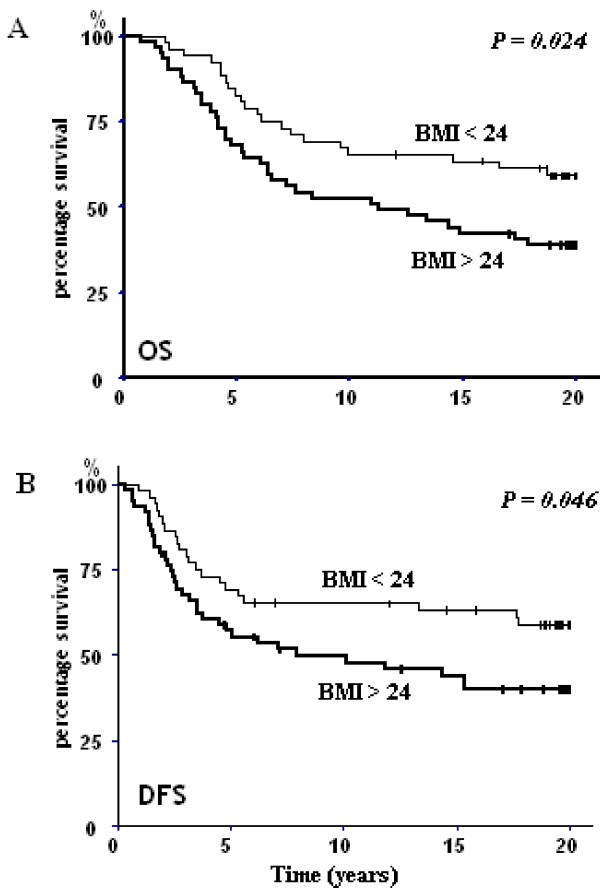
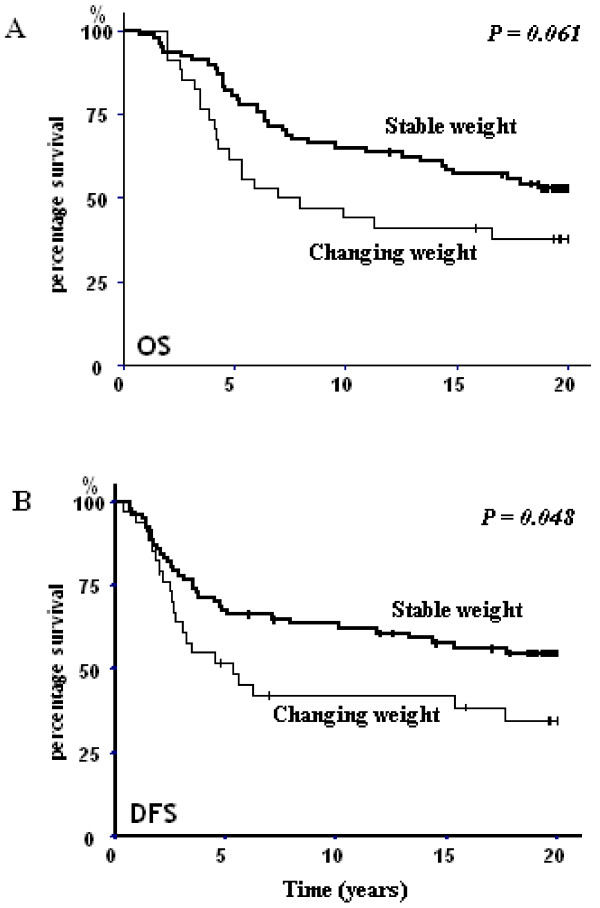
Baseline BMI was 24.4 kg/m2 [17.1 - 40.5]. During chemotherapy treatment, 31% of patients presented a notable weight variation which was greater than 5% of their initial weight.In multivariate analyses, weight change (> 5%) was positively associated with an increased risk of both recurrence (RR 2.28; 95% CI: 1.29-4.03) and death (RR 2.11; 95% CI: 1.21-3.66).
Our results suggest that weight change during breast-cancer chemotherapy treatment may be related to poorer prognosis with higher recurrence and higher mortality in comparison to women who maintained their weight.
化疗期间的体重变化与乳腺癌患者的预后较差相关,无论是体重增加还是体重减轻。然而,大多数研究是在蒽环类化疗广泛应用之前,针对北美人群进行的,这些人群的平均 BMI 被归类为超重。我们的研究旨在评估蒽环类化疗期间体重变化对欧洲人群非转移性乳腺癌(欧洲人群)的预后价值,并进行长期随访。
本研究纳入了 111 名接受蒽环类化疗方案治疗的早期和局部晚期乳腺癌患者。计算基线和化疗后治疗期间的相对体重变化百分比(WV),并分为体重变化(WV > 5%)或稳定(WV < 5%)。中位随访时间为 20.4 年[19.4-27.6]。使用 Cox 比例风险模型评估体重变化与已知预后因素与复发时间和总生存时间之间的潜在关联。
基线 BMI 为 24.4 kg/m2[17.1-40.5]。在化疗期间,31%的患者出现了明显的体重变化,超过了初始体重的 5%。在多变量分析中,体重变化(> 5%)与复发风险增加(RR 2.28;95%CI:1.29-4.03)和死亡风险增加(RR 2.11;95%CI:1.21-3.66)均呈正相关。
我们的研究结果表明,与体重保持不变的女性相比,乳腺癌化疗期间的体重变化可能与预后较差相关,复发率和死亡率更高。