School of Dentistry and Dental Research Institute, University of California - Los Angeles, 10833 Le Conte Avenue, 73-029 CHS, Los Angeles, CA 90095, USA.
Oral Oncol. 2011 Jan;47(1):51-5. doi: 10.1016/j.oraloncology.2010.10.009. Epub 2010 Nov 24.
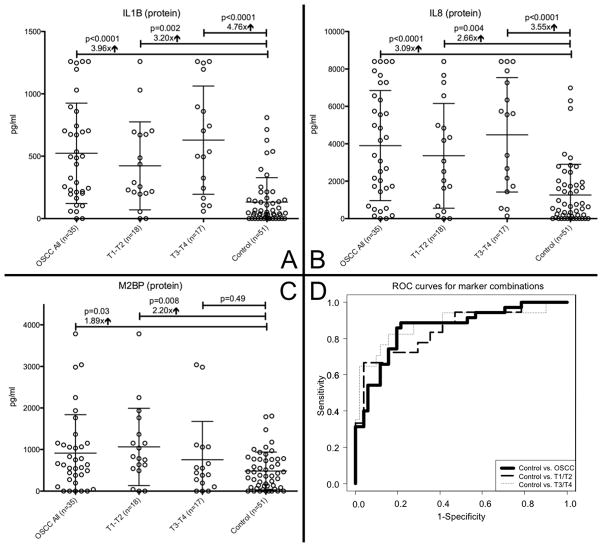
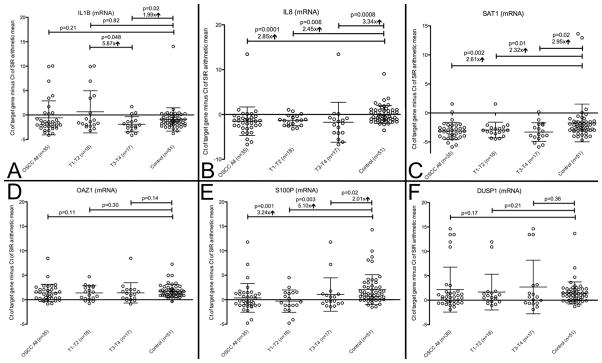
Early detection of oral squamous cell cancer (OSCC) is the key to improve the low 5-year survival rate. Using proteomic and genomic technologies we have previously discovered and validated salivary OSCC markers in American patients. The question arises whether these biomarkers are discriminatory in cohorts of different ethnic background. Six transcriptome (DUSP1, IL8, IL1B, OAZ1, SAT1, and S100P) and three proteome (IL1B, IL8, and M2BP) biomarkers were tested on 18 early and 17 late stage OSCC patients and 51 healthy controls with quantitative PCR and ELISA. Four transcriptome (IL8, IL1B, SAT1, and S100P) and all proteome biomarkers were significantly elevated (p<0.05) in OSCC patients. The combination of markers yielded an AUC of 0.86, 0.85 and 0.88 for OSCC total, T1-T2, and T3-T4, respectively. The sensitivity/specificity for OSCC total was 0.89/0.78, for T1-T2 0.67/0.96, and for T3-T4 0.82/0.84. In conclusion, seven of the nine salivary biomarkers (three proteins and four mRNAs) were validated and performed strongest in late stage cancer. Patient-based salivary diagnostics is a highly promising approach for OSCC detection. This study shows that previously discovered and validated salivary OSCC biomarkers are discriminatory and reproducible in a different ethnic cohort. These findings support the feasibility to implement multi-center, multi-ethnicity clinical trials towards the pivotal validation of salivary biomarkers for OSCC detection.
早期发现口腔鳞状细胞癌(OSCC)是提高 5 年生存率的关键。我们之前使用蛋白质组学和基因组学技术在美国患者中发现并验证了唾液 OSCC 标志物。问题是这些生物标志物在不同种族背景的队列中是否具有区分能力。我们在 18 名早期和 17 名晚期 OSCC 患者以及 51 名健康对照者中使用定量 PCR 和 ELISA 测试了 6 个转录组(DUSP1、IL8、IL1B、OAZ1、SAT1 和 S100P)和 3 个蛋白质组(IL1B、IL8 和 M2BP)生物标志物。在 OSCC 患者中,4 个转录组(IL8、IL1B、SAT1 和 S100P)和所有蛋白质组生物标志物均显著升高(p<0.05)。标志物组合对 OSCC 总、T1-T2 和 T3-T4 的 AUC 分别为 0.86、0.85 和 0.88。OSCC 总、T1-T2 和 T3-T4 的敏感性/特异性分别为 0.89/0.78、0.67/0.96 和 0.82/0.84。总之,9 个唾液生物标志物中的 7 个(3 种蛋白质和 4 种 mRNA)得到了验证,在晚期癌症中表现最强。基于患者的唾液诊断是一种很有前途的 OSCC 检测方法。本研究表明,之前发现并验证的唾液 OSCC 标志物在不同种族队列中具有区分能力和可重复性。这些发现支持了实施多中心、多民族临床试验的可行性,以验证唾液标志物用于 OSCC 检测的关键性。