Febit group, Heidelberg, Germany.
Nat Biotechnol. 2010 Dec;28(12):1291-4. doi: 10.1038/nbt.1710. Epub 2010 Nov 28.
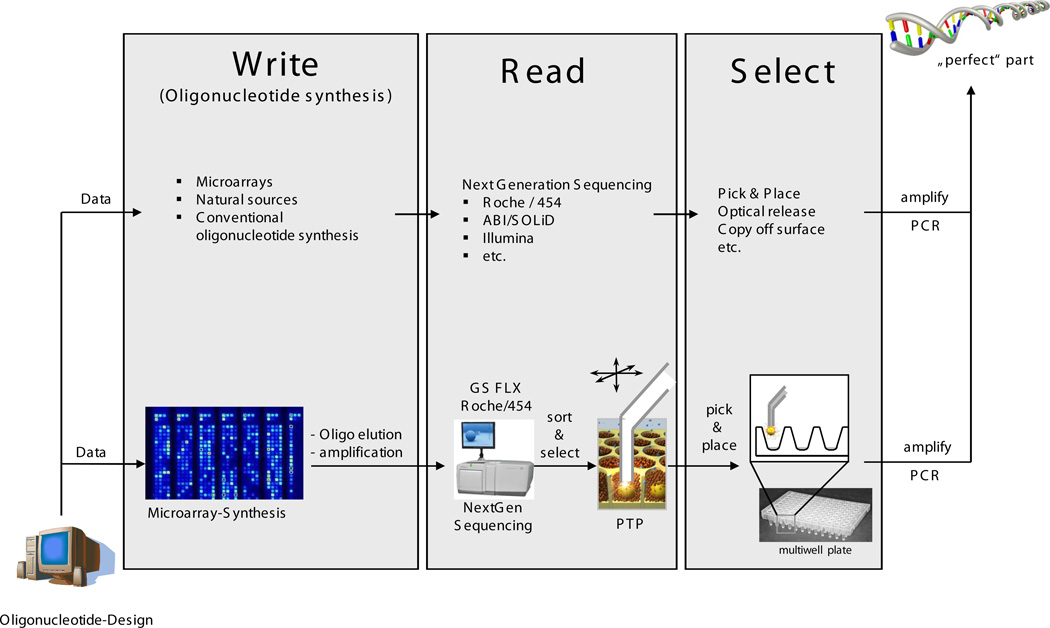
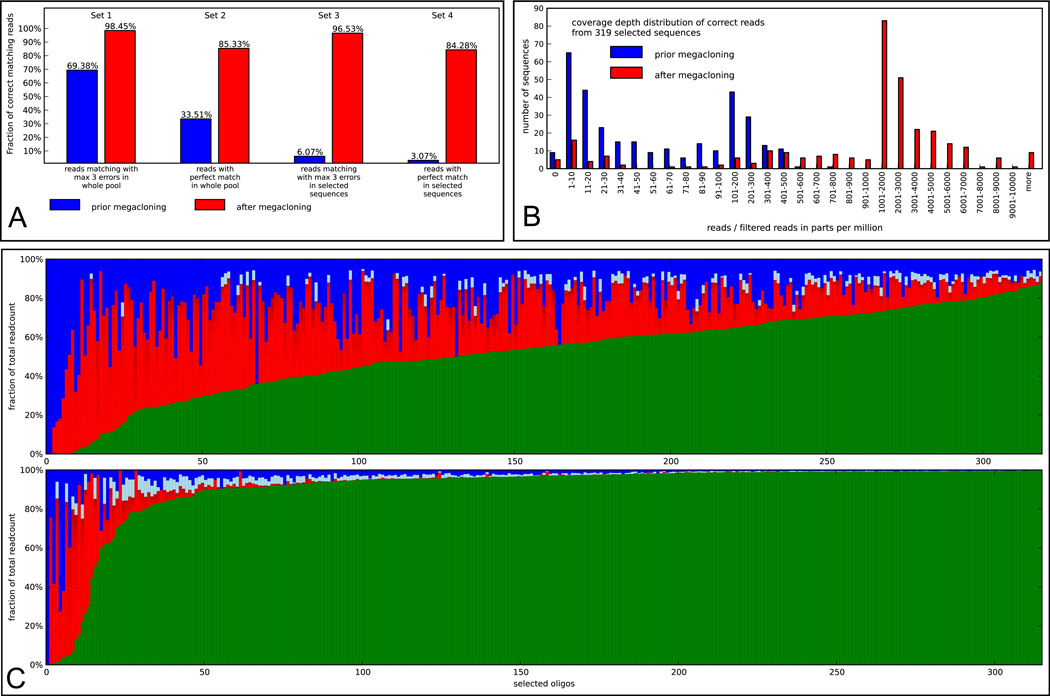
The construction of synthetic biological systems involving millions of nucleotides is limited by the lack of high-quality synthetic DNA. Consequently, the field requires advances in the accuracy and scale of chemical DNA synthesis and in the processing of longer DNA assembled from short fragments. Here we describe a highly parallel and miniaturized method, called megacloning, for obtaining high-quality DNA by using next-generation sequencing (NGS) technology as a preparative tool. We demonstrate our method by processing both chemically synthesized and microarray-derived DNA oligonucleotides with a robotic system for imaging and picking beads directly off of a high-throughput pyrosequencing platform. The method can reduce error rates by a factor of 500 compared to the starting oligonucleotide pool generated by microarray. We use DNA obtained by megacloning to assemble synthetic genes. In principle, millions of DNA fragments can be sequenced, characterized and sorted in a single megacloner run, enabling constructive biology up to the megabase scale.
涉及数百万个核苷酸的合成生物学系统的构建受到高质量合成 DNA 的缺乏的限制。因此,该领域需要在化学 DNA 合成的准确性和规模上取得进展,并且需要在将较短片段组装成长 DNA 方面取得进展。在这里,我们描述了一种高度并行和小型化的方法,称为大片段克隆,该方法使用下一代测序 (NGS) 技术作为制备工具来获得高质量的 DNA。我们通过使用用于直接从高通量焦磷酸测序平台上成像和挑取珠粒的机器人系统来处理化学合成和微阵列衍生的 DNA 寡核苷酸来证明我们的方法。与通过微阵列生成的起始寡核苷酸池相比,该方法可以将错误率降低 500 倍。我们使用大片段克隆获得的 DNA 来组装合成基因。原则上,在单个大片段克隆器运行中可以对数百万个 DNA 片段进行测序、表征和分类,从而实现兆碱基规模的建设性生物学。