Division of Genetics and Population Health, Queensland Institute of Medical Research, Brisbane, Australia.
Breast Cancer Res. 2010;12(6):R102. doi: 10.1186/bcr2785. Epub 2010 Nov 29.
Current attempts to identify genetic modifiers of BRCA1 and BRCA2 associated risk have focused on a candidate gene approach, based on knowledge of gene functions, or the development of large genome-wide association studies. In this study, we evaluated 24 SNPs tagged to 14 candidate genes derived through a novel approach that analysed gene expression differences to prioritise candidate modifier genes for association studies.
We successfully genotyped 24 SNPs in a cohort of up to 4,724 BRCA1 and 2,693 BRCA2 female mutation carriers from 15 study groups and assessed whether these variants were associated with risk of breast cancer in BRCA1 and BRCA2 mutation carriers.
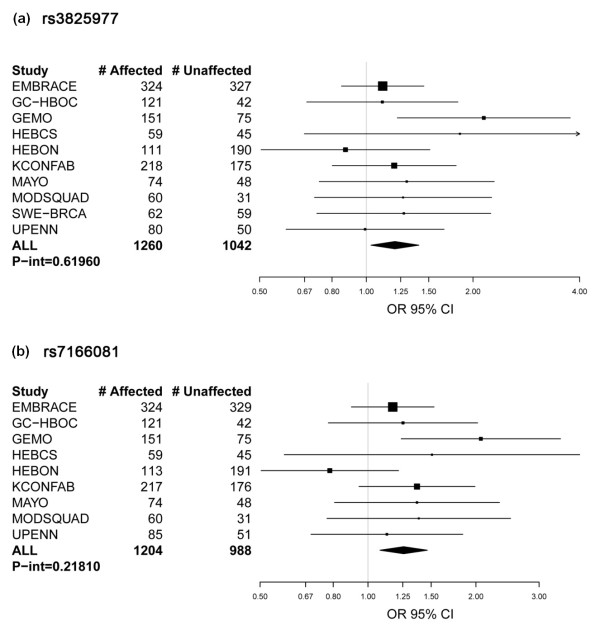
SNPs in five of the 14 candidate genes showed evidence of association with breast cancer risk for BRCA1 or BRCA2 carriers (P < 0.05). Notably, the minor alleles of two SNPs (rs7166081 and rs3825977) in high linkage disequilibrium (r² = 0.77), located at the SMAD3 locus (15q22), were each associated with increased breast cancer risk for BRCA2 mutation carriers (relative risk = 1.25, 95% confidence interval = 1.07 to 1.45, P(trend) = 0.004; and relative risk = 1.20, 95% confidence interval = 1.03 to 1.40, P(trend) = 0.018).
This study provides evidence that the SMAD3 gene, which encodes a key regulatory protein in the transforming growth factor beta signalling pathway and is known to interact directly with BRCA2, may contribute to increased risk of breast cancer in BRCA2 mutation carriers. This finding suggests that genes with expression associated with BRCA1 and BRCA2 mutation status are enriched for the presence of common genetic modifiers of breast cancer risk in these populations.
目前,识别 BRCA1 和 BRCA2 相关风险的遗传修饰因子的尝试集中在候选基因方法上,该方法基于对基因功能的了解,或开展大规模全基因组关联研究。在这项研究中,我们通过一种新方法分析了基因表达差异,以确定候选修饰基因进行关联研究的优先级,从而评估了 14 个候选基因中 24 个 SNP 的标记。
我们成功地对来自 15 个研究组的多达 4724 名 BRCA1 和 2693 名 BRCA2 女性突变携带者的队列中的 24 个 SNP 进行了基因分型,并评估了这些变体是否与 BRCA1 和 BRCA2 突变携带者的乳腺癌风险相关。
在 14 个候选基因中的 5 个基因中的 SNP 显示出与 BRCA1 或 BRCA2 携带者的乳腺癌风险相关的证据(P<0.05)。值得注意的是,两个 SNP(rs7166081 和 rs3825977)的较小等位基因位于 SMAD3 基因座(15q22),处于高度连锁不平衡(r²=0.77),每个 SNP 都与 BRCA2 突变携带者的乳腺癌风险增加相关(相对风险=1.25,95%置信区间=1.07 至 1.45,P(趋势)=0.004;相对风险=1.20,95%置信区间=1.03 至 1.40,P(趋势)=0.018)。
这项研究提供了证据表明,SMAD3 基因,它编码转化生长因子β信号通路中的关键调节蛋白,并且已知与 BRCA2 直接相互作用,可能导致 BRCA2 突变携带者的乳腺癌风险增加。这一发现表明,与 BRCA1 和 BRCA2 突变状态相关的表达基因在这些人群中富含乳腺癌风险的常见遗传修饰因子。