Mizunami Makoto, Matsumoto Yukihisa
Graduate School of Life Science, Hokkaido University, Sapporo, Japan.
Front Behav Neurosci. 2010 Nov 17;4:172. doi: 10.3389/fnbeh.2010.00172. eCollection 2010.
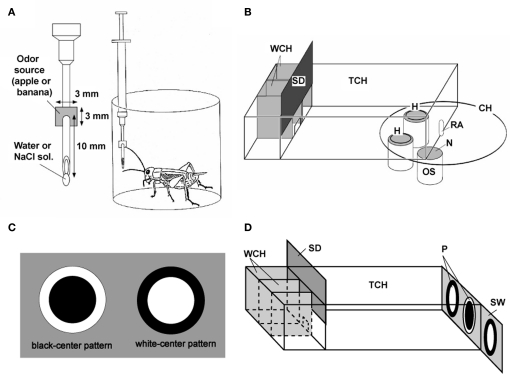
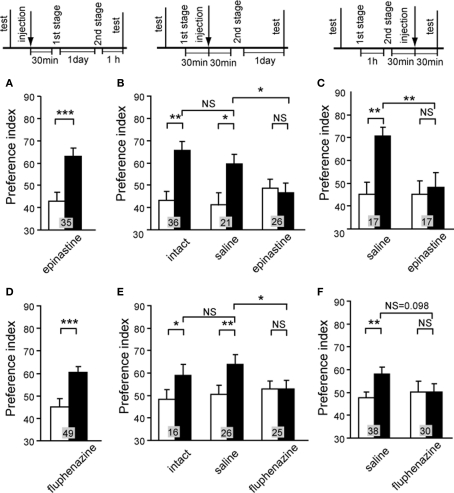
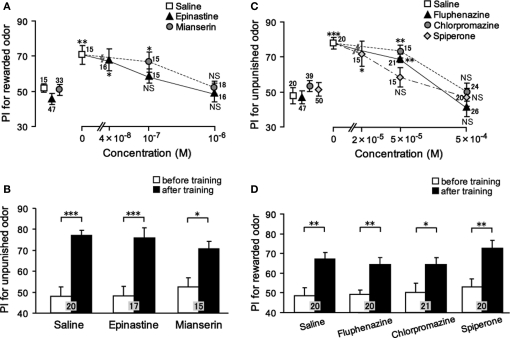
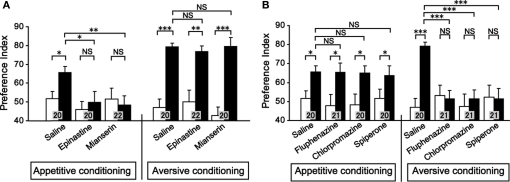
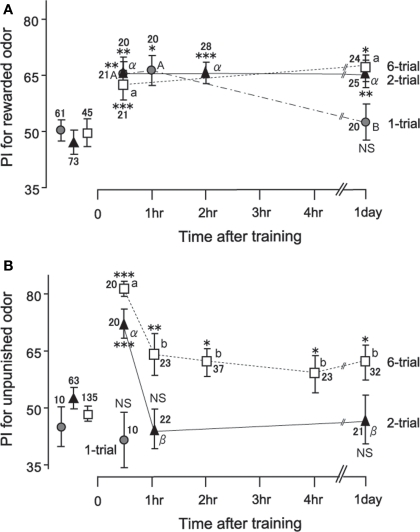
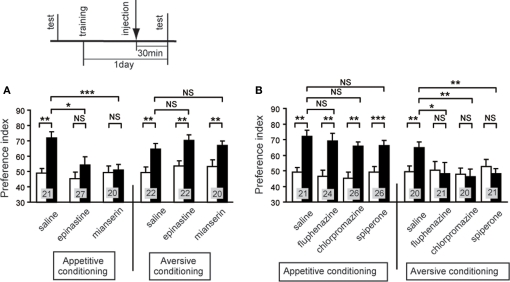
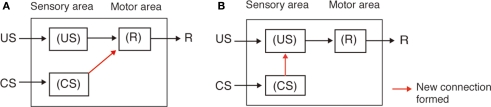
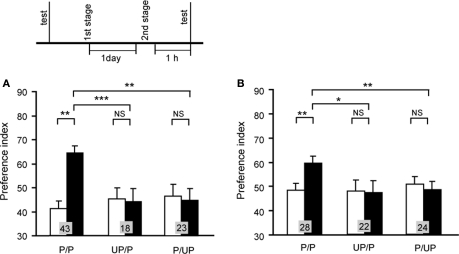
We review recent progress in the study of roles of octopaminergic (OA-ergic) and dopaminergic (DA-ergic) signaling in insect classical conditioning, focusing on our studies on crickets. Studies on olfactory learning in honey bees and fruit-flies have suggested that OA-ergic and DA-ergic neurons convey reinforcing signals of appetitive unconditioned stimulus (US) and aversive US, respectively. Our work suggested that this is applicable to olfactory, visual pattern, and color learning in crickets, indicating that this feature is ubiquitous in learning of various sensory stimuli. We also showed that aversive memory decayed much faster than did appetitive memory, and we proposed that this feature is common in insects and humans. Our study also suggested that activation of OA- or DA-ergic neurons is needed for appetitive or aversive memory recall, respectively. To account for this finding, we proposed a model in which it is assumed that two types of synaptic connections are strengthened by conditioning and are activated during memory recall, one type being connections from neurons representing conditioned stimulus (CS) to neurons inducing conditioned response and the other being connections from neurons representing CS to OA- or DA-ergic neurons representing appetitive or aversive US, respectively. The former is called stimulus-response (S-R) connection and the latter is called stimulus-stimulus (S-S) connection by theorists studying classical conditioning in vertebrates. Results of our studies using a second-order conditioning procedure supported our model. We propose that insect classical conditioning involves the formation of S-S connection and its activation for memory recall, which are often called cognitive processes.
我们回顾了章鱼胺能(OA能)和多巴胺能(DA能)信号在昆虫经典条件反射中作用的研究进展,重点介绍我们对蟋蟀的研究。对蜜蜂和果蝇嗅觉学习的研究表明,OA能神经元和DA能神经元分别传递正向非条件刺激(US)和负向非条件刺激的强化信号。我们的研究表明,这适用于蟋蟀的嗅觉、视觉模式和颜色学习,表明这一特征在各种感觉刺激的学习中普遍存在。我们还表明,负向记忆的衰退比正向记忆快得多,我们提出这一特征在昆虫和人类中很常见。我们的研究还表明,分别需要激活OA能或DA能神经元来唤起正向或负向记忆。为了解释这一发现,我们提出了一个模型,假设两种类型的突触连接通过条件反射得到加强,并在记忆唤起时被激活,一种类型是从代表条件刺激(CS)的神经元到诱导条件反应的神经元的连接,另一种类型是从代表CS的神经元到分别代表正向或负向US的OA能或DA能神经元的连接。研究脊椎动物经典条件反射的理论家将前者称为刺激-反应(S-R)连接,后者称为刺激-刺激(S-S)连接。我们使用二阶条件反射程序的研究结果支持了我们的模型。我们提出,昆虫经典条件反射涉及S-S连接的形成及其对记忆唤起的激活,这通常被称为认知过程。