Douw Linda, van Dellen Edwin, Baayen Johannes C, Klein Martin, Velis Demetrios N, Alpherts Willem C J, Heimans Jan J, Reijneveld Jaap C, Stam Cornelis Jan
Department of Neurology, VU University Medical Center Amsterdam, Netherlands.
Front Hum Neurosci. 2010 Nov 11;4:174. doi: 10.3389/fnhum.2010.00174. eCollection 2010.
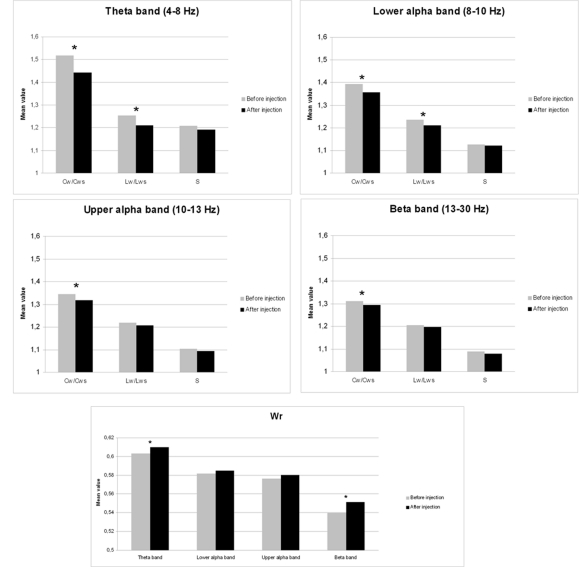
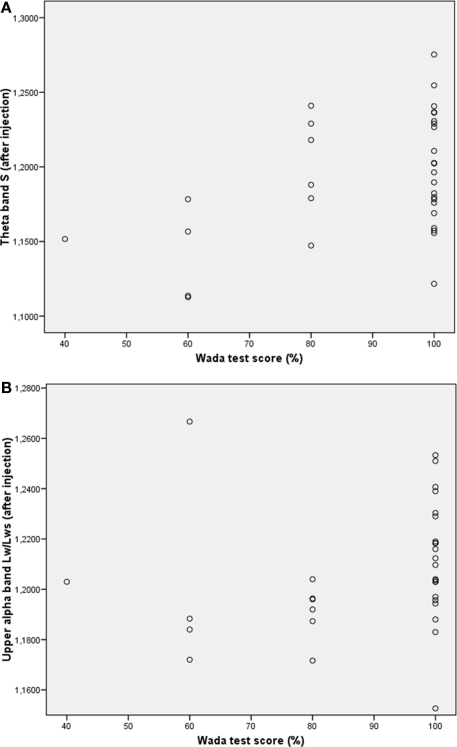
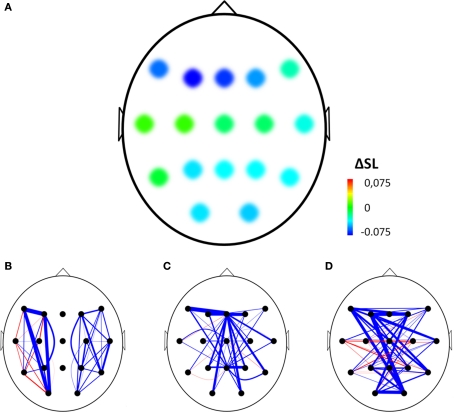
The intra-arterial amobarbital procedure (IAP or Wada test) is used to determine language lateralization and contralateral memory functioning in patients eligible for neurosurgery because of pharmaco-resistant epilepsy. During unilateral sedation, functioning of the contralateral hemisphere is assessed by means of neuropsychological tests. We use the IAP as a reversible model for the effect of lesions on brain network topology. Three artifact-free epochs (4096 samples) were selected from each electroencephalogram record before and after amobarbital injection. Functional connectivity was assessed by means of the synchronization likelihood. The resulting functional connectivity matrices were constructed for all six epochs per patient in four frequency bands, and weighted network analysis was performed. The clustering coefficient, average path length, small-world index, and edge weight correlation were calculated. Recordings of 33 patients were available. Network topology changed significantly after amobarbital injection: clustering decreased in all frequency bands, while path length decreased in the theta and lower alpha band, indicating a shift toward a more random network topology. Likewise, the edge weight correlation decreased after injection of amobarbital in the theta and beta bands. Network characteristics after injection of amobarbital were correlated with memory score: higher theta band small-world index and increased upper alpha path length were related to better memory score. The whole-brain network topology in patients eligible for epilepsy surgery becomes more random and less optimally organized after selective sedation of one hemisphere, as has been reported in studies with brain tumor patients. Furthermore, memory functioning after injection seems related to network topology, indicating that functional performance is related to topological network properties of the brain.
动脉内注射异戊巴比妥程序(IAP或Wada试验)用于确定因药物难治性癫痫而符合神经外科手术条件的患者的语言偏侧化和对侧记忆功能。在单侧镇静期间,通过神经心理学测试评估对侧半球的功能。我们将IAP用作损伤对脑网络拓扑结构影响的可逆模型。在注射异戊巴比妥之前和之后,从每个脑电图记录中选择三个无伪迹的时段(4096个样本)。通过同步似然性评估功能连接性。为每位患者的所有六个时段在四个频段构建得到的功能连接矩阵,并进行加权网络分析。计算聚类系数、平均路径长度、小世界指数和边权重相关性。有33例患者的记录可用。注射异戊巴比妥后,网络拓扑结构发生了显著变化:所有频段的聚类均减少,而θ频段和较低α频段的路径长度减少,表明向更随机的网络拓扑结构转变。同样,在θ频段和β频段注射异戊巴比妥后,边权重相关性降低。注射异戊巴比妥后的网络特征与记忆评分相关:较高的θ频段小世界指数和增加的上α频段路径长度与更好的记忆评分相关。正如在脑肿瘤患者的研究中所报道的那样,在对一个半球进行选择性镇静后,符合癫痫手术条件的患者的全脑网络拓扑结构变得更加随机且组织得不太优化。此外,注射后的记忆功能似乎与网络拓扑结构有关,这表明功能表现与大脑的拓扑网络特性有关。