de Haan Willem, Pijnenburg Yolande A L, Strijers Rob L M, van der Made Yolande, van der Flier Wiesje M, Scheltens Philip, Stam Cornelis J
Alzheimer Center, VU University Medical Center, Amsterdam, the Netherlands.
BMC Neurosci. 2009 Aug 21;10:101. doi: 10.1186/1471-2202-10-101.
Although a large body of knowledge about both brain structure and function has been gathered over the last decades, we still have a poor understanding of their exact relationship. Graph theory provides a method to study the relation between network structure and function, and its application to neuroscientific data is an emerging research field. We investigated topological changes in large-scale functional brain networks in patients with Alzheimer's disease (AD) and frontotemporal lobar degeneration (FTLD) by means of graph theoretical analysis of resting-state EEG recordings. EEGs of 20 patients with mild to moderate AD, 15 FTLD patients, and 23 non-demented individuals were recorded in an eyes-closed resting-state. The synchronization likelihood (SL), a measure of functional connectivity, was calculated for each sensor pair in 0.5-4 Hz, 4-8 Hz, 8-10 Hz, 10-13 Hz, 13-30 Hz and 30-45 Hz frequency bands. The resulting connectivity matrices were converted to unweighted graphs, whose structure was characterized with several measures: mean clustering coefficient (local connectivity), characteristic path length (global connectivity) and degree correlation (network 'assortativity'). All results were normalized for network size and compared with random control networks.
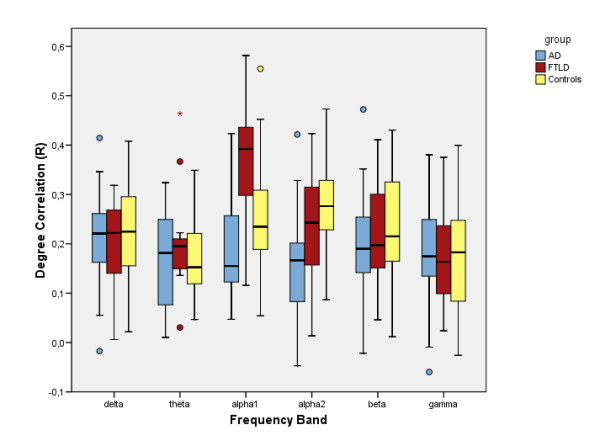
In AD, the clustering coefficient decreased in the lower alpha and beta bands (p < 0.001), and the characteristic path length decreased in the lower alpha and gamma bands (p < 0.05) compared to controls. In FTLD no significant differences with controls were found in these measures. The degree correlation decreased in both alpha bands in AD compared to controls (p < 0.05), but increased in the FTLD lower alpha band compared with controls (p < 0.01).
With decreasing local and global connectivity parameters, the large-scale functional brain network organization in AD deviates from the optimal 'small-world' network structure towards a more 'random' type. This is associated with less efficient information exchange between brain areas, supporting the disconnection hypothesis of AD. Surprisingly, FTLD patients show changes in the opposite direction, towards a (perhaps excessively) more 'ordered' network structure, possibly reflecting a different underlying pathophysiological process.
尽管在过去几十年里已经积累了大量关于大脑结构和功能的知识,但我们对它们的确切关系仍然了解甚少。图论提供了一种研究网络结构与功能之间关系的方法,其在神经科学数据中的应用是一个新兴的研究领域。我们通过对静息态脑电图记录进行图论分析,研究了阿尔茨海默病(AD)和额颞叶变性(FTLD)患者大脑大规模功能网络的拓扑变化。在闭眼静息状态下记录了20例轻度至中度AD患者、15例FTLD患者和23例非痴呆个体的脑电图。计算了0.5 - 4Hz、4 - 8Hz、8 - 10Hz、10 - 13Hz、13 - 30Hz和30 - 45Hz频段内每个传感器对的同步似然性(SL),这是一种功能连接性的度量。将得到的连接矩阵转换为无权图,其结构用几种度量来表征:平均聚类系数(局部连接性)、特征路径长度(全局连接性)和度相关性(网络“ assortativity”)。所有结果都针对网络大小进行了归一化,并与随机对照网络进行了比较。
与对照组相比,AD患者在较低α和β频段的聚类系数降低(p < 0.001),在较低α和γ频段的特征路径长度降低(p < 0.05)。在FTLD患者中,这些度量与对照组相比未发现显著差异。与对照组相比,AD患者两个α频段的度相关性降低(p < 0.05),但与对照组相比,FTLD患者较低α频段的度相关性增加(p < 0.01)。
随着局部和全局连接参数的降低,AD患者大脑的大规模功能网络组织偏离了最优的“小世界”网络结构,趋向于更“随机”的类型。这与脑区之间信息交换效率降低有关,支持了AD的失连接假说。令人惊讶的是,FTLD患者表现出相反方向的变化,趋向于(可能过度地)更“有序”的网络结构,这可能反映了不同的潜在病理生理过程。