Computation and Systems Biology, Singapore-MIT Alliance, Singapore, Singapore.
PLoS One. 2010 Nov 19;5(11):e14063. doi: 10.1371/journal.pone.0014063.
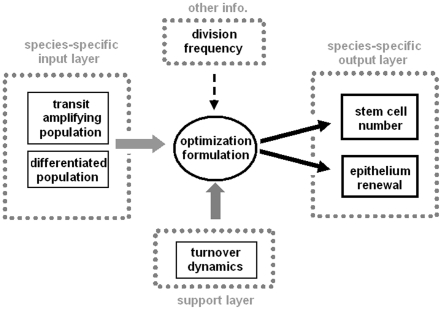
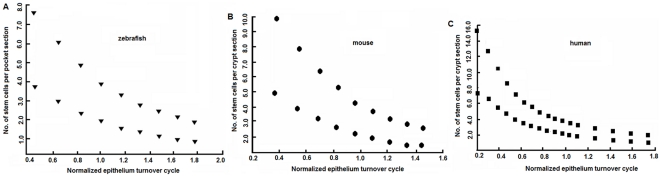
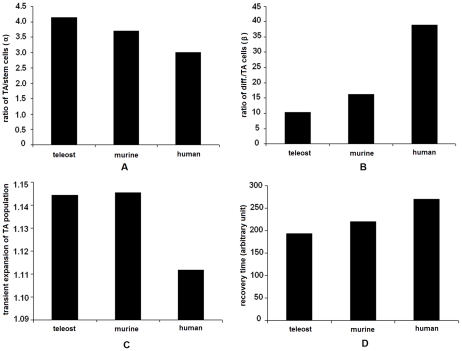
Intestinal stem cells play a pivotal role in the epithelial tissue renewal, homeostasis and cancer development. The lack of a general marker for intestinal stem cells across species has hampered analysis of stem cell number in different species and their adaptive changes upon intestinal lesions or during development of cancer. Here a two-dimensional model, named STORM, has been developed to address this issue. By optimizing epithelium renewal dynamics, the model examines the epithelial stem cell number by taking experimental input information regarding epithelium proliferation and differentiation. As the results suggest, there are 2.0-4.1 epithelial stem cells on each pocket section of zebrafish intestine, 2.0-4.1 stem cells on each crypt section of murine small intestine and 1.8-3.5 stem cells on each crypt section of human duodenum. The model is able to provide quick results for stem cell number and its adaptive changes, which is not easy to measure through experiments. Its general applicability to different species makes it a valuable tool for analysis of intestinal stem cells under various pathological conditions.
肠干细胞在肠道上皮组织的更新、稳态和癌症发展中起着关键作用。由于缺乏跨物种的通用肠干细胞标志物,因此难以分析不同物种的干细胞数量及其在肠道损伤或癌症发展过程中的适应性变化。本文开发了一种名为 STORM 的二维模型来解决这个问题。通过优化上皮组织更新动力学,该模型通过考虑关于上皮组织增殖和分化的实验输入信息来检查上皮干细胞的数量。结果表明,在斑马鱼肠道的每个隐窝段有 2.0-4.1 个肠上皮干细胞,在小鼠小肠的每个隐窝段有 2.0-4.1 个干细胞,在人类十二指肠的每个隐窝段有 1.8-3.5 个干细胞。该模型能够快速提供干细胞数量及其适应性变化的结果,这是通过实验难以测量的。它对不同物种的普遍适用性使其成为分析各种病理条件下肠道干细胞的有价值的工具。