Instituto de Biología y Medicina Experimental (CONICET), Vuelta de Obligado 2490 (1428) Buenos Aires, Argentina.
Reprod Biol Endocrinol. 2010 Dec 2;8:148. doi: 10.1186/1477-7827-8-148.
In non-obstructive azoospermia, histological patterns of Sertoli cell-only Syndrome (SCO) and hypospermatogenesis (H) are commonly found. In these pathologies, Leydig cell hyperplasia (LCH) is detected in some patients. Since TGF-β1 is involved in cellular proliferation/development, the aim of this work was to analyze the expression of TGF-β1, its receptors TGFBRII, TGFBRI (ALK-1 and ALK-5), and the co-receptor endoglin in human biopsies from patients with idiopathic infertility.
Specific immunostaining of TGF-β1, its receptors TGFBRII, TGFBRI (ALK-1 and ALK-5), co-receptor endoglin and Smads proteins, were carried out in testicular biopsies from normal and infertile men with SCO or H. Gene expression of TGF-β1 system were made in biopsies from infertile patients with semi-quantitative and quantitative PCR.
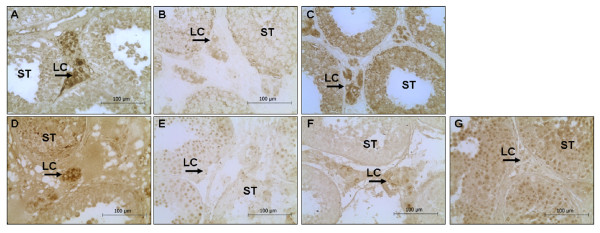
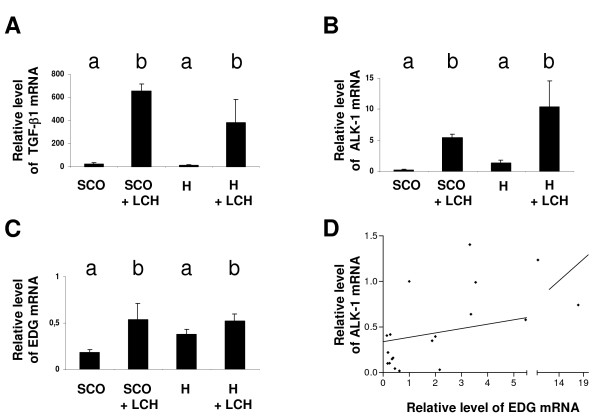
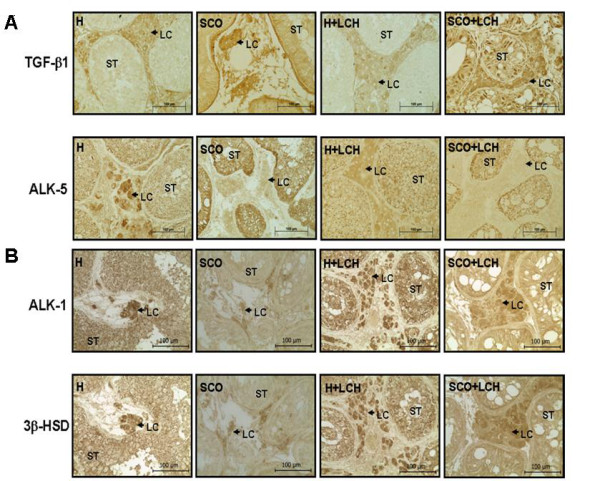
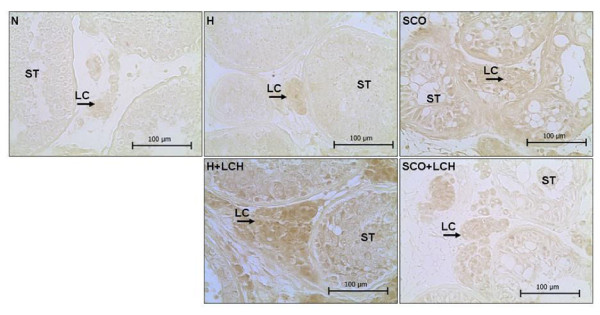
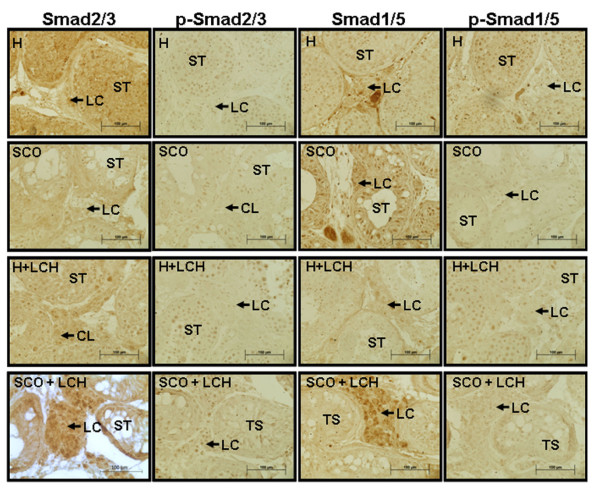
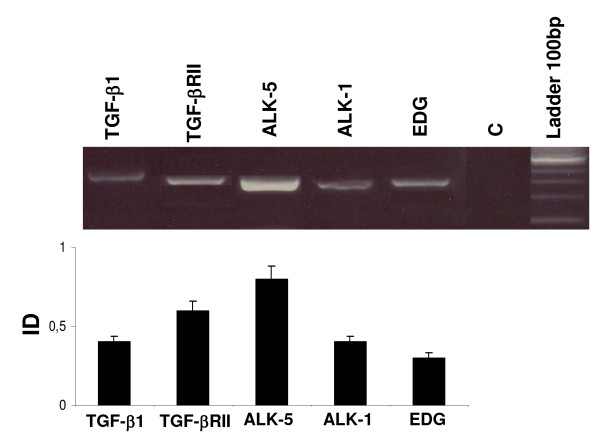
Immunohistochemical studies revealed that TGF-β1 and its specific receptors are present in Leydig cells in biopsies from normal tissue or patients with SCO or H with or without LCH. Smad proteins, which are involved in TGF-β1 signaling, are also detected in both their phosphorylated (activated) and dephosphorylated form in all samples TGF-β1, ALK-1 and endoglin gene expression are stronger in human biopsies with LCH than in those with SCO or H. Neither TGFBRII nor ALK-5 gene expression showed significant differences between pathologies. A significant correlation between ALK-1 and endoglin expression was observed.
In conclusion, the high levels of mRNA and protein expression of the TGF-β1 system in patients with LCH, particularly ALK1 and its correlation with endoglin, suggest that these proteins acting in concert might be, at least in part, committed actors in the Leydig cell hyperplasia.
在非梗阻性无精子症中,通常发现 Sertoli 细胞仅综合征(SCO)和少精子症(H)的组织学模式。在这些病变中,一些患者检测到 Leydig 细胞增生(LCH)。由于 TGF-β1 参与细胞增殖/发育,本工作的目的是分析 TGF-β1、其受体 TGFBRII、TGFBRI(ALK-1 和 ALK-5)和共受体内格林在特发性不育症患者的活检组织中的表达。
对正常和不育男性的睾丸活检组织中 TGF-β1、其受体 TGFBRII、TGFBRI(ALK-1 和 ALK-5)、共受体内格林和 Smads 蛋白进行特异性免疫染色。采用半定量和定量 PCR 检测不育症患者活检组织中 TGF-β1 系统的基因表达。
免疫组织化学研究表明,TGF-β1 及其特异性受体存在于正常组织或 SCO 或 H 患者的睾丸活检组织中的 Leydig 细胞中,无论是否存在 LCH。涉及 TGF-β1 信号转导的 Smad 蛋白也存在于所有样本的磷酸化(激活)和去磷酸化形式中。TGF-β1、ALK-1 和内格林基因表达在具有 LCH 的人类活检组织中比在具有 SCO 或 H 的组织中更强。TGFBRII 或 ALK-5 基因表达在病变之间没有明显差异。观察到 ALK-1 和内格林表达之间存在显著相关性。
总之,LCH 患者 TGF-β1 系统的 mRNA 和蛋白表达水平较高,特别是 ALK1 及其与内格林的相关性表明,这些协同作用的蛋白至少部分参与了 Leydig 细胞增生。