Universitätsmedizin Göttingen, Herzzentrum, Kardiologie und Pneumologie, Robert-Koch-Str. 40, 37099, Göttingen, Germany.
Clin Res Cardiol. 2011 May;100(5):433-8. doi: 10.1007/s00392-010-0261-4. Epub 2010 Dec 4.
Pyruvate was shown to increase cardiac performance in isolated human and animal myocardium and in patients with chronic heart failure. We sought to investigate the effects of pyruvate in acute heart failure.
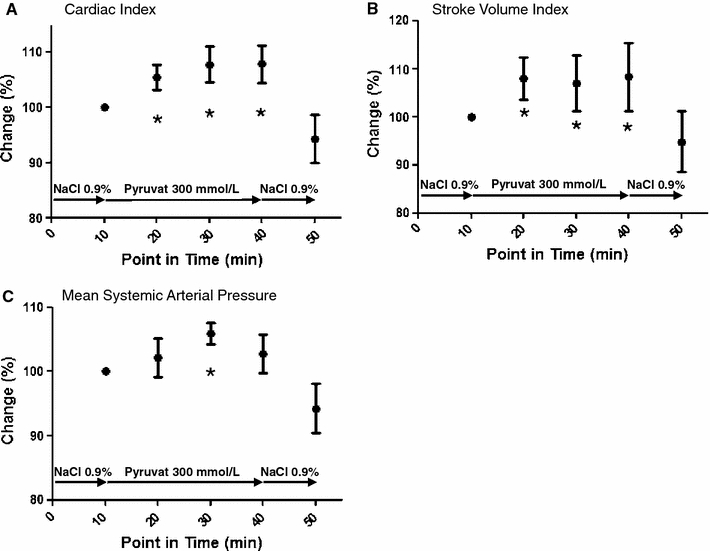
Patients presenting with cardiogenic shock because of acute myocardial infarction were subjected to standard care with primary PCI and intra-aortic balloon pump (IABP). Then, a Swan-Ganz catheter was placed in the pulmonary artery and hemodynamics was analyzed before, during and after intracoronary administration of 300 mmol/L pyruvate (360 ml/h). Pyruvate induced a significant increase in cardiac index (CI 2.23 ± 0.53 vs. 1.95 ± 0.45 L min(-1) m(-2); p < 0.05), stroke volume index (SVI, 29 ± 6 vs. 26 ± 5 mL m(-2); p < 0.05), and mean systemic arterial pressure (mean SAP, 95 ± 9 vs. 87 ± 9 mmHg; p < 0.05), whereas heart rate did not significantly change. The effects occurred rapidly within 30 min and were reversible within 10 min.
Intracoronary pyruvate might show beneficial effects in severe acute heart failure in addition to treatment with catecholamines and IABP. These effects should be further investigated in randomized controlled trials.
丙酮酸已被证明可增加离体人心肌和动物心肌以及慢性心力衰竭患者的心脏功能。我们旨在研究丙酮酸在急性心力衰竭中的作用。
因急性心肌梗死导致心源性休克的患者接受标准治疗,包括经皮冠状动脉介入治疗和主动脉内球囊反搏(IABP)。然后,将 Swan-Ganz 导管置入肺动脉,并在冠状动脉内给予 300mmol/L 丙酮酸(360ml/h)前后及期间分析血流动力学。丙酮酸可显著增加心指数(CI 2.23 ± 0.53 比 1.95 ± 0.45 L min(-1) m(-2);p < 0.05)、每搏量指数(SVI,29 ± 6 比 26 ± 5 mL m(-2);p < 0.05)和平均体循环动脉压(mean SAP,95 ± 9 比 87 ± 9mmHg;p < 0.05),而心率无明显变化。这些作用在 30 分钟内迅速发生,并在 10 分钟内可逆。
除了使用儿茶酚胺和 IABP 治疗外,冠状动脉内给予丙酮酸可能对严重急性心力衰竭有益。这些作用应在随机对照试验中进一步研究。