Enzo Life Sciences, 10 Executive Blvd, Farmingdale, NY 11735, USA.
Cell Biochem Biophys. 2011 Jul;60(3):173-85. doi: 10.1007/s12013-010-9138-4.
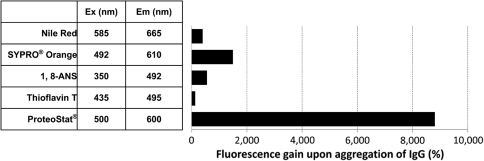
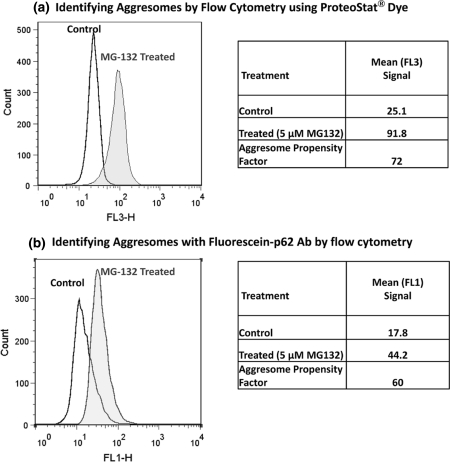
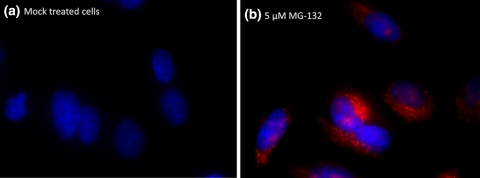
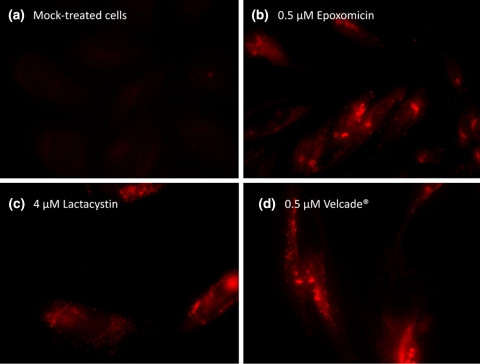
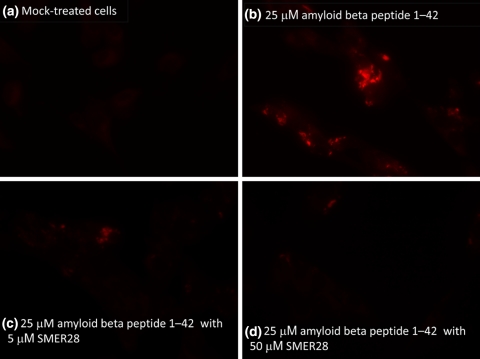
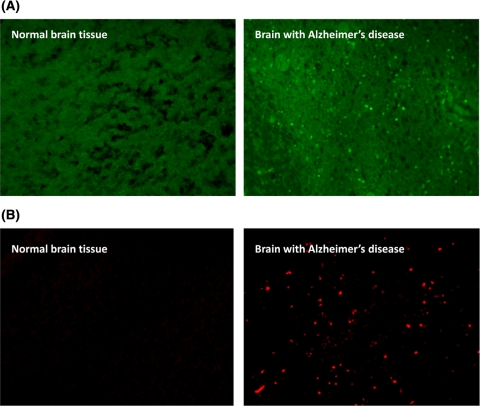
Aggresomes and related inclusion bodies appear to serve as storage depots for misfolded and aggregated proteins within cells, which can potentially be degraded by the autophagy pathway. A homogenous fluorescence-based assay was devised to detect aggregated proteins inside aggresomes and inclusion bodies within an authentic cellular context. The assay employs a novel red fluorescent molecular rotor dye, which is essentially nonfluorescent until it binds to structural features associated with the aggregated protein cargo. Aggresomes and related structures were generated within cultured cells using various potent, cell permeable, proteasome inhibitors: MG-132, lactacystin, epoxomicin and bortezomib, and then selectively detected with the fluorescent probe. Employing the probe in combination with various fluorescein-labeled primary antibodies facilitated co-localization of key components of the autophagy system (ubiquitin, p62, and LC3) with aggregated protein cargo by fluorescence microscopy. Furthermore, cytoplasmic aggregates were highlighted in SK-N-SH human neuroblastoma cells incubated with exogenously supplied amyloid beta peptide 1-42. SMER28, a small molecule modulator of autophagy acting via an mTOR-independent mechanism, prevented the accumulation of amyloid beta peptide within these cells. The described assay allows assessment of the effects of protein aggregation directly in cells, without resorting to the use of non-physiological protein mutations or genetically engineered cell lines. With minor modification, the assay was also adapted to the analysis of frozen or formalin-fixed, paraffin-embedded tissue sections, with demonstration of co-localization of aggregated cargo with β-amyloid and tau proteins in brain tissue sections from Alzheimer's disease patients.
聚集物和相关的包含体似乎作为细胞内错误折叠和聚集蛋白的储存库,这些蛋白可以通过自噬途径被降解。设计了一种基于荧光的均相测定法来检测聚集物中的聚集蛋白和包含体中的包含体,该测定法采用了一种新型的红色荧光分子转子染料,该染料在与聚集蛋白货物相关的结构特征结合之前基本上没有荧光。在培养的细胞中使用各种有效的、细胞通透性的蛋白酶体抑制剂(MG-132、乳酰半胱氨酸、环氧酶抑制剂和硼替佐米)生成聚集物和相关结构,然后用荧光探针选择性地检测。该探针与各种荧光素标记的一抗结合使用,通过荧光显微镜促进了自噬系统(泛素、p62 和 LC3)的关键成分与聚集蛋白货物的共定位。此外,在孵育外源性淀粉样β肽 1-42 的 SK-N-SH 人神经母细胞瘤细胞中突出显示细胞质聚集物。SMER28 是一种通过 mTOR 非依赖性机制调节自噬的小分子调节剂,可防止这些细胞中淀粉样β肽的积累。该描述的测定法允许直接在细胞中评估蛋白聚集的影响,而无需使用非生理蛋白突变或基因工程细胞系。通过微小的修改,该测定法还适用于冷冻或福尔马林固定、石蜡包埋组织切片的分析,并证明了聚集货物与β-淀粉样蛋白和 tau 蛋白在阿尔茨海默病患者脑组织切片中的共定位。