Department of Gynecology, Catholic University Med. School, and Department of Blood Transfusion and Cell Therapy, Azienda Ospedaliera S. Camillo-Forlanini, Rome, Italy.
J Transl Med. 2010 Dec 7;8:129. doi: 10.1186/1479-5876-8-129.
Cytokine-induced killer (CIK) cells are typically differentiated in vitro with interferon (IFN)-γ and αCD3 monoclonal antibodies (mAb), followed by the repeated provision of interleukin (IL)-2. It is presently unknown whether thymoglobulin (TG), a preparation of polyclonal rabbit γ immunoglobulins directed against human thymocytes, can improve the generation efficiency of CIK cells compared with αCD3 mAb in a clinical-grade culture protocol.
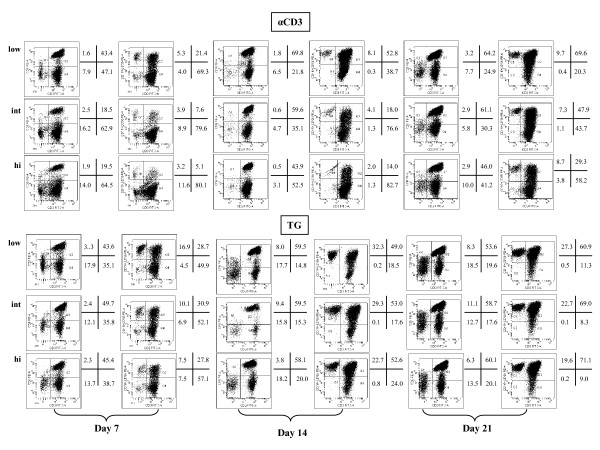
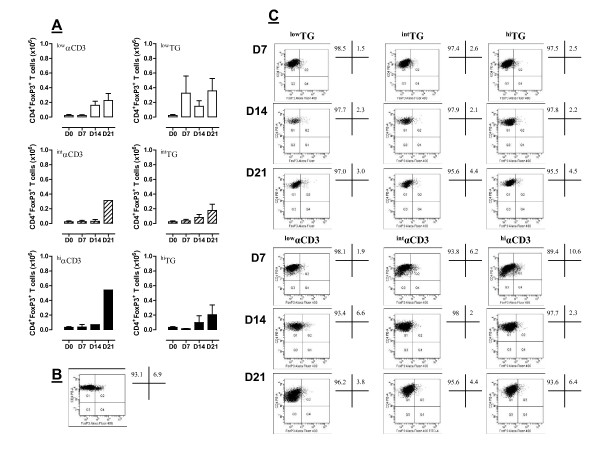
Peripheral blood mononuclear cells (PBMC) from 10 healthy donors and 4 patients with solid cancer were primed with IFN-γ on day 0 and low (50 ng/ml), intermediate (250 ng/ml) and high (500 ng/ml) concentrations of either αCD3 mAb or TG on day 1, and were fed with IL-2 every 3 days for 21 days. Aliquots of cells were harvested weekly to monitor the expression of representative members of the killer-like immunoglobulin receptor (KIR), NK inhibitory receptor, NK activating receptor and NK triggering receptor families. We also quantified the frequency of bona fide regulatory T cells (Treg), a T-cell subset implicated in the down-regulation of anti-tumor immunity, and tested the in vitro cytotoxic activity of CIK cells against NK-sensitive, chronic myeloid leukaemia K562 cells.
CIK cells expanded more vigorously in cultures supplemented with intermediate and high concentrations of TG compared with 50 ng/ml αCD3 mAb. TG-driven CIK cells expressed a constellation of NK activating/inhibitory receptors, such as CD158a and CD158b, NKp46, NKG2D and NKG2A/CD94, released high quantities of IL-12p40 and efficiently lysed K562 target cells. Of interest, the frequency of Treg cells was lower at any time-point compared with PBMC cultures nurtured with αCD3 mAb. Cancer patient-derived CIK cells were also expanded after priming with TG, but they expressed lower levels of the NKp46 triggering receptor and NKG2D activating receptor, thus manifesting a reduced ability to lyse K562 cells.
TG fosters the generation of functional CIK cells with no concomitant expansion of tumor-suppressive Treg cells. The culture conditions described herein should be applicable to cancer-bearing individuals, although the differentiation of fully functional CIK cells may be hindered in patients with advanced malignancies.
细胞因子诱导的杀伤(CIK)细胞通常在体外通过干扰素(IFN)-γ和αCD3 单克隆抗体(mAb)分化,然后反复提供白细胞介素(IL)-2。目前尚不清楚胸腺球蛋白(TG)是否可以在临床级培养方案中与αCD3 mAb 相比提高 CIK 细胞的生成效率。TG 是一种针对人胸腺细胞的多克隆兔γ免疫球蛋白制剂。
10 名健康供体和 4 名实体瘤患者的外周血单核细胞(PBMC)在第 0 天用 IFN-γ 启动,在第 1 天用低(50ng/ml)、中(250ng/ml)和高(500ng/ml)浓度的αCD3 mAb 或 TG 启动,每 3 天用 IL-2 喂养 21 天。每周收获细胞以监测代表杀伤样免疫球蛋白受体(KIR)、NK 抑制性受体、NK 激活受体和 NK 触发受体家族的成员的表达。我们还定量检测了真正的调节性 T 细胞(Treg)的频率,Treg 是一种参与下调抗肿瘤免疫的 T 细胞亚群,并测试了 CIK 细胞对 NK 敏感的慢性髓性白血病 K562 细胞的体外细胞毒性活性。
与 50ng/ml αCD3 mAb 相比,在添加中浓度和高浓度 TG 的培养物中,CIK 细胞的扩增更为活跃。TG 驱动的 CIK 细胞表达了一系列 NK 激活/抑制受体,如 CD158a 和 CD158b、NKp46、NKG2D 和 NKG2A/CD94,释放大量的 IL-12p40,并有效地裂解 K562 靶细胞。有趣的是,与用 αCD3 mAb 培养的 PBMC 相比,任何时间点的 Treg 细胞频率都较低。用 TG 诱导后,癌症患者来源的 CIK 细胞也得到了扩增,但它们表达的 NKp46 触发受体和 NKG2D 激活受体水平较低,因此裂解 K562 细胞的能力降低。
TG 促进了具有无肿瘤抑制性 Treg 细胞同时扩增的功能 CIK 细胞的产生。本文所述的培养条件应适用于癌症患者,尽管在晚期恶性肿瘤患者中完全功能的 CIK 细胞的分化可能受到阻碍。