Bitel Claudine L, Perrone-Bizzozero Nora I, Frederikse Peter H
Department of Pharmacology and Physiology & Rutgers-UMDNJ Integrative Neurosciences Program, UMDNJ New Jersey Medical School, Newark, NJ 07103, USA.
Mol Vis. 2010 Nov 4;16:2301-16.
An interlocking network of transcription factors, RNA binding proteins, and miRNAs globally regulates gene expression and alternative splicing throughout development, and ensures the coordinated mutually exclusive expression of non-neural and neuronal forms of these factors during neurogenesis. Striking similarities between lens fiber cell and neuron cell morphology led us to determine if these factors are also used in the lens. HuR and polypyrimidine tract binding protein (PTB) have been described as 'global regulators' of RNA alternative splicing, stability, and translation in non-neuronal (including ectodermal) tissues examined to date in diverse species, and REST/NRSF (RE-1 Silencing Transcription Factor/Neuron Restrictive Silencing Factor) represses>2,000 neuronal genes in all non-neuronal tissues examined to date, but has not included the lens. During neurogenesis these factors are replaced by what has been considered neuron-specific HuB/C/D, nPTB, and alternatively spliced REST (REST4), which work with miR-124 to activate this battery of genes, comprehensively reprogram neuronal alternative splicing, and maintain their exclusive expression in post-mitotic neurons.
Immunoprecipitation, western blot, immunofluorescence, and immunohistochemistry were used to determine the expression and distribution of proteins in mouse and rat lenses. Mobility shift assays were used to examine lenses for REST/NRSF DNA binding activity, and RT-PCR, DNA sequencing, and northern blots were used to identify RNA expression and alternative splicing events in lenses from mouse, rat, and goldfish (N. crassa).
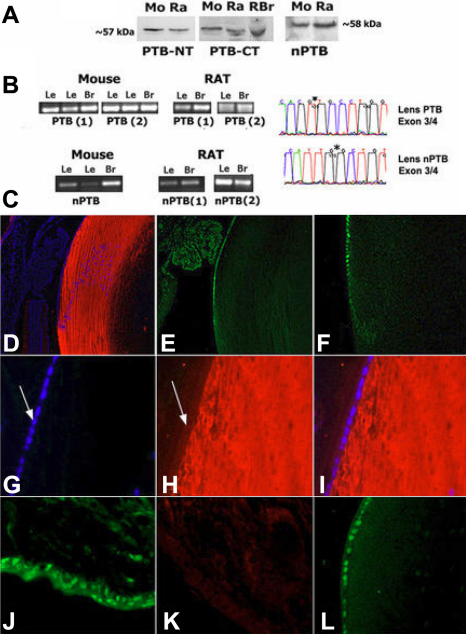
We demonstrated that REST, HuR, and PTB proteins are expressed predominantly in epithelial cells in mouse and rat lenses, and showed these factors are also replaced by the predominant expression of REST4, HuB/C/D and nPTB in post-mitotic fiber cells, together with miR-124 expression in vertebrate lenses. REST-regulated gene products were found to be restricted to fiber cells where REST is decreased. These findings predicted nPTB- and HuB/C/D-dependent splicing reactions can also occur in lenses, and we showed Neuronal C-src and Type 1 Neurofibromatosis 1 splicing as well as calcitonin gene related peptide (CGRP) and neural cell adhesion molecule (NCAM-180) alternative transcripts in lenses. Transgenic mice with increased HuD in lens also showed increased growth associated protein 43 (GAP43) and Ca++/Calmodulin dependent kinase IIα (CamKIIα) HuD target gene expression in the lens, similar to brain.
The present study provides the first evidence this fundamental set of regulatory factors, previously considered to have a unique role in governing neurogenesis are also used in the lens, and raises questions about the origins of these developmental factors and mechanisms in lens and neuronal cells that also have a basic role in determining the neuronal phenotype.
转录因子、RNA结合蛋白和微小RNA(miRNA)构成的互锁网络在整个发育过程中全面调控基因表达和可变剪接,并确保这些因子的非神经形式和神经形式在神经发生过程中相互排斥的协调表达。晶状体纤维细胞与神经元细胞形态之间惊人的相似性促使我们确定这些因子是否也在晶状体中发挥作用。HuR和多聚嘧啶序列结合蛋白(PTB)在迄今为止研究的不同物种的非神经组织(包括外胚层组织)中被描述为RNA可变剪接、稳定性和翻译的“全局调节因子”,而RE-1沉默转录因子/神经元限制性沉默因子(REST/NRSF)在迄今为止研究的所有非神经组织中抑制超过2000个神经元基因,但未包括晶状体。在神经发生过程中,这些因子被认为是神经元特异性的HuB/C/D、nPTB和可变剪接的REST(REST4)所取代,它们与miR-124共同作用激活这一系列基因,全面重编程神经元可变剪接,并在有丝分裂后神经元中维持其特异性表达。
采用免疫沉淀、蛋白质印迹、免疫荧光和免疫组织化学方法确定小鼠和大鼠晶状体中蛋白质的表达和分布。采用迁移率变动分析检测晶状体中REST/NRSF的DNA结合活性,采用逆转录聚合酶链反应(RT-PCR)、DNA测序和Northern印迹鉴定小鼠、大鼠和金鱼晶状体中的RNA表达和可变剪接事件。
我们证明REST、HuR和PTB蛋白主要在小鼠和大鼠晶状体的上皮细胞中表达,并表明这些因子在有丝分裂后纤维细胞中也被REST4、HuB/C/D和nPTB的优势表达所取代,同时脊椎动物晶状体中有miR-124表达。发现REST调控的基因产物仅限于REST表达降低的纤维细胞。这些发现预示nPTB和HuB/C/D依赖性剪接反应也可能在晶状体中发生,并且我们展示了晶状体中神经元C-src和1型神经纤维瘤病1的剪接以及降钙素基因相关肽(CGRP)和神经细胞黏附分子(NCAM-180)的可变转录本。晶状体中HuD增加的转基因小鼠在晶状体中也显示生长相关蛋白43(GAP43)和钙/钙调蛋白依赖性蛋白激酶IIα(CamKIIα)这两个HuD靶基因的表达增加,类似于在脑中的情况。
本研究首次提供证据表明,这组先前被认为在神经发生中具有独特作用的基本调节因子也在晶状体中发挥作用,并引发了关于这些发育因子在晶状体和神经元细胞中的起源以及机制的问题,这些因子在决定神经元表型方面也具有基本作用。