Department of Urology, UCLA School of Medicine, Los Angeles, CA 90095, USA.
Curr Urol Rep. 2011 Feb;12(1):62-7. doi: 10.1007/s11934-010-0160-2.
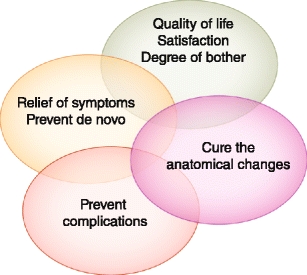
The objective of this review is to discuss emerging concepts in pelvic organ prolapse, in particular, "What is cure?" In a post-trial data analysis of the CARE (Colpopexy and Urinary Reduction Efforts) trial, treatment success varied tremendously depending on the definition used (19.2%-97.2%). Definitions that included the absence of vaginal bulge symptoms had the strongest relationships with the patients' assessment of overall improvement and treatment success. As demonstrated by this study, there are several challenges in defining cure in prolapse surgery. Additionally, the symptoms of prolapse are variable. The degree of prolapse does not correlate directly with symptoms. There are many surgical approaches to pelvic organ prolapse. Multiple ways to quantify prolapse are used. There is a lack of standardized definition of cure. The data on prolapse surgery outcomes are heterogeneous. The goal of surgical repair is to return the pelvic organs to their original anatomic positions. Ideally, we have four main goals: no anatomic prolapse, no functional symptoms, patient satisfaction, and the avoidance of complications. The impact of transvaginal mesh requires thoughtful investigation. The driving force should be patient symptoms in defining cure of prolapse.
本次综述的目的在于讨论盆腔器官脱垂领域的一些新观点,尤其是“治愈的标准是什么?”在 CARE(阴道封闭术和尿失禁治疗)试验的一项试验后数据分析中,根据使用的定义,治疗成功的比例差异巨大(19.2%-97.2%)。将阴道膨出症状缺失纳入定义的方法与患者对整体改善和治疗成功的评估关系最密切。本研究表明,在脱垂手术的治愈定义方面存在诸多挑战。此外,脱垂的症状具有多变性。脱垂的程度与症状并不直接相关。有多种治疗盆腔器官脱垂的手术方法。目前,用于定量脱垂的方法有很多。而且,治愈的定义尚未标准化。脱垂手术结果的数据存在异质性。手术修复的目标是将盆腔器官恢复到其原始解剖位置。理想情况下,我们有四个主要目标:无解剖学脱垂、无功能症状、患者满意和避免并发症。阴道网片的影响需要仔细研究。定义脱垂的治愈标准时,应以患者的症状为主要驱动力。