CNRS URA 2578, Département de Biologie du Développement, Institut Pasteur, 25 Rue du Dr Roux, Paris, France.
BMC Genomics. 2010 Dec 8;11:696. doi: 10.1186/1471-2164-11-696.
Pax3 is a key upstream regulator of the onset of myogenesis, controlling progenitor cell survival and behaviour as well as entry into the myogenic programme. It functions in the dermomyotome of the somite from which skeletal muscle derives and in progenitor cell populations that migrate from the somite such as those of the limbs. Few Pax3 target genes have been identified. Identifying genes that lie genetically downstream of Pax3 is therefore an important endeavour in elucidating the myogenic gene regulatory network.
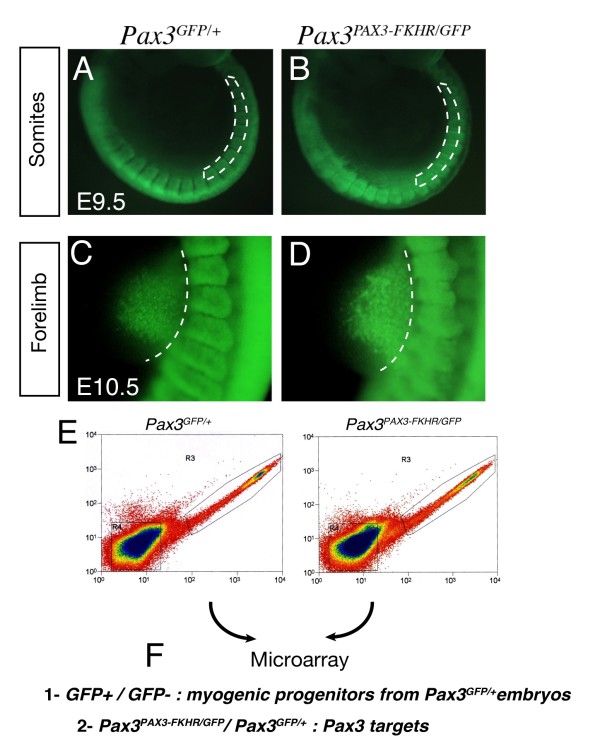
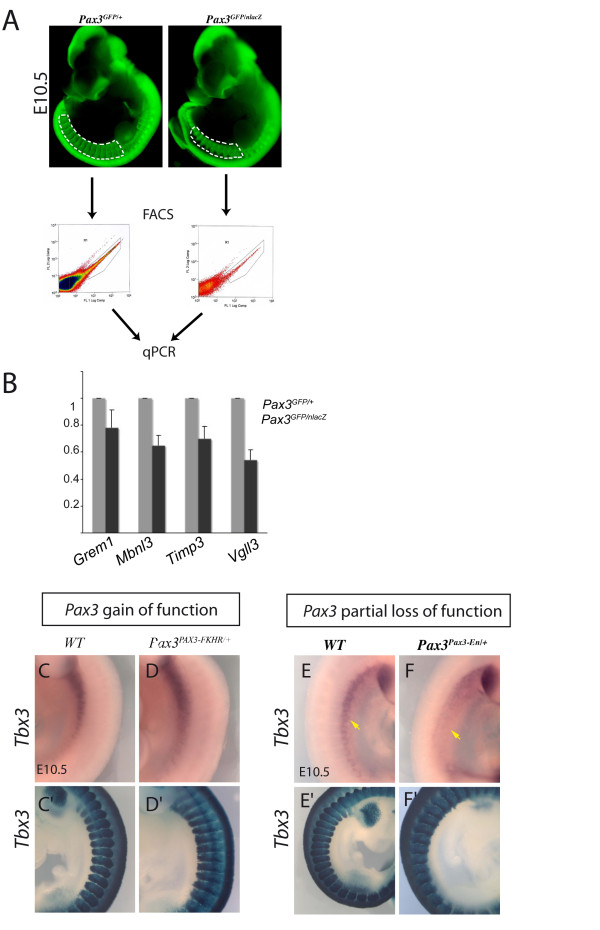
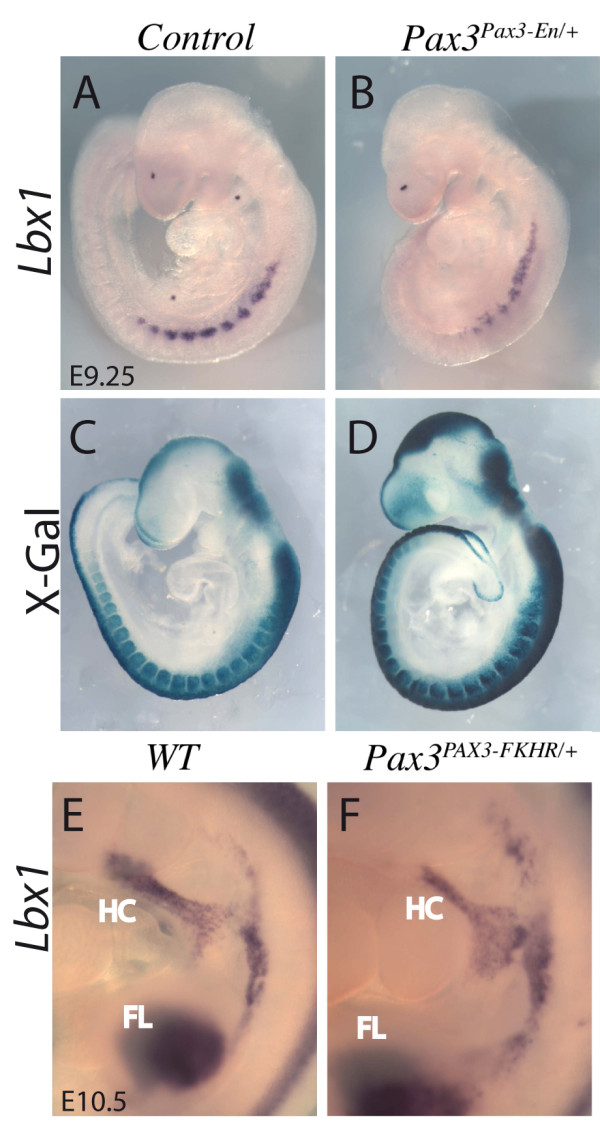
We have undertaken a screen in the mouse embryo which employs a Pax3GFP allele that permits isolation of Pax3 expressing cells by flow cytometry and a Pax3PAX3-FKHR allele that encodes PAX3-FKHR in which the DNA binding domain of Pax3 is fused to the strong transcriptional activation domain of FKHR. This constitutes a gain of function allele that rescues the Pax3 mutant phenotype. Microarray comparisons were carried out between Pax3GFP/+ and Pax3GFP/PAX3-FKHR preparations from the hypaxial dermomyotome of somites at E9.5 and forelimb buds at E10.5. A further transcriptome comparison between Pax3-GFP positive and negative cells identified sequences specific to myogenic progenitors in the forelimb buds. Potential Pax3 targets, based on changes in transcript levels on the gain of function genetic background, were validated by analysis on loss or partial loss of function Pax3 mutant backgrounds. Sequences that are up- or down-regulated in the presence of PAX3-FKHR are classified as somite only, somite and limb or limb only. The latter should not contain sequences from Pax3 positive neural crest cells which do not invade the limbs. Verification by whole mount in situ hybridisation distinguishes myogenic markers. Presentation of potential Pax3 target genes focuses on signalling pathways and on transcriptional regulation.
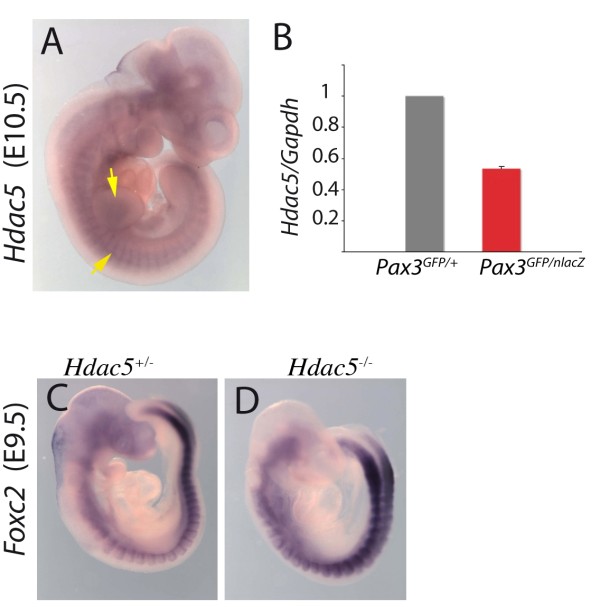
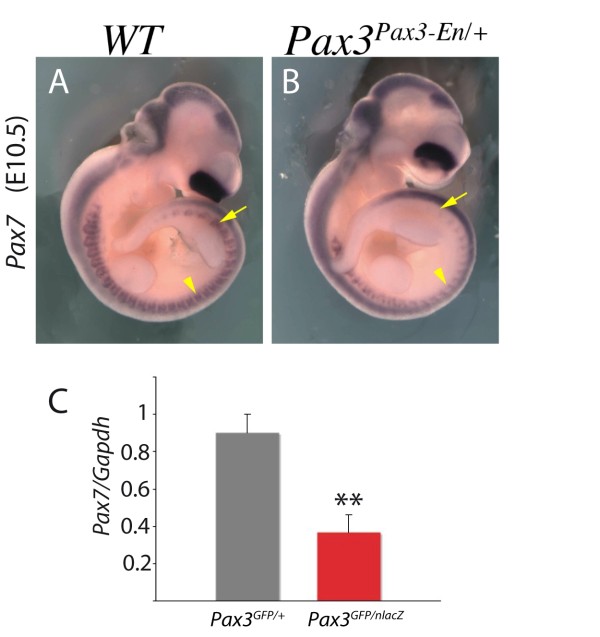
Pax3 orchestrates many of the signalling pathways implicated in the activation or repression of myogenesis by regulating effectors and also, notably, inhibitors of these pathways. Important transcriptional regulators of myogenesis are candidate Pax3 targets. Myogenic determination genes, such as Myf5 are controlled positively, whereas the effect of Pax3 on genes encoding inhibitors of myogenesis provides a potential brake on differentiation. In the progenitor cell population, Pax7 and also Hdac5 which is a potential repressor of Foxc2, are subject to positive control by Pax3.
Pax3 是肌肉发生起始的关键上游调节因子,控制祖细胞的存活和行为,以及进入肌肉发生程序。它在体节的真皮肌节中起作用,也在体节中迁移的祖细胞群中起作用,例如四肢的祖细胞。已经鉴定出少数 Pax3 靶基因。因此,鉴定遗传上位于 Pax3 下游的基因是阐明肌肉发生基因调控网络的重要工作。
我们在小鼠胚胎中进行了一项筛选,该筛选使用了 Pax3GFP 等位基因,该基因允许通过流式细胞术分离表达 Pax3 的细胞,以及 Pax3PAX3-FKHR 等位基因,该基因编码 PAX3-FKHR,其中 Pax3 的 DNA 结合域融合到 FKHR 的强转录激活结构域。这构成了一种功能获得性等位基因,可以挽救 Pax3 突变表型。在 E9.5 时体节的下轴真皮肌节和 E10.5 时前肢芽中,我们对 Pax3GFP/+和 Pax3GFP/PAX3-FKHR 制剂之间进行了微阵列比较。在前肢芽中,我们还对 Pax3-GFP 阳性和阴性细胞之间的转录组比较,鉴定了肌肉发生祖细胞特有的序列。基于功能获得性遗传背景上转录水平的变化,基于潜在的 Pax3 靶标,通过分析 Pax3 突变体的缺失或部分缺失功能背景进行了验证。在 PAX3-FKHR 存在的情况下上调或下调的序列被分类为仅体节、体节和肢或仅肢。后者不应包含不侵入肢体的 Pax3 阳性神经嵴细胞的序列。通过整体原位杂交杂交验证可区分肌生成标记物。潜在 Pax3 靶基因的呈现侧重于信号通路和转录调控。
Pax3 通过调节效应子,以及显著地,这些途径的抑制剂,协调许多与肌肉发生的激活或抑制有关的信号通路。肌肉发生的重要转录调节因子是候选的 Pax3 靶标。肌肉决定基因,如 Myf5,受到正调控,而 Pax3 对编码肌肉发生抑制剂的基因的作用为分化提供了潜在的制动。在祖细胞群体中,Pax3 受到 Pax7 和可能抑制 Foxc2 的 Hdac5 的正调控。