Department of Obstetrics and Gynecology, School of Medicine, University of Uruguay, Montevideo, Uruguay.
Am J Obstet Gynecol. 2011 Mar;204(3):238.e1-5. doi: 10.1016/j.ajog.2010.10.005. Epub 2010 Dec 8.
The purpose of this study was to evaluate whether the use of oxytocin during the first and second stages of labor is associated with a higher incidence of postpartum hemorrhage (PPH) in pregnant women who received active management of third stage of labor (AMTSL).
A secondary data analysis from vaginal deliveries in a hospital-based cohort study from 24 maternity hospitals in South America. The primary outcomes that were analyzed were moderate PPH (≥500 mL of blood loss), severe PPH (≥1000 mL of blood loss), and need of blood transfusion.
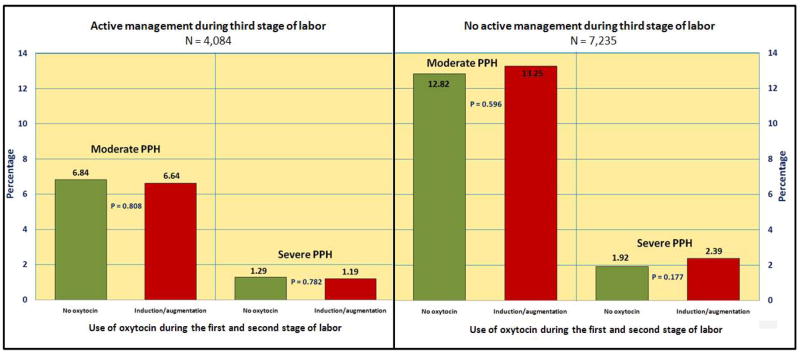
A total of 11,323 vaginal deliveries were included. The incidence of moderate and severe PPH was 10.8% and 1.86%, respectively. Overall, 36% of deliveries received AMTSL. There was no association between induced/augmented labor and moderate PPH (P = .753), severe PPH (P = .273), and blood transfusion (P = .603) in the population that received AMTSL.
AMTSL should be recommended, regardless of whether pregnant women received oxytocin during the first and second stages of labor.
本研究旨在评估在接受第三产程积极管理(AMTSL)的孕妇中,分娩第一和第二阶段使用催产素是否与产后出血(PPH)发生率增加相关。
对来自南美洲 24 家产科医院的基于医院队列研究中的阴道分娩进行二次数据分析。分析的主要结局是中度 PPH(≥500 毫升失血)、重度 PPH(≥1000 毫升失血)和输血需求。
共纳入 11323 例阴道分娩。中度和重度 PPH 的发生率分别为 10.8%和 1.86%。总体而言,36%的分娩接受了 AMTSL。在接受 AMTSL 的人群中,诱导/增强产程与中度 PPH(P =.753)、重度 PPH(P =.273)和输血(P =.603)之间均无关联。
应推荐 AMTSL,而不论孕妇在分娩第一和第二阶段是否使用了催产素。