Department of Human Genetics, The University of Chicago, Chicago, Illinois, United States of America.
PLoS Genet. 2010 Dec 9;6(12):e1001236. doi: 10.1371/journal.pgen.1001236.
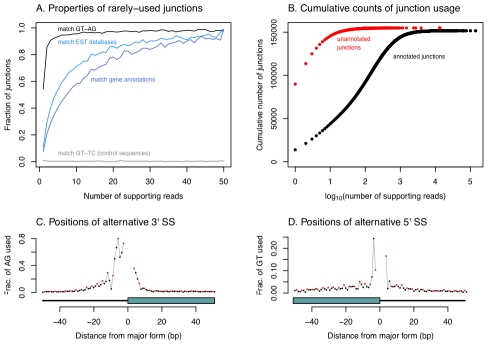
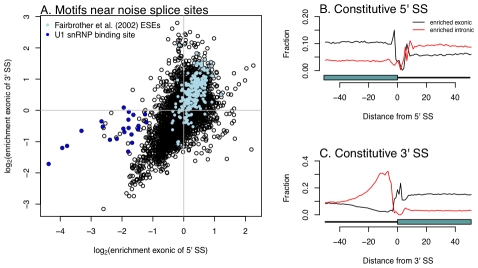
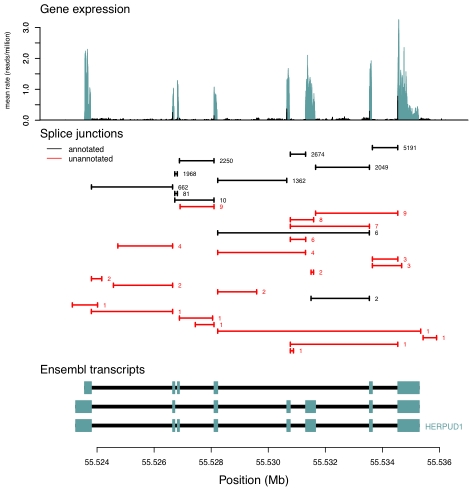
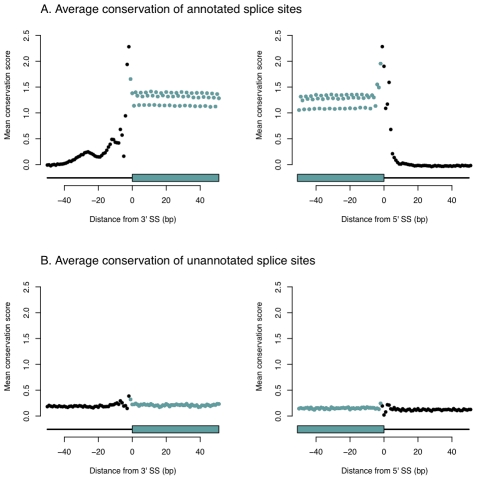
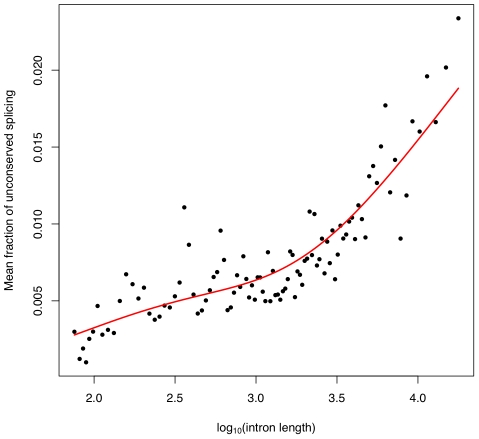
While the majority of multiexonic human genes show some evidence of alternative splicing, it is unclear what fraction of observed splice forms is functionally relevant. In this study, we examine the extent of alternative splicing in human cells using deep RNA sequencing and de novo identification of splice junctions. We demonstrate the existence of a large class of low abundance isoforms, encompassing approximately 150,000 previously unannotated splice junctions in our data. Newly-identified splice sites show little evidence of evolutionary conservation, suggesting that the majority are due to erroneous splice site choice. We show that sequence motifs involved in the recognition of exons are enriched in the vicinity of unconserved splice sites. We estimate that the average intron has a splicing error rate of approximately 0.7% and show that introns in highly expressed genes are spliced more accurately, likely due to their shorter length. These results implicate noisy splicing as an important property of genome evolution.
虽然大多数多外显子的人类基因都显示出一些可变剪接的证据,但尚不清楚观察到的剪接形式中有多少是具有功能相关性的。在这项研究中,我们使用深度 RNA 测序和从头鉴定剪接接头来检查人类细胞中可变剪接的程度。我们证明了大量低丰度异构体的存在,这些异构体包含了我们数据中大约 150000 个以前未注释的剪接接头。新鉴定的剪接位点几乎没有进化保守的证据,这表明大多数是由于错误的剪接位点选择造成的。我们表明,参与外显子识别的序列基序在非保守剪接位点附近富集。我们估计平均内含子的剪接错误率约为 0.7%,并表明高表达基因中的内含子剪接更准确,这可能是由于它们的长度较短。这些结果表明,嘈杂剪接是基因组进化的一个重要特征。