Department of Pharmacology, University Medical Center Goettingen, Goettingen, Germany.
PLoS One. 2010 Dec 9;5(12):e14263. doi: 10.1371/journal.pone.0014263.
Mechanical overload leads to cardiac hypertrophy and mechanical unloading to cardiac atrophy. Both conditions produce similar transcriptional changes including a re-expression of fetal genes, despite obvious differences in phenotype. MicroRNAs (miRNAs) are discussed as superordinate regulators of global gene networks acting mainly at the translational level. Here, we hypothesized that defined sets of miRNAs may determine the direction of cardiomyocyte plasticity responses.
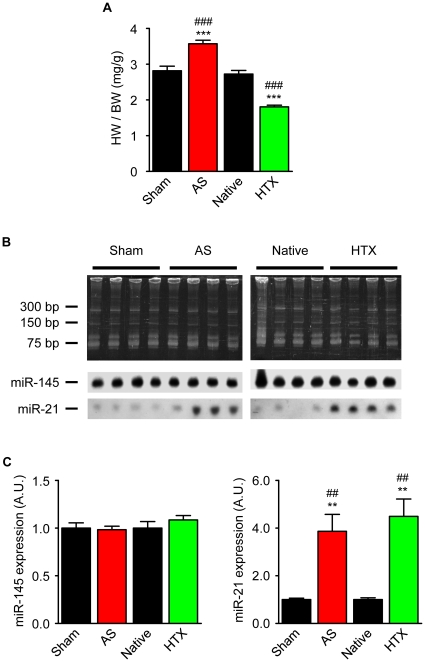
METHODOLOGY/PRINCIPAL FINDINGS: We employed ascending aortic stenosis (AS) and heterotopic heart transplantation (HTX) in syngenic Lewis rats to induce mechanical overloading and unloading, respectively. Heart weight was 26±3% higher in AS (n = 7) and 33±2% lower in HTX (n = 7) as compared to sham-operated (n = 6) and healthy controls (n = 7). Small RNAs were enriched from the left ventricles and subjected to quantitative stem-loop specific RT-PCR targeting a panel of 351 miRNAs. In total, 153 miRNAs could be unambiguously detected. Out of 72 miRNAs previously implicated in the cardiovascular system, 40 miRNAs were regulated in AS and/or HTX. Overall, HTX displayed a slightly broader activation pattern for moderately regulated miRNAs. Surprisingly, however, the regulation of individual miRNA expression was strikingly similar in direction and amplitude in AS and HTX with no miRNA being regulated in opposite direction. In contrast, fetal hearts from Lewis rats at embryonic day 18 exhibited an entirely different miRNA expression pattern.
Taken together, our findings demonstrate that opposite changes in cardiac workload induce a common miRNA expression pattern which is markedly different from the fetal miRNA expression pattern. The direction of postnatal adaptive cardiac growth does, therefore, not appear to be determined at the level of single miRNAs or a specific set of miRNAs. Moreover, miRNAs themselves are not reprogrammed to a fetal program in response to changes in hemodynamic load.
机械性过载会导致心肌肥厚,而机械性卸载则会导致心肌萎缩。尽管表型存在明显差异,但这两种情况都会导致相似的转录变化,包括胎儿基因的重新表达。microRNAs(miRNAs)被认为是主要在翻译水平上调节全局基因网络的上级调控因子。在这里,我们假设特定的 miRNAs 集可能决定心肌细胞可塑性反应的方向。
方法/主要发现:我们采用升主动脉狭窄(AS)和异位心脏移植(HTX)在同基因 Lewis 大鼠中分别诱导机械性过载和卸载。与假手术(n = 6)和健康对照(n = 7)相比,AS 组(n = 7)的心脏重量增加了 26 ± 3%,HTX 组(n = 7)的心脏重量降低了 33 ± 2%。从小鼠左心室中富集小 RNA,并采用针对 351 个 miRNA 面板的定量茎环特异性 RT-PCR 进行检测。总共可以明确检测到 153 个 miRNA。在 72 个先前被认为与心血管系统有关的 miRNA 中,有 40 个在 AS 和/或 HTX 中受到调节。总体而言,HTX 对中度调节的 miRNA 显示出稍宽的激活模式。然而,令人惊讶的是,AS 和 HTX 中单个 miRNA 表达的调节方向和幅度非常相似,没有 miRNA 的调节方向相反。相比之下,来自 Lewis 大鼠的胚胎第 18 天的胎儿心脏表现出完全不同的 miRNA 表达模式。
总的来说,我们的研究结果表明,心脏工作量的相反变化会诱导一种共同的 miRNA 表达模式,这种模式与胎儿 miRNA 表达模式明显不同。因此,出生后适应性心肌生长的方向似乎不是由单个 miRNA 或特定的 miRNA 集决定的。此外,miRNAs 本身在应对血液动力学负荷变化时不会重新编程为胎儿程序。