Kee Hae Jin, Kook Hyun
Medical Research Center for Gene Regulation, Chonnam National University Medical School, Gwangju 501-746, Republic of Korea.
J Biomed Biotechnol. 2011;2011:928326. doi: 10.1155/2011/928326. Epub 2010 Nov 29.
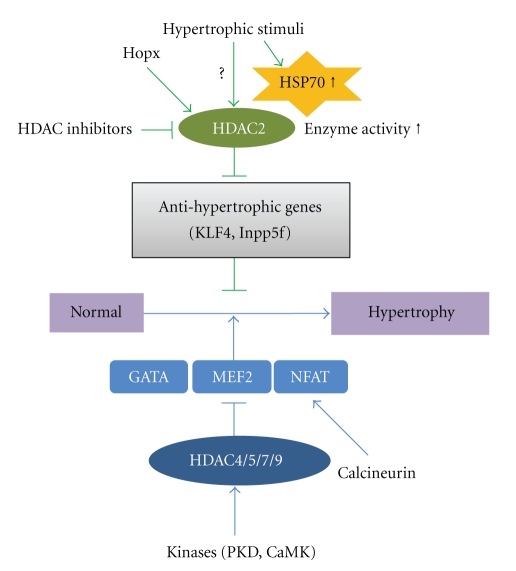
Cardiac hypertrophy occurs in association with heart diseases and ultimately results in cardiac dysfunction and heart failure. Histone deacetylases (HDACs) are post-translational modifying enzymes that can deacetylate histones and non-histone proteins. Research with HDAC inhibitors has provided evidence that the class I HDACs are pro-hypertrophic. Among the class I HDACs, HDAC2 is activated by hypertrophic stresses in association with the induction of heat shock protein 70. Activated HDAC2 triggers hypertrophy by inhibiting the signal cascades of either Krüppel like factor 4 (KLF4) or inositol polyphosphate-5-phosphatase f (Inpp5f). Thus, modulators of HDAC2 enzymes, such as selective HDAC inhibitors, are considered to be an important target for heart diseases, especially for preventing cardiac hypertrophy. In contrast, class IIa HDACs have been shown to repress cardiac hypertrophy by inhibiting cardiac-specific transcription factors such as myocyte enhancer factor 2 (MEF2), GATA4, and NFAT in the heart. Studies of class IIa HDACs have shown that the underlying mechanism is regulated by nucleo-cytoplasm shuttling in response to a variety of stress signals. In this review, we focus on the class I and IIa HDACs that play critical roles in mediating cardiac hypertrophy and discuss the non-histone targets of HDACs in heart disease.
心脏肥大与心脏病相关联,最终会导致心脏功能障碍和心力衰竭。组蛋白去乙酰化酶(HDACs)是一种翻译后修饰酶,可使组蛋白和非组蛋白去乙酰化。对HDAC抑制剂的研究表明,I类HDACs具有促肥大作用。在I类HDACs中,HDAC2在热休克蛋白70的诱导下被肥大应激激活。激活的HDAC2通过抑制Krüppel样因子4(KLF4)或肌醇多磷酸-5-磷酸酶f(Inpp5f)的信号级联反应来触发肥大。因此,HDAC2酶的调节剂,如选择性HDAC抑制剂,被认为是心脏病的重要靶点,尤其是在预防心脏肥大方面。相比之下,IIa类HDACs已被证明可通过抑制心脏特异性转录因子,如心肌细胞增强因子2(MEF2)、GATA4和心脏中的核因子活化T细胞(NFAT)来抑制心脏肥大。对IIa类HDACs的研究表明,其潜在机制是通过响应各种应激信号的核质穿梭来调节的。在这篇综述中,我们重点关注在介导心脏肥大中起关键作用的I类和IIa类HDACs,并讨论HDACs在心脏病中的非组蛋白靶点。