Han Yu, Nie Jiali, Wang Dao Wen, Ni Li
Division of Cardiology, Department of Internal Medicine, Tongji Hospital, Tongji Medical College, Huazhong University of Science and Technology, Wuhan, China.
Hubei Key Laboratory of Genetics and Molecular Mechanisms of Cardiological Disorders, Wuhan, China.
Front Cardiovasc Med. 2022 Jul 26;9:931475. doi: 10.3389/fcvm.2022.931475. eCollection 2022.
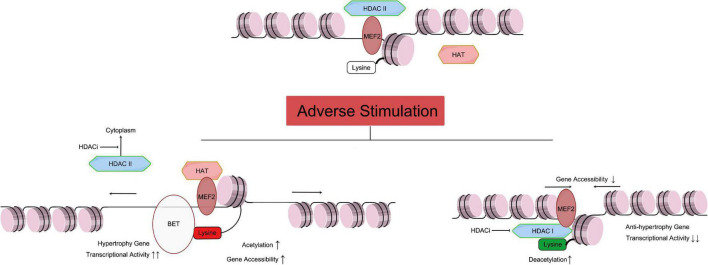
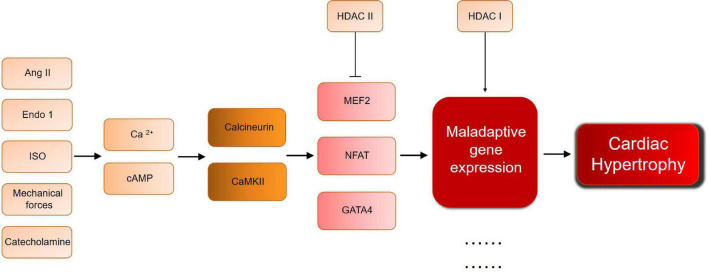
Cardiac hypertrophy is a key process in cardiac remodeling development, leading to ventricle enlargement and heart failure. Recently, studies show the complicated relation between cardiac hypertrophy and epigenetic modification. Post-translational modification of histone is an essential part of epigenetic modification, which is relevant to multiple cardiac diseases, especially in cardiac hypertrophy. There is a group of enzymes related in the balance of histone acetylation/deacetylation, which is defined as histone acetyltransferase (HAT) and histone deacetylase (HDAC). In this review, we introduce an important enzyme family HDAC, a key regulator in histone deacetylation. In cardiac hypertrophy HDAC I downregulates the anti-hypertrophy gene expression, including Kruppel-like factor 4 (Klf4) and inositol-5 phosphatase f (Inpp5f), and promote the development of cardiac hypertrophy. On the contrary, HDAC II binds to myocyte-specific enhancer factor 2 (MEF2), inhibit the assemble ability to HAT and protect against cardiac hypertrophy. Under adverse stimuli such as pressure overload and calcineurin stimulation, the HDAC II transfer to cytoplasm, and MEF2 can bind to nuclear factor of activated T cells (NFAT) or GATA binding protein 4 (GATA4), mediating inappropriate gene expression. HDAC III, also known as SIRTs, can interact not only to transcription factors, but also exist interaction mechanisms to other HDACs, such as HDAC IIa. We also present the latest progress of HDAC inhibitors (HDACi), as a potential treatment target in cardiac hypertrophy.
心脏肥大是心脏重塑发展中的关键过程,会导致心室扩大和心力衰竭。最近,研究表明心脏肥大与表观遗传修饰之间存在复杂的关系。组蛋白的翻译后修饰是表观遗传修饰的重要组成部分,与多种心脏疾病相关,尤其是在心脏肥大方面。有一组与组蛋白乙酰化/去乙酰化平衡相关的酶,被定义为组蛋白乙酰转移酶(HAT)和组蛋白去乙酰化酶(HDAC)。在本综述中,我们介绍一种重要的酶家族HDAC,它是组蛋白去乙酰化的关键调节因子。在心脏肥大中,HDAC I下调抗肥大基因的表达,包括 Kruppel样因子4(Klf4)和肌醇-5磷酸酶f(Inpp5f),并促进心脏肥大的发展。相反,HDAC II与心肌细胞特异性增强子因子2(MEF2)结合,抑制其与HAT的组装能力,从而预防心脏肥大。在压力过载和钙调神经磷酸酶刺激等不良刺激下,HDAC II转移到细胞质中,MEF2可与活化T细胞核因子(NFAT)或GATA结合蛋白4(GATA4)结合,介导不适当的基因表达。HDAC III,也称为沉默调节蛋白,不仅可以与转录因子相互作用,还与其他HDAC存在相互作用机制,如HDAC IIa。我们还介绍了HDAC抑制剂(HDACi)作为心脏肥大潜在治疗靶点的最新进展。