Laboratoire Evolution, Génomes et Spéciation, UPR-CNRS 9034, Gif/Yvette, France.
PLoS One. 2010 Dec 3;5(12):e15231. doi: 10.1371/journal.pone.0015231.
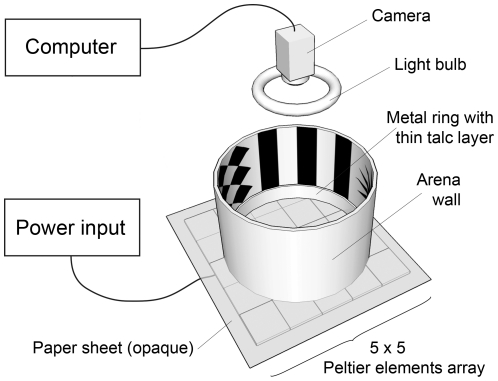
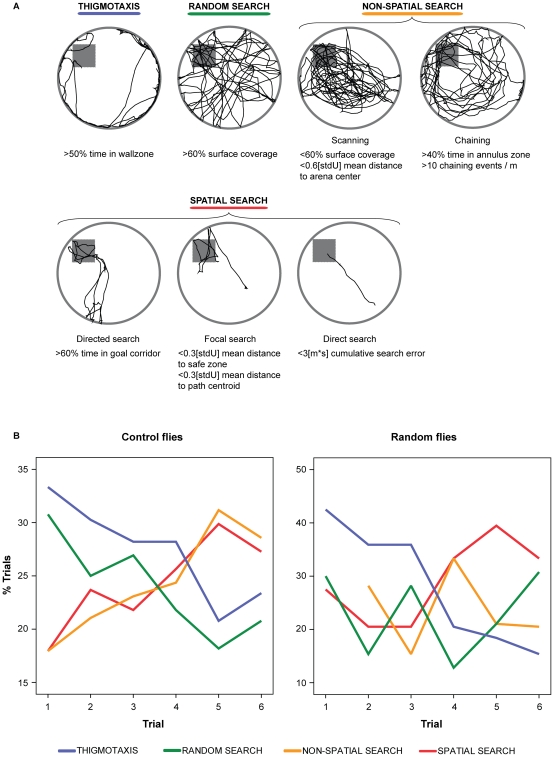
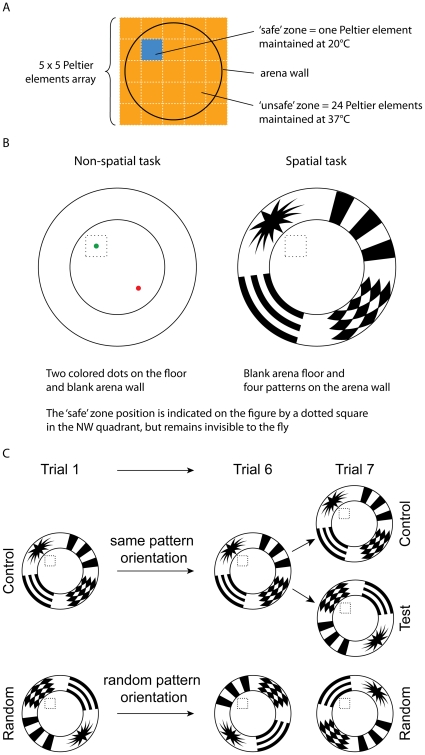
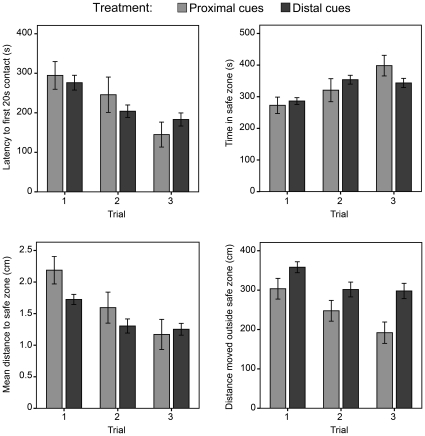
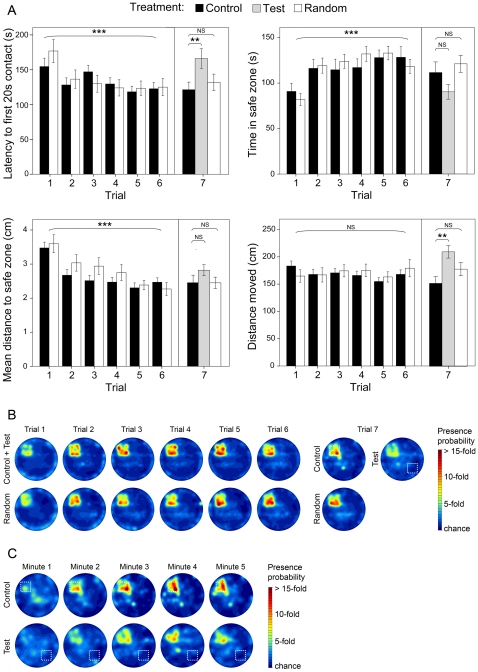
Learning the spatial organization of the environment is crucial to fitness in most animal species. Understanding proximate and ultimate factors underpinning spatial memory is thus a major goal in the study of animal behavior. Despite considerable interest in various aspects of its behavior and biology, the model species Drosophila melanogaster lacks a standardized apparatus to investigate spatial learning and memory. We propose here a novel apparatus, the heat maze, conceptually based on the Morris water maze used in rodents. Using the heat maze, we demonstrate that D. melanogaster flies are able to use either proximal or distal visual cues to increase their performance in navigating to a safe zone. We also show that flies are actively using the orientation of distal visual cues when relevant in targeting the safe zone, i.e., Drosophila display spatial learning. Parameter-based classification of search strategies demonstrated the progressive use of spatially precise search strategies during learning. We discuss the opportunity to unravel the mechanistic and evolutionary bases of spatial learning in Drosophila using the heat maze.
学习环境的空间组织对于大多数动物物种的适应性至关重要。因此,了解支持空间记忆的近因和远因是动物行为研究的主要目标。尽管人们对果蝇的行为和生物学的各个方面都很感兴趣,但这种模式生物缺乏一种标准化的设备来研究空间学习和记忆。我们在这里提出了一种新的设备,热迷宫,其概念基于啮齿动物中使用的 Morris 水迷宫。使用热迷宫,我们证明了 D. melanogaster 果蝇能够使用近端或远端视觉线索来提高它们在导航到安全区域的表现。我们还表明,当相关时,果蝇会主动使用远端视觉线索的方向来定位安全区域,即果蝇表现出空间学习。基于参数的搜索策略分类表明,在学习过程中逐渐使用空间精确的搜索策略。我们讨论了使用热迷宫揭示果蝇空间学习的机制和进化基础的机会。