Hagedorn Research Institute, Gentofte, Denmark.
PLoS One. 2010 Dec 1;5(12):e14190. doi: 10.1371/journal.pone.0014190.
Several obesity risk alleles affecting adult adiposity have been identified by the recent wave of genome wide association studies. We aimed to examine the potential effect of these variants on fetal body composition by investigating the variants in relation to birth weight and ponderal index of the newborn.
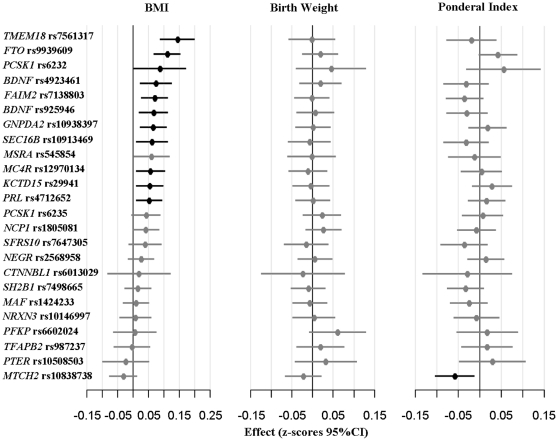
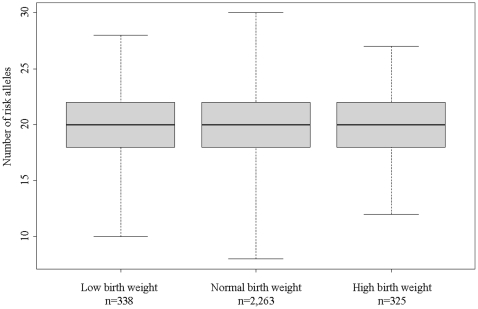
METHODOLOGY/PRINCIPAL FINDINGS: Midwife records from the Danish State Archives provided information on mother's age, parity, as well as birth weight, birth length and prematurity of the newborn in 4,744 individuals of the population-based Inter99 study. Twenty-four risk alleles showing genome-wide associations with adult BMI and/or waist circumference were genotyped. None of the 24 risk variants tested showed an association with birth weight or ponderal index after correction for multiple testing. Birth weight was divided into three categories low (≤10(th) percentile), normal (10(th)-90(th) percentile) and high birth weight (≥90th percentile) to allow for non-linear associations. There was no difference in the number of risk alleles between the groups (p = 0.57). No interactions between each risk allele and birth weight in the prediction of adult BMI were observed. An obesity risk score was created by summing up risk alleles. The risk score did not associate with fetal body composition. Moreover there was no interaction between the risk score and birth weight/ponderal index in the prediction of adult BMI.
24 common variants associated with adult adiposity did not affect or interact with birth weight among Danes suggesting that the effects of these variants predominantly arise in the post-natal life.
最近的全基因组关联研究发现了几个影响成年人肥胖的肥胖风险等位基因。我们旨在通过研究这些变体与新生儿出生体重和体重指数的关系,来研究这些变体对胎儿身体成分的潜在影响。
方法/主要发现:丹麦国家档案馆的助产士记录提供了人口基础的 Inter99 研究中 4744 个人的母亲年龄、产次以及新生儿的出生体重、出生身长和早产情况的信息。对 24 个与成人 BMI 和/或腰围具有全基因组关联的风险等位基因进行了基因分型。在进行多次检验校正后,没有一个 24 个风险变体与出生体重或体重指数相关。将出生体重分为三个类别:低体重(≤第 10 个百分位)、正常体重(第 10-90 个百分位)和高出生体重(≥第 90 个百分位),以允许非线性关联。在这三个组别中,风险等位基因的数量没有差异(p=0.57)。在预测成人 BMI 时,每个风险等位基因与出生体重之间没有相互作用。通过将风险等位基因相加创建了一个肥胖风险评分。该风险评分与胎儿身体成分无关。此外,在预测成人 BMI 时,风险评分与出生体重/体重指数之间也没有相互作用。
在丹麦人中,24 个与成人肥胖相关的常见变异体不会影响或与出生体重相互作用,这表明这些变异体的作用主要发生在出生后。