MRC Epidemiology Unit, Addenbrooke's Hospital, Cambridge, United Kingdom.
PLoS Med. 2010 May 25;7(5):e1000284. doi: 10.1371/journal.pmed.1000284.
Genome-wide studies have identified several common genetic variants that are robustly associated with adult obesity risk. Exploration of these genotype associations in children may provide insights into the timing of weight changes leading to adult obesity.
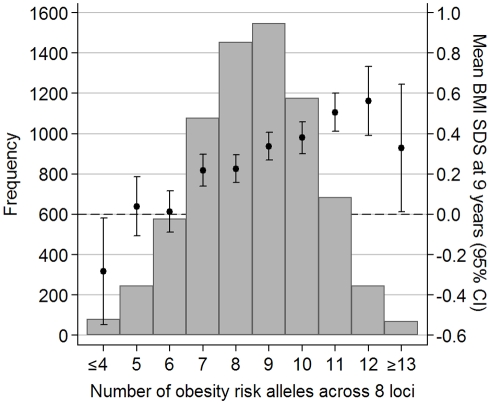
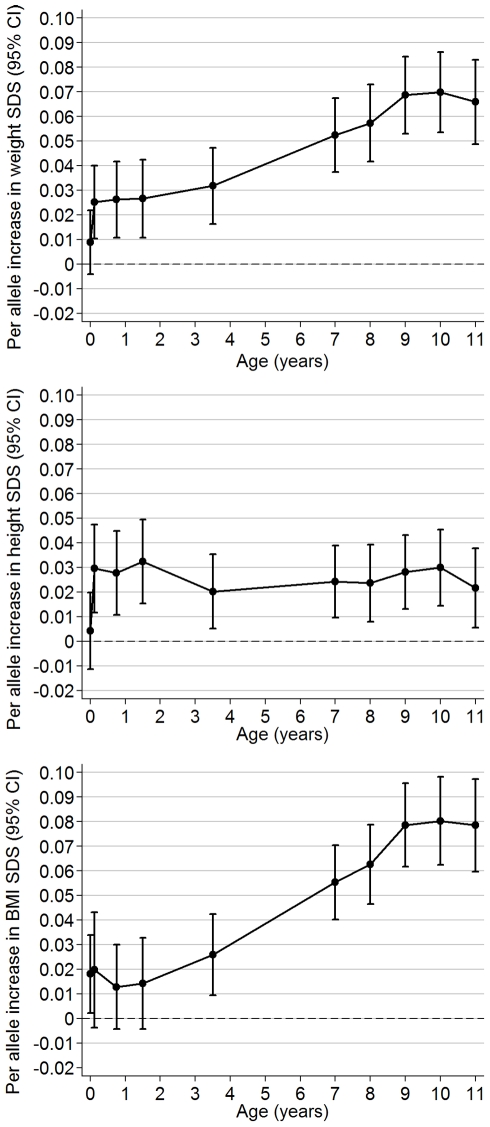
Children from the Avon Longitudinal Study of Parents and Children (ALSPAC) birth cohort were genotyped for ten genetic variants previously associated with adult BMI. Eight variants that showed individual associations with childhood BMI (in/near: FTO, MC4R, TMEM18, GNPDA2, KCTD15, NEGR1, BDNF, and ETV5) were used to derive an "obesity-risk-allele score" comprising the total number of risk alleles (range: 2-15 alleles) in each child with complete genotype data (n = 7,146). Repeated measurements of weight, length/height, and body mass index from birth to age 11 years were expressed as standard deviation scores (SDS). Early infancy was defined as birth to age 6 weeks, and early infancy failure to thrive was defined as weight gain between below the 5th centile, adjusted for birth weight. The obesity-risk-allele score showed little association with birth weight (regression coefficient: 0.01 SDS per allele; 95% CI 0.00-0.02), but had an apparently much larger positive effect on early infancy weight gain (0.119 SDS/allele/year; 0.023-0.216) than on subsequent childhood weight gain (0.004 SDS/allele/year; 0.004-0.005). The obesity-risk-allele score was also positively associated with early infancy length gain (0.158 SDS/allele/year; 0.032-0.284) and with reduced risk of early infancy failure to thrive (odds ratio = 0.92 per allele; 0.86-0.98; p = 0.009).
The use of robust genetic markers identified greater early infancy gains in weight and length as being on the pathway to adult obesity risk in a contemporary birth cohort.
全基因组研究已经确定了几个与成人肥胖风险密切相关的常见遗传变异。在儿童中探索这些基因型关联可能有助于了解导致成人肥胖的体重变化时间。
阿冯纵向研究父母和孩子(ALSPAC)出生队列的儿童进行了十种先前与成人 BMI 相关的遗传变异的基因分型。在儿童 BMI 中显示个体关联的八种变体(位于/附近:FTO、MC4R、TMEM18、GNPDA2、KCTD15、NEGR1、BDNF 和 ETV5)被用来推导一个“肥胖风险等位基因评分”,包括每个具有完整基因型数据的儿童(n = 7146)中的总风险等位基因数(范围:2-15 个等位基因)。从出生到 11 岁的体重、长度/身高和体重指数的重复测量值表示为标准偏差分数(SDS)。婴儿期定义为出生至 6 周龄,婴儿期生长不良定义为体重增加低于第 5 百分位,按出生体重调整。肥胖风险等位基因评分与出生体重相关性不大(回归系数:每个等位基因 0.01 SDS;95%CI 0.00-0.02),但对婴儿期体重增加的影响明显更大(0.119 SDS/等位基因/年;0.023-0.216),而对后续儿童体重增加的影响较小(0.004 SDS/等位基因/年;0.004-0.005)。肥胖风险等位基因评分与婴儿期长度增加呈正相关(0.158 SDS/等位基因/年;0.032-0.284),与婴儿期生长不良风险降低相关(优势比=每个等位基因 0.92;0.86-0.98;p = 0.009)。
在当代出生队列中,使用稳健的遗传标记物确定了更大的婴儿期体重和长度增加,这是导致成人肥胖风险的途径。