Van Orshoven Narender P, Jansen Paul A F, Oudejans Irène, Schoon Yvonne, Oey P Liam
Department of Neurology, Rudolf Magnus Institute of Neuroscience, University Medical Center Utrecht, P.O. Box 85500, 3508 GA Utrecht, The Netherlands.
J Aging Res. 2010 Sep 30;2010:243752. doi: 10.4061/2010/243752.
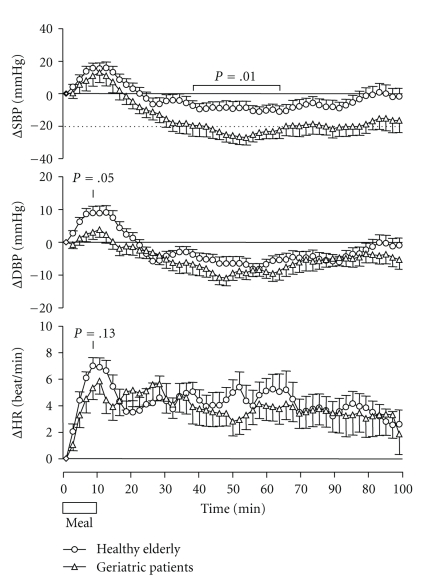
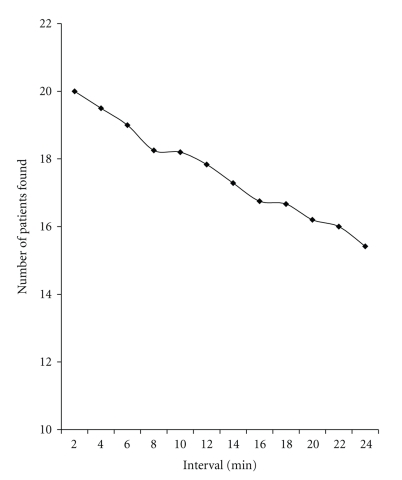
The aims of this study were to find out whether Postprandial hypotension (PPH) occurs more frequently in patients admitted to a geriatric ward than in healthy elderly individuals, what the optimal interval between blood pressure measurements is in order to diagnose PPH and how often it is associated with symptoms.The result of this study indicates that PPH is present in a high number of frail elderly, but also in a few healthy older persons. Measuring blood pressure at least every 10 minutes for 60 minutes after breakfast will adequately diagnose PPH, defined as >20 mmHg systolic fall, in most patients. However with definition of PPH as >30 mmHg systolic fall, measuring blood pressure every 10 minutes will miss PPH in one of three patients. With the latter definition of PPH the presence of postprandial complaints is not associated with the existence of PPH.
本研究的目的是查明老年病房收治的患者发生餐后低血压(PPH)的频率是否高于健康老年人,为诊断PPH进行血压测量的最佳间隔时间是多久,以及PPH与症状的关联频率如何。本研究结果表明,大量体弱老年人存在PPH,但少数健康老年人也有。早餐后至少每10分钟测量一次血压,持续60分钟,将能充分诊断大多数患者的PPH(定义为收缩压下降>20 mmHg)。然而,若将PPH定义为收缩压下降>30 mmHg,每10分钟测量一次血压会使三分之一的患者漏诊PPH。按照PPH的后一种定义,餐后不适的存在与PPH的存在并无关联。