Laboratory of Molecular Biology, Department of Biofunctional Analysis, Gifu Pharmaceutical University, Gifu, Japan; E-Mails:
Int J Mol Sci. 2010 Oct 22;11(10):4114-23. doi: 10.3390/ijms11104114.
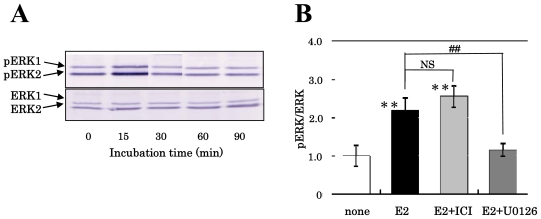
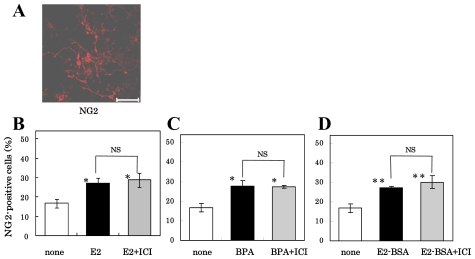
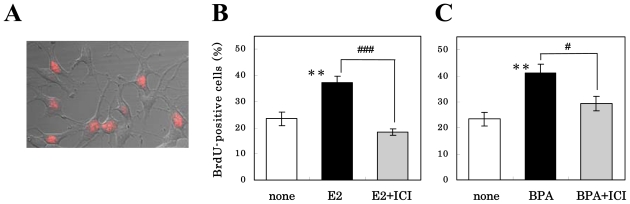
Our previous study indicated that both 17β-estradiol (E2), known to be an endogenous estrogen, and bisphenol A (BPA), known to be a xenoestrogen, could positively influence the proliferation or differentiation of neural stem/progenitor cells (NS/PCs). The aim of the present study was to identify the signal transduction pathways for estrogenic activities promoting proliferation and differentiation of NS/PCs via well known nuclear estrogen receptors (ERs) or putative membrane-associated ERs. NS/PCs were cultured from the telencephalon of 15-day-old rat embryos. In order to confirm the involvement of nuclear ERs for estrogenic activities, their specific antagonist, ICI-182,780, was used. The presence of putative membrane-associated ER was functionally examined as to whether E2 can activate rapid intracellular signaling mechanism. In order to confirm the involvement of membrane-associated ERs for estrogenic activities, a cell-impermeable E2, bovine serum albumin-conjugated E2 (E2-BSA) was used. We showed that E2 could rapidly activate extracellular signal-regulated kinases 1/2 (ERK 1/2), which was not inhibited by ICI-182,780. ICI-182,780 abrogated the stimulatory effect of these estrogens (E2 and BPA) on the proliferation of NS/PCs, but not their effect on the differentiation of the NS/PCs into oligodendroglia. Furthermore, E2-BSA mimicked the activity of differentiation from NS/PCs into oligodendroglia, but not the activity of proliferation. Our study suggests that (1) the estrogen induced proliferation of NS/PCs is mediated via nuclear ERs; (2) the oligodendroglial generation from NS/PCs is likely to be stimulated via putative membrane-associated ERs.
我们之前的研究表明,内源性雌激素 17β-雌二醇(E2)和外源性雌激素双酚 A(BPA)都能正向影响神经干细胞/祖细胞(NS/PCs)的增殖或分化。本研究旨在通过已知的核雌激素受体(ERs)或假定的膜结合 ERs 确定促进 NS/PCs 增殖和分化的雌激素信号转导途径。NS/PC 从 15 日龄大鼠胚胎的端脑中培养得到。为了确认核 ERs 在雌激素活性中的参与,使用了它们的特异性拮抗剂 ICI-182,780。通过 E2 是否能激活快速细胞内信号机制,对假定的膜结合 ER 的存在进行了功能检测。为了确认膜结合 ERs 在雌激素活性中的参与,使用了一种细胞不可渗透的 E2,牛血清白蛋白结合的 E2(E2-BSA)。我们表明,E2 可以快速激活细胞外信号调节激酶 1/2(ERK 1/2),而这一过程不受 ICI-182,780 的抑制。ICI-182,780 阻断了这些雌激素(E2 和 BPA)对 NS/PC 增殖的刺激作用,但不阻断它们对 NS/PC 分化为少突胶质细胞的作用。此外,E2-BSA 模拟了 NS/PC 分化为少突胶质细胞的活性,但不模拟增殖活性。我们的研究表明:(1)雌激素诱导 NS/PCs 增殖是通过核 ERs 介导的;(2)NS/PC 向少突胶质细胞的分化可能是通过假定的膜结合 ERs 来刺激的。