The Centre for Research into Circulating Fetal Nucleic Acids, Li Ka Shing Institute of Health Sciences, The Chinese University of Hong Kong, Hong Kong Special Administrative Region, China.
PLoS One. 2010 Nov 30;5(11):e15069. doi: 10.1371/journal.pone.0015069.
Noninvasive prenatal diagnosis of fetal aneuploidy by maternal plasma analysis is challenging owing to the low fractional and absolute concentrations of fetal DNA in maternal plasma. Previously, we demonstrated for the first time that fetal DNA in maternal plasma could be specifically targeted by epigenetic (DNA methylation) signatures in the placenta. By comparing one such methylated fetal epigenetic marker located on chromosome 21 with another fetal genetic marker located on a reference chromosome in maternal plasma, we could infer the relative dosage of fetal chromosome 21 and noninvasively detect fetal trisomy 21. Here we apply this epigenetic-genetic (EGG) chromosome dosage approach to detect Edwards syndrome (trisomy 18) in the fetus noninvasively.
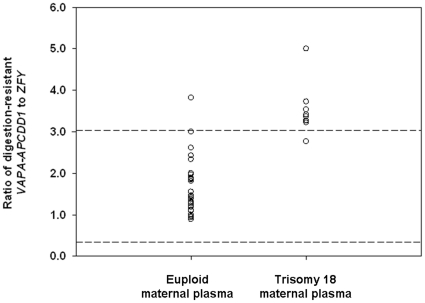
We have systematically identified methylated fetal epigenetic markers on chromosome 18 by methylated DNA immunoprecipitation (MeDIP) and tiling array analysis with confirmation using quantitative DNA methylation assays. Methylated DNA sequences from an intergenic region between the VAPA and APCDD1 genes (the VAPA-APCDD1 DNA) were detected in pre-delivery, but not post-delivery, maternal plasma samples. The concentrations correlated positively with those of an established fetal genetic marker, ZFY, in pre-delivery maternal plasma. The ratios of methylated VAPA-APCDD1(chr18) to ZFY(chrY) were higher in maternal plasma samples of 9 male trisomy 18 fetuses than those of 27 male euploid fetuses (Mann-Whitney test, P=0.029). We defined the cutoff value for detecting trisomy 18 fetuses as mean+1.96 SD of the EGG ratios of the euploid cases. Eight of 9 trisomy 18 and 1 of 27 euploid cases showed EGG ratios higher than the cutoff value, giving a sensitivity of 88.9% and a specificity of 96.3%.
Our data have shown that the methylated VAPA-APCDD1 DNA in maternal plasma is predominantly derived from the fetus. We have demonstrated that this novel fetal epigenetic marker in maternal plasma is useful for the noninvasive detection of fetal trisomy 18.
由于母体血浆中胎儿 DNA 的分数和绝对浓度较低,因此通过母体血浆分析进行无创性产前诊断胎儿非整倍体具有挑战性。以前,我们首次证明母体血浆中的胎儿 DNA 可以通过胎盘上的表观遗传(DNA 甲基化)特征特异性靶向。通过比较位于 21 号染色体上的一个这样的甲基化胎儿表观遗传标记和位于母体血浆中参考染色体上的另一个胎儿遗传标记,我们可以推断出胎儿 21 号染色体的相对剂量,并无创地检测出胎儿 21 三体。在这里,我们应用这种表观遗传 - 遗传(EGG)染色体剂量方法无创地检测胎儿爱德华兹综合征(18 三体)。
我们通过甲基化 DNA 免疫沉淀(MeDIP)和平铺阵列分析系统地鉴定了染色体 18 上的甲基化胎儿表观遗传标记,并使用定量 DNA 甲基化测定进行了验证。在产前但不在产后的母体血浆样本中检测到 VAPA 和 APCDD1 基因之间的一个基因间区域的甲基化 DNA 序列(VAPA-APCDD1 DNA)。在产前母体血浆中,该浓度与已建立的胎儿遗传标记 ZFY 呈正相关。在 9 例男性 18 三体胎儿的母体血浆样本中,甲基化 VAPA-APCDD1(chr18)与 ZFY(chrY)的比值高于 27 例男性正常胎儿(Mann-Whitney 检验,P=0.029)。我们将检测 18 三体胎儿的截断值定义为正常病例 EGG 比值的均值+1.96 SD。9 例 18 三体中 8 例和 27 例正常中 1 例的 EGG 比值高于截断值,敏感性为 88.9%,特异性为 96.3%。
我们的数据表明母体血浆中的甲基化 VAPA-APCDD1 DNA 主要来源于胎儿。我们已经证明,母体血浆中的这种新型胎儿表观遗传标记可用于无创检测胎儿 18 三体。