Zucchi Fabiola C R, Yao Youli, Metz Gerlinde A
Canadian Centre for Behavioural Neuroscience, University of Lethbridge, Lethbridge, AB, Canada.
Front Genet. 2012 Jun 4;3:96. doi: 10.3389/fgene.2012.00096. eCollection 2012.
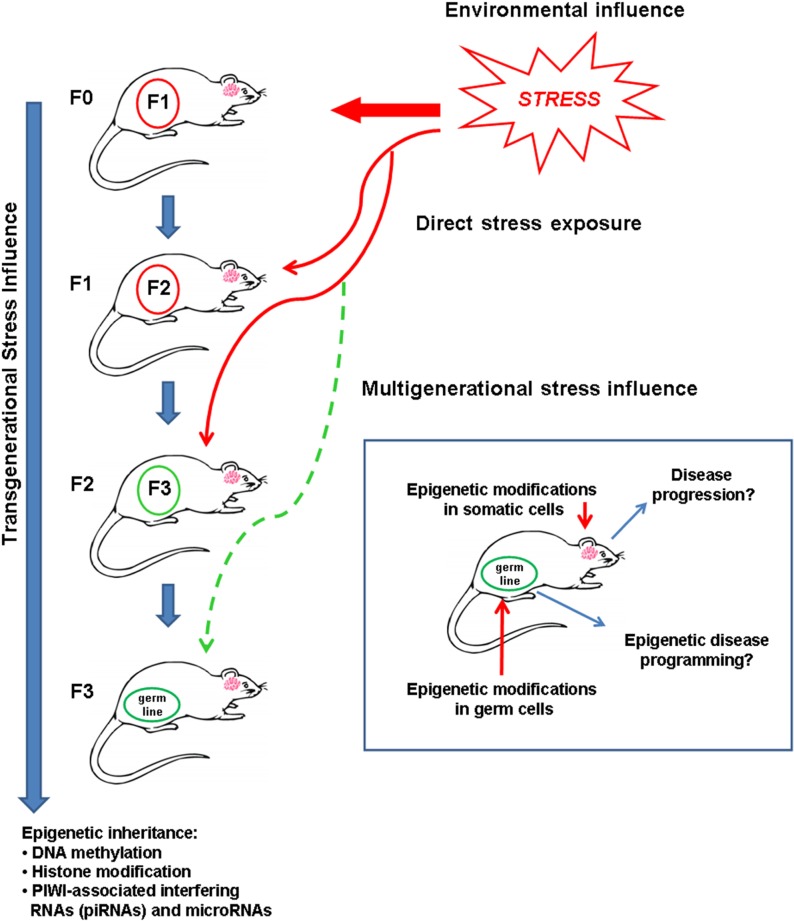
Epigenetic regulation modulates gene expression without altering the DNA sequence to facilitate rapid adjustments to dynamically changing environmental conditions. The formation of an epigenetic memory allows passing on this information to subsequent generations. Here we propose that epigenetic memories formed by adverse environmental conditions and stress represent a critical determinant of health and disease in the F3 generation and beyond. Transgenerational programming of epigenetic regulation may represent a key to understand adult-onset complex disease pathogenesis and cumulative effects of life span and familial disease etiology. Ultimately, the mechanisms of generating an epigenetic memory may become of potentially promising diagnostic and therapeutic relevance due to their reversible nature. Exploring the role of environmental factors, such as stress, in causing variations in epigenetic profiles may lead to new avenues of personalized, preventive medicine based on epigenetic signatures and interventions.
表观遗传调控可在不改变DNA序列的情况下调节基因表达,以促进对动态变化的环境条件进行快速调整。表观遗传记忆的形成使得这种信息能够传递给后代。在此,我们提出由不利环境条件和压力形成的表观遗传记忆是F3代及以后健康和疾病的关键决定因素。表观遗传调控的跨代编程可能是理解成人发病的复杂疾病发病机制以及寿命累积效应和家族性疾病病因的关键。最终,由于其可逆性,产生表观遗传记忆的机制可能具有潜在的诊断和治疗意义。探索压力等环境因素在导致表观遗传谱变化中的作用,可能会开辟基于表观遗传特征和干预措施的个性化预防医学新途径。