Department of Nature Conservation, Institute of Biology, M. Curie-Skłodowska University, Lublin, Poland.
Oecologia. 2011 Jun;166(2):517-30. doi: 10.1007/s00442-010-1862-3. Epub 2010 Dec 12.
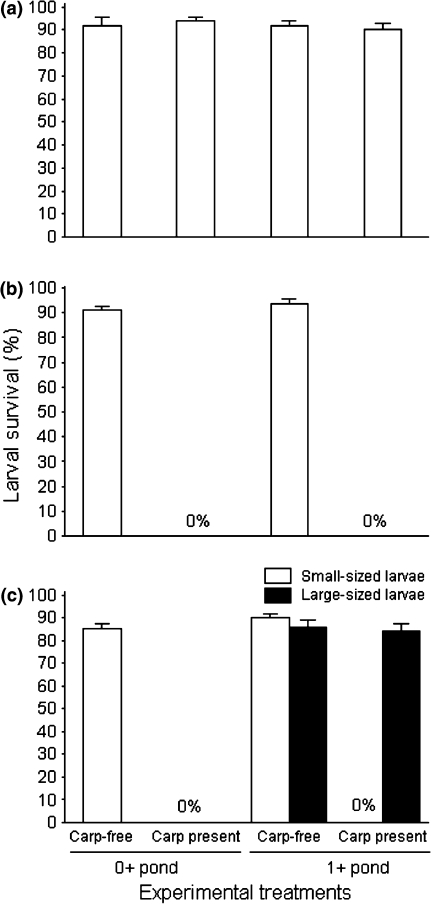
Size-structured interspecific interactions can shift between predation and competition, depending on ontogenetic changes in size relationships. I examined the effects of common carp (Cyprinus carpio), an omnivorous fish, on the reproductive success of the red-necked grebe (Podiceps grisegena), an avian gape-limited predator, along a fish size gradient created by stocking distinct age-cohorts in seminatural ponds. Young-of-the-year (0+) carp were an essential food source for young grebes. Only adult birds were able to consume 1-year-old (1+) fish, while 2-year-old (2+) fish attained a size refuge from grebes. Amphibian larvae were the principal alternative prey to fish, followed by macroinvertebrates, but the abundance of both dramatically decreased along the carp size gradient. Fledging success was 2.8 times greater in ponds with 0+ versus 1+ carp; in ponds with 1+ carp, chicks received on average 2.6-3 times less prey biomass from their parents, and over 1/3 of broods suffered total failure. Breeding birds avoided settling on 2+ ponds. These results show that changes in prey fish size structure can account for shifts from positive trophic effects on the avian predator to a negative impact on the predator's alternative resources. However, competition did not fully explain the decrease in grebe food resources in the presence of large fish, as carp and grebes overlapped little in diet. In experimental cages, 1+ carp totally eliminated young larvae of amphibians palatable to fish. In field conditions, breeding adults of palatable taxa avoided ponds with 1+ and older carp. Non-trophic interactions such as habitat selection by amphibians or macroinvertebrates to avoid large fish may provide an indirect mechanism strengthening the adverse bottom-up effects of fish on birds.
种间相互作用的大小结构可以在捕食和竞争之间转换,这取决于大小关系的个体发育变化。我研究了杂食性鱼类鲤鱼(Cyprinus carpio)对红颈杓鹬(Podiceps grisegena)繁殖成功的影响,红颈杓鹬是一种鸟类捕食者,口裂受限。研究是沿着通过在半自然池塘中放养不同年龄群体创造的鱼类大小梯度进行的。当年幼鱼(0+)是幼鸟的重要食物来源。只有成年鸟类才能食用 1 龄鱼(1+),而 2 龄鱼(2+)的体型可以躲避红颈杓鹬。两栖类幼虫是鱼类的主要替代食物,其次是大型无脊椎动物,但随着鲤鱼大小梯度的增加,这两种生物的丰度都显著下降。在有 0+鲤鱼的池塘中,雏鸟的离巢成功率比有 1+鲤鱼的池塘高 2.8 倍;在有 1+鲤鱼的池塘中,雏鸟从其父母那里获得的猎物生物量平均减少了 2.6-3 倍,超过 1/3 的繁殖对完全失败。繁殖鸟类避免在有 2+鲤鱼的池塘中定居。这些结果表明,猎物鱼类大小结构的变化可以解释从对鸟类捕食者的正营养影响到对捕食者替代资源的负面影响的转变。然而,竞争并没有完全解释在有大鱼存在的情况下红颈杓鹬食物资源的减少,因为鲤鱼和红颈杓鹬的饮食重叠很少。在实验笼中,1+鲤鱼完全消灭了鱼类可食用的年轻两栖类幼虫。在野外条件下,可食用类别的繁殖成鸟避免了有 1+和更老的鲤鱼的池塘。非营养相互作用,如两栖动物或大型无脊椎动物为避免大鱼而选择栖息地,可能为鱼类对鸟类的不利下行影响提供一种间接机制。