Department of Psychology, University of Illinois at Urbana Champaign, Champaign, IL, USA.
Psychol Health Med. 2010 Dec;15(6):694-719. doi: 10.1080/13548506.2010.498892.
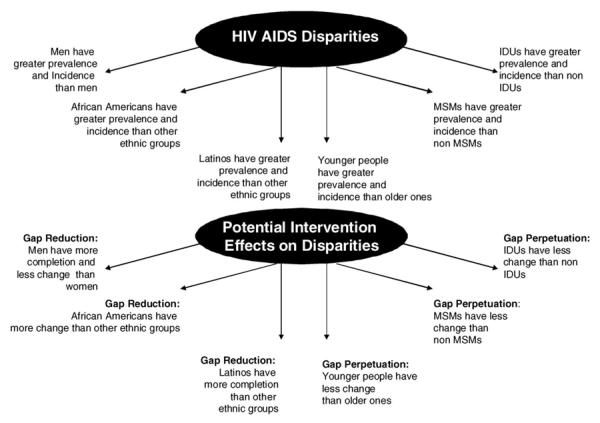
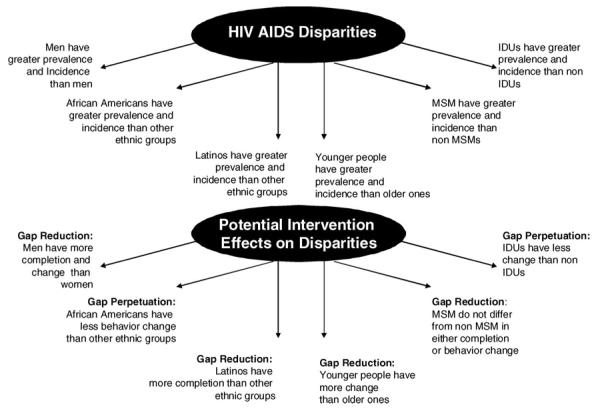
Although experimental behavioral interventions to prevent HIV are generally designed to correct undesirable epidemiological trends, it is presently unknown whether the resulting body of behavioral interventions is adequate to correct the social disparities in HIV-prevalence and incidence present in the United States. Two large, diverse-population meta-analytic databases were reanalyzed to estimate potential perpetuation and change in demographic and behavioral gaps as a result of introducing the available behavioral interventions advocating condom use. This review suggested that, if uniformly applied across populations, the analyzed set of experimental (i.e. under testing) interventions is well poised to correct the higher prevalence and incidence among males (vs. females) and African-Americans and Latinos (vs. other groups), but ill poised to correct the higher prevalence and incidence among younger (vs. older) people, as well as men who have sex with men, injection-drug users, and multiple partner heterosexuals (vs. other behavioral groups). Importantly, when the characteristics of the interventions most efficacious for each population were included in the analyses of behavior change, results replicated with three exceptions. Specifically, after accounting for interactions of intervention and facilitator features with characteristics of the recipient population (e.g. gender), there was no behavior change bias for men who have sex with men, younger individuals changed their behavior more than older individuals, and African-Americans changed their behavior less than other groups.
虽然预防艾滋病毒的实验行为干预措施通常旨在纠正不良的流行病学趋势,但目前尚不清楚由此产生的一系列行为干预措施是否足以纠正美国目前艾滋病毒流行率和发病率方面存在的社会差异。对两个大型、多样化人群的荟萃分析数据库进行了重新分析,以估计由于引入提倡使用避孕套的现有行为干预措施,可能会延续和改变人口统计学和行为上的差距。这项研究表明,如果在所有人群中统一应用,分析的一套实验性(即正在测试中)干预措施非常适合纠正男性(与女性相比)和非裔美国人及拉丁裔(与其他群体相比)中更高的流行率和发病率,但对于纠正年轻人(与老年人相比)以及男男性行为者、注射毒品使用者和多个性伴侣异性恋者(与其他行为群体相比)中更高的流行率和发病率则准备不足。重要的是,当分析行为变化时纳入了对每个群体最有效的干预措施的特征,除了三个例外情况,结果是可以复制的。具体来说,在考虑到干预措施和促进者特征与受干预群体特征(如性别)的相互作用后,男男性行为者不存在行为变化偏见,年轻人比老年人更有可能改变行为,而非裔美国人改变行为的可能性比其他群体更小。