Department of Pediatrics, Pusan Paik Hospital, Inje University College of Medicine, Busan, Korea.
Yonsei Med J. 2011 Jan;52(1):65-73. doi: 10.3349/ymj.2011.52.1.65.
Granulocyte colony stimulating factor (G-CSF) has been known to increase neutrophil production and have anti-inflammatory properties, but the effect of G-CSF on pulmonary system is in controversy. We investigated whether G-CSF treatment could attenuate hyperoxia-induced lung injury, and whether this protective effect is mediated by the down-modulation of inflammatory responses in a neonatal rat model.
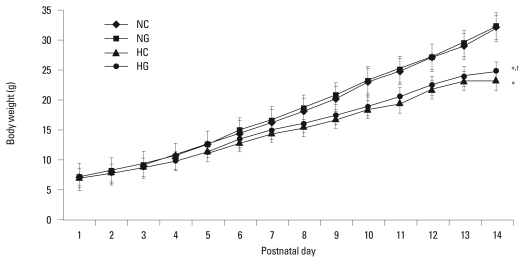
Newborn Sprague-Dawley rats (Orient Co., Seoul, Korea) were subjected to 14 days of hyperoxia (90% oxygen) beginning within 10 h after birth. G-CSF (20 μg/kg) was administered intraperitoneally on the fourth, fifth, and sixth postnatal days.
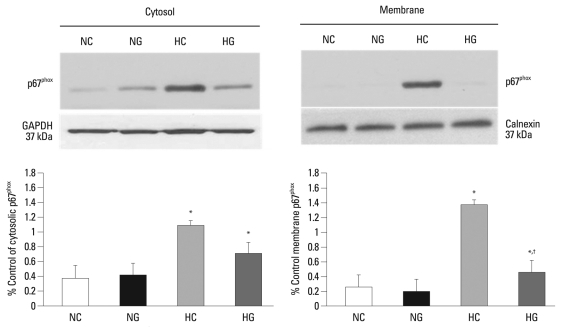
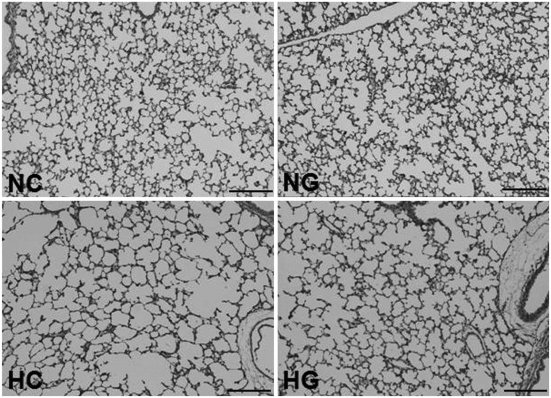
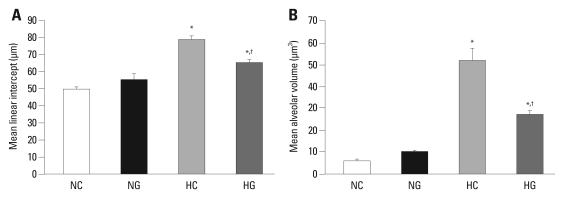
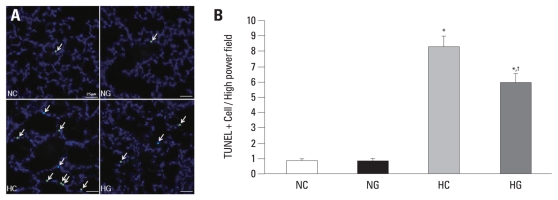
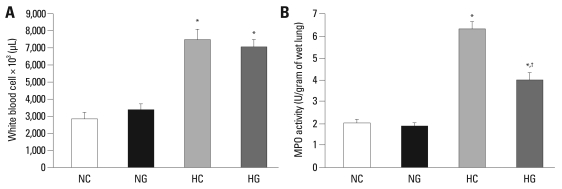
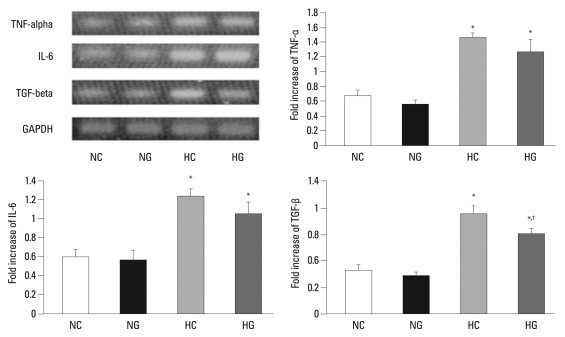
This treatment significantly improved hyperoxia-induced reduction in body weight gain and lung pathology such as increased mean linear intercept, mean alveolar volume, terminal deoxynucleotidyl transferase-mediated deoxyuridine triphosphate nick end labeling positive cells. Hyperoxia- induced activation of nicotinamide adenine dinucleotide phosphate oxidase, which is responsible for superoxide anion production, as evidenced by upregulation and membrane translocation of p67(phox) was significantly attenuated after G-CSF treatment, as were inflammatory responses such as increased myeloperoxidase activity and mRNA expression of transforming growth factor-β. However, the attenuation of other proinflammatory cytokines such as tumor necrosis factor-α and interleukin- 6 was not significant.
In sum, G-CSF treatment significantly attenuated hyperoxia-induced lung injury by down-modulating the inflammatory responses in neonatal rats.
粒细胞集落刺激因子(G-CSF)已被证实可增加中性粒细胞的生成并具有抗炎作用,但 G-CSF 对肺部系统的影响存在争议。我们研究了 G-CSF 治疗是否可以减轻高氧诱导的肺损伤,以及这种保护作用是否通过下调新生儿大鼠模型中的炎症反应来介导。
新生 Sprague-Dawley 大鼠(Orient Co.,首尔,韩国)在出生后 10 小时内接受 14 天的高氧(90%氧气)处理。G-CSF(20 μg/kg)在出生后第 4、5 和 6 天通过腹腔内给药。
这种治疗显著改善了高氧诱导的体重增加减少和肺病理学,例如增加了平均线性截距、平均肺泡体积、末端脱氧核苷酸转移酶介导的脱氧尿苷三磷酸缺口末端标记阳性细胞。高氧诱导的烟酰胺腺嘌呤二核苷酸磷酸氧化酶的激活,这是由超氧化物阴离子产生的,表现为 p67(phox)的上调和膜易位,在 G-CSF 治疗后显著减弱,同时还减弱了炎症反应,如髓过氧化物酶活性和转化生长因子-β的 mRNA 表达增加。然而,其他促炎细胞因子如肿瘤坏死因子-α和白细胞介素-6 的衰减并不显著。
总之,G-CSF 治疗通过下调新生儿大鼠中的炎症反应,显著减轻了高氧诱导的肺损伤。