Digestive Disease Center, CHA Bundang Medical Center, CHA University, Seongnam, Korea.
Yonsei Med J. 2011 Jan;52(1):81-8. doi: 10.3349/ymj.2011.52.1.81.
(18)F-fluorodeoxyglucose positron emission tomography/computed tomography ((18)F-FDG PET/CT) scans are frequently performed for the screening or staging of malignant tumors. This study aimed to assess the usefulness of (18)F-FDG PET/CT in detection of gastric cancer recurrence after curative gastrectomy.
Eighty nine patients who had undergone curative gastrectomy due to gastric cancer and had (18)F-FDG PET/CT and contrast CT scans within 2 weeks for surveillance in asymptomatic patients (n = 11) or to clarify suspected recurrence (n = 78) were consecutively collected and retrospectively analyzed. They had clinical follow-up for at least 12 months after PET/CT and CT scans.
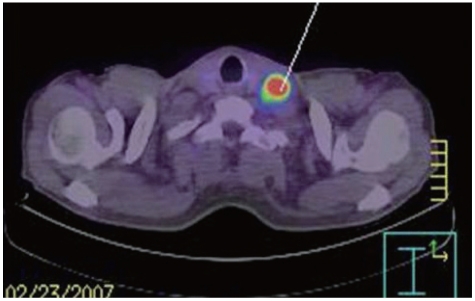
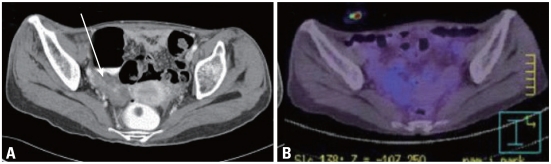
Fifteen of the 89 patients (16.9%) were diagnosed with recurrent gastric cancer in 21 organs. Forty one organs showed an increase in FDG uptake, and only 9 of these organs were diagnosed with recurrent gastric cancer by (18)F-FDG PET/CT. The sensitivity, specificity, positive predictive value, negative predictive value, and diagnostic accuracy of the (18)F-FDG PET/CT were 42.9%, 59.7%, 29.3%, 78.2%, and 57.3%, respectively. On the CT scan, 18 of 21 recurrent gastric cancers were detected, and 7 cases were in agreement with the (18)F-FDG PET/CT. The sensitivity and specificity of the CT scan were 85.8% and 87.3%, respectively, which are superior to the (18)F-FDG PET/CT. When we diagnosed a recurrence based on either (18)F-FDG PET/CT or CT scans, the sensitivity increased to 95.2% and the specificity decreased to 45.6%, when compared with the contrast CT scan alone.
(18)F-FDG PET/CT is an insufficient diagnostic method in detection of recurrence after curative gastrectomy, and even less accurate than contrast CT scan alone.
(18)氟-脱氧葡萄糖正电子发射断层扫描/计算机断层扫描((18)F-FDG PET/CT)常用于恶性肿瘤的筛查或分期。本研究旨在评估(18)F-FDG PET/CT 在检测根治性胃切除术后胃癌复发中的作用。
连续收集了 89 例因胃癌接受根治性胃切除术且在无症状患者(n=11)或为明确可疑复发(n=78)进行监测的 2 周内行(18)F-FDG PET/CT 和对比 CT 扫描的患者,并进行回顾性分析。他们在 PET/CT 和 CT 扫描后至少进行了 12 个月的临床随访。
89 例患者中有 15 例(16.9%)在 21 个器官中诊断为复发性胃癌。41 个器官显示 FDG 摄取增加,但只有 9 个器官通过(18)F-FDG PET/CT 诊断为复发性胃癌。(18)F-FDG PET/CT 的敏感性、特异性、阳性预测值、阴性预测值和诊断准确性分别为 42.9%、59.7%、29.3%、78.2%和 57.3%。在 CT 扫描上,21 例复发性胃癌中有 18 例被检出,其中 7 例与(18)F-FDG PET/CT 一致。CT 扫描的敏感性和特异性分别为 85.8%和 87.3%,优于(18)F-FDG PET/CT。当我们根据(18)F-FDG PET/CT 或 CT 扫描诊断复发时,与单独对比 CT 扫描相比,敏感性增加到 95.2%,特异性降低到 45.6%。
(18)F-FDG PET/CT 是一种检测根治性胃切除术后复发的不足够的诊断方法,甚至不如单独对比 CT 扫描准确。