Sim Sung Hoon, Kim Yu Jung, Oh Do-Youn, Lee Se-Hoon, Kim Dong-Wan, Kang Won Jun, Im Seock-Ah, Kim Tae-You, Kim Woo Ho, Heo Dae Seog, Bang Yung-Jue
Department of Internal Medicine, Seoul National University Hospital, Seoul National University College of Medicine, Seoul, Korea.
BMC Cancer. 2009 Mar 1;9:73. doi: 10.1186/1471-2407-9-73.
In the course of surveillance of gastric cancer recurrence after curative resection, contrast CT scan is used in general. However, new findings from CT scan are not always confirmatory for the recurrence. In this case, we usually use short-term follow up strategy or therapeutic intervention with clinical decision. Recently, the use of fusion Positron Emission Tomography/Computed Tomography (PET/CT) is increasing. The purpose of this study is to evaluate the efficacy and usefulness of PET/CT for detecting recurrence of gastric cancer after curative resection.
Fifty two patients who received curative resection of gastric cancer and had undergone PET/CT and contrast CT for surveillance of recurrence until Dec 2006 in Seoul National University Hospital were analyzed retrospectively. Recurrence of gastric cancer was validated by histologic confirmation (n = 17) or serial contrast CT follow up with at least 5 month interval (n = 35). McNemar's test and Fisher's exact test were used to evaluate sensitivity and specificity of PET/CT and contrast CT.
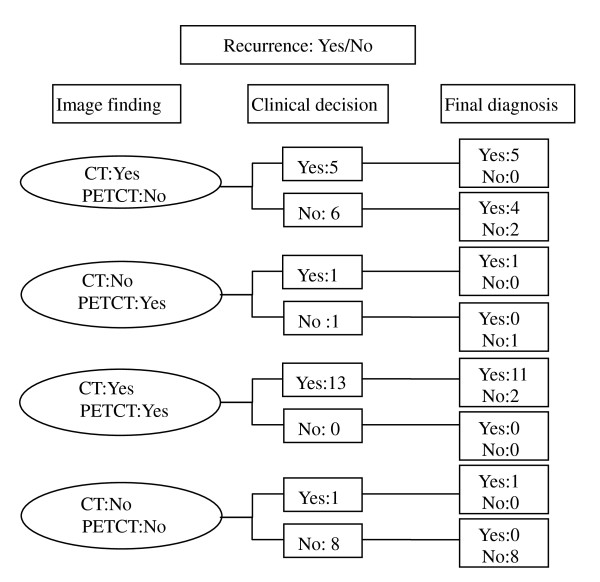
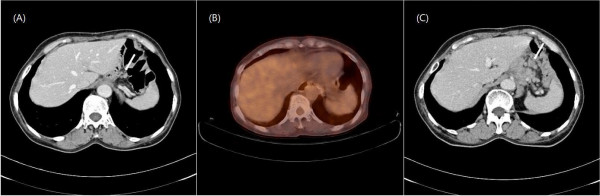
Of 52 patients, 38 patients were confirmed as recurrence. The sensitivity was 68.4% (26/38) for PET/CT and 89.4% (34/38) for contrast CT (p = 0.057). The specificity was 71.4% (10/14) and 64.2% (9/14), respectively (p = 1.0). In terms of the recurred sites, the sensitivity and specificity of PET/CT were similar to those of contrast CT in all sites except peritoneum. Contrast CT was more sensitive than PET/CT (p = 0.039) for detecting peritoneal seeding. Additional PET/CT on contrast CT showed no further increase of positive predictive value regardless of sites. Among 13 patients whose image findings between two methods were discordant and tissue confirmation was difficult, the treatment decision was made in 7 patients based on PET/CT, showing the final diagnostic accuracy of 42.8% (3/7).
PET/CT was as sensitive and specific as contrast CT in detection of recurred gastric cancer except peritoneal seeding. However, additional PET/CT on contrast CT did not increase diagnostic accuracy in detection of recurred gastric cancer. Further studies are warranted to validate the role of PET/CT in detection of gastric cancer recurrence.
在胃癌根治性切除术后的复发监测过程中,通常使用对比增强CT扫描。然而,CT扫描的新发现并不总是能确诊复发情况。在这种情况下,我们通常采用短期随访策略或根据临床决策进行治疗干预。近年来,正电子发射断层显像/计算机断层扫描(PET/CT)融合技术的应用日益增多。本研究旨在评估PET/CT在检测胃癌根治性切除术后复发中的有效性和实用性。
回顾性分析了2006年12月前在首尔国立大学医院接受胃癌根治性切除,并接受PET/CT和对比增强CT进行复发监测的52例患者。胃癌复发通过组织学确诊(n = 17)或至少间隔5个月的系列对比增强CT随访确诊(n = 35)。采用McNemar检验和Fisher精确检验评估PET/CT和对比增强CT的敏感性和特异性。
52例患者中,38例确诊为复发。PET/CT的敏感性为68.4%(26/38),对比增强CT的敏感性为89.4%(34/38)(p = 0.057)。特异性分别为71.4%(10/14)和64.2%(9/14)(p = 1.0)。就复发部位而言,除腹膜外,PET/CT在所有部位的敏感性和特异性与对比增强CT相似。在检测腹膜种植方面,对比增强CT比PET/CT更敏感(p = 0.039)。在对比增强CT基础上加做PET/CT,无论在哪个部位,阳性预测值均未进一步提高。在13例两种检查方法影像表现不一致且难以进行组织确诊的患者中,7例根据PET/CT做出了治疗决策,最终诊断准确率为42.8%(3/7)。
除腹膜种植外,PET/CT在检测复发性胃癌方面与对比增强CT具有相同的敏感性和特异性。然而,在对比增强CT基础上加做PET/CT并未提高复发性胃癌检测的诊断准确性。有必要进行进一步研究以验证PET/CT在检测胃癌复发中的作用。