Neve Melinda J, Collins Clare E, Morgan Philip J
School of Health Sciences, Faculty of Health, The University of Newcastle, Callaghan, Australia.
J Med Internet Res. 2010 Dec 14;12(4):e69. doi: 10.2196/jmir.1640.
An understanding of the factors that predict retention and website use are critical to the development of effective Web-based weight loss interventions. However, poor retention (dropout attrition) and website utilization (nonusage attrition) are major inhibitors to the effectiveness of Web-based programs.
The study aimed to (1) describe the prevalence of dropout and nonusage attrition and (2) examine pretreatment predictors of nonusage attrition in a cohort of commercial Web-based weight loss program participants.
Participants enrolled in the online program, The Biggest Loser Club, Australia, from August 15, 2007, to May 31, 2008. Only those who subscribed for 12 or 52 weeks were included in this study. All data were collected by the program proprietors, SP Health Co Pty Ltd (Sydney, Australia), and provided in "deidentified" form. Data collected included responses to a pretreatment survey (sociodemographic and behavioral characteristics), subscription history (date of enrollment and subscription end), and website use (log-ins, food and exercise diary entries, weigh-ins, and forum posts). Participants were classified as a member of the program at 12 or 52 weeks if they held an active subscription plan at that point in time. Participants were classified as nonusers at 12 or 52 weeks if they had stopped using all of the website features and had not returned. Predictors of nonusage attrition were explored using Cox proportional hazards regression analysis.
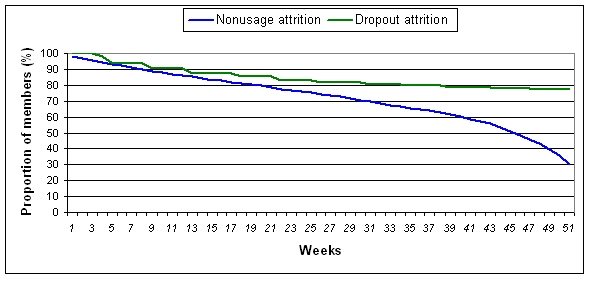
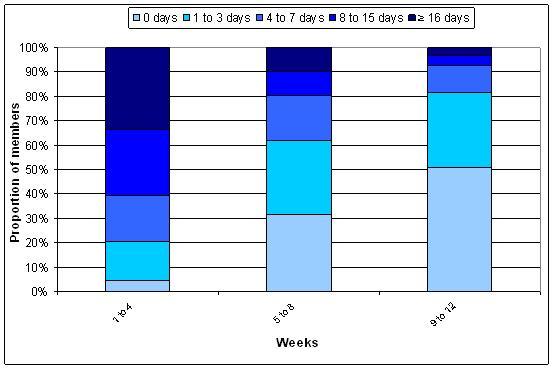
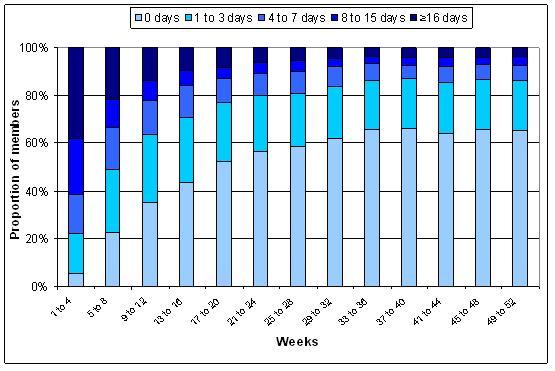
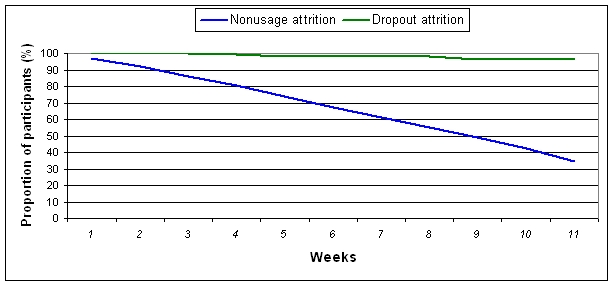
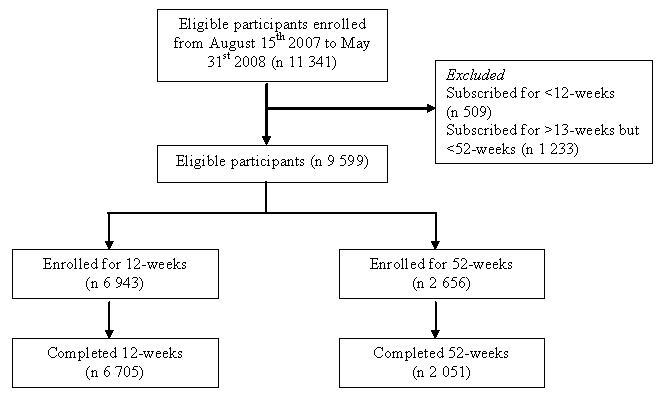
Of the 9599 eligible participants, 6943 (72%) subscribed to the program for 12 weeks, and 2656 (28%) subscribed for 52 weeks. Of all participants, 31% (2975/9599) were classified as overweight, 61% (5866/9599) were classified as obese, 86% (8279/9599) were female, and participants' mean (SD) age was 35.7 (9.5) years. The 12 week and 52 week subscribers' retention rates were 97% and 77% respectively. Of 12 week subscribers, 35% were classified as program "users" after 12 weeks, and 30% of 52 week subscribers were classified as "users" after 52 weeks. Significant predictors of nonusage attrition among 12 week subscribers included age (hazard ratio for 45 to 55 years of age = 0.83, 95% confidence interval [CI] 0.73 - 0.93, P = .001; hazard ratio for 55 to 65 years of age = 0.80, 95% CI 0.66 - 0.99, P = .04), exercise level (hazard ratio = 0.76, 95% CI 0.72 - 0.81, P < .001), emotional eating (hazard ratio = 1.11, 95% CI 1.04 - 1.18, P = .001), eating breakfast (hazard ratio = 0.88, 95% CI 0.82 - 0.95, P = .001), and skipping meals (hazard ratio = 1.12, 95% CI 1.04 -1.19, P = .001). For 52 week subscribers, eating breakfast (hazard ratio = 0.88, 95% CI 0.79 - 0.99, P = .04) and not drinking tea or coffee with sugar (hazard ratio = 1.23, 95% CI 1.11 - 1.37, P < .001) were the pretreatment characteristics that significantly decreased risk of nonusage attrition.
The findings demonstrate a high prevalence of nonusage attrition among a cohort of commercial Web-based weight loss program participants. Several sociodemographic and behavioral factors were shown to independently predict nonusage attrition.
了解预测留存率和网站使用情况的因素对于开发有效的基于网络的减肥干预措施至关重要。然而,低留存率(退出损耗)和网站利用率低(未使用损耗)是基于网络的减肥项目效果的主要阻碍因素。
本研究旨在(1)描述退出和未使用损耗的发生率,以及(2)调查一组商业性基于网络的减肥项目参与者中未使用损耗的预处理预测因素。
参与者于2007年8月15日至2008年5月31日注册参加澳大利亚的在线项目“减肥达人俱乐部”。本研究仅纳入订阅12周或52周的参与者。所有数据由项目所有者SP Health Co Pty Ltd(澳大利亚悉尼)收集,并以“去识别化”形式提供。收集的数据包括预处理调查问卷的回复(社会人口统计学和行为特征)、订阅历史(注册日期和订阅结束日期)以及网站使用情况(登录次数、饮食和运动日记条目、体重测量和论坛帖子)。如果参与者在12周或52周时持有有效订阅计划,则被归类为该项目的成员。如果参与者停止使用所有网站功能且未再返回,则在12周或52周时被归类为非用户。使用Cox比例风险回归分析探索未使用损耗的预测因素。
在9599名符合条件的参与者中,6943名(72%)订阅该项目12周,2656名(28%)订阅52周。在所有参与者中,31%(2975/9599)被归类为超重,61%(5866/9599)被归类为肥胖,86%(8279/9599)为女性,参与者的平均(标准差)年龄为35.7(9.5)岁。12周和52周订阅者的留存率分别为97%和77%。在12周订阅者中,35%在12周后被归类为项目“用户”,52周订阅者中有30%在52周后被归类为“用户”。12周订阅者中未使用损耗的显著预测因素包括年龄(45至55岁的风险比 = 0.83,95%置信区间[CI] 0.73 - 0.93,P = 0.001;55至65岁 的风险比 = 0.80,95% CI 〇.66 - 0.99,P = 0.04)、运动水平(风险比 = 0.76,95% CI 0.72 - 0.81,P < 0.001)、情绪化进食(风险比 = 1.11,95% CI 1.04 - 1.18,P = 0.001)、吃早餐(风险比 = 0.88,95% CI 0.82 - 0.95,P = 0.001)和不规律饮食(风险比 = 1.12,95% CI 1.04 - 1.19,P = 0.001)。对于52周订阅者,吃早餐(风险比 = 0.88,95% CI 0.79 - 0.99,P = 0.04)和不喝加糖茶或咖啡(风险比 = 1.23,95% CI 1.11 - 1.37,P < 0.001)是显著降低未使用损耗风险的预处理特征。
研究结果表明,在一组商业性基于网络的减肥项目参与者中,未使用损耗的发生率很高。一些社会人口统计学和行为因素被证明可独立预测未使用损耗。