Neve Melinda, Morgan Philip J, Collins Clare E
School of Health Sciences, University of Newcastle, Callaghan, NSW, Australia.
J Med Internet Res. 2011 Oct 12;13(4):e83. doi: 10.2196/jmir.1756.
There is a paucity of information in the scientific literature on the effectiveness of commercial weight loss programs, including Web-based programs. The potential of Web-based weight loss programs has been acknowledged, but their ability to achieve significant weight loss has not been proven.
The objectives were to evaluate the weight change achieved within a large cohort of individuals enrolled in a commercial Web-based weight loss program for 12 or 52 weeks and to describe participants' program use in relation to weight change.
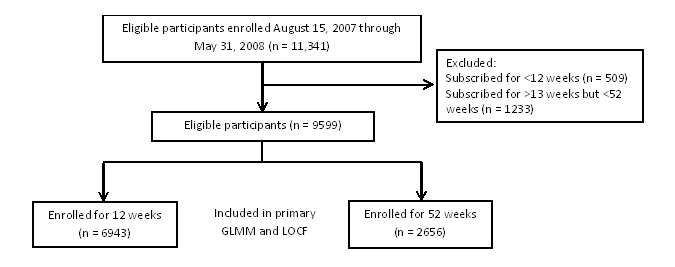
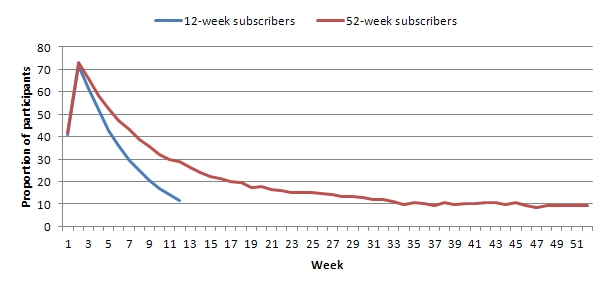
Participants enrolled in an Australian commercial Web-based weight loss program from August 15, 2007, through May 31, 2008. Self-reported weekly weight records were used to determine weight change after 12- and 52-week subscriptions. The primary analysis estimated weight change using generalized linear mixed models (GLMMs) for all participants who subscribed for 12 weeks and also for those who subscribed for 52 weeks. A sensitivity analysis was conducted using the last observation carried forward (LOCF) method. Website use (ie, the number of days participants logged on, made food or exercise entries to the Web-based diary, or posted to the discussion forum) was described from program enrollment to 12 and 52 weeks, and differences in website use by percentage weight change category were tested using Kruskal-Wallis test for equality of populations.
Participants (n = 9599) had a mean (standard deviation [SD]) age of 35.7 (9.5) years and were predominantly female (86% or 8279/9599) and obese (61% or 5866/9599). Results from the primary GLMM analysis including all enrollees found the mean percentage weight change was -6.2% among 12-week subscribers (n = 6943) and -6.9% among 52-week subscribers (n = 2656). Sensitivity analysis using LOCF revealed an average weight change of -3.0% and -3.5% after 12 and 52 weeks respectively. The use of all website features increased significantly (P < .01) as percentage weight change improved.
The weight loss achieved by 12- and 52-week subscribers of a commercial Web-based weight loss program is likely to be in the range of the primary and sensitivity analysis results. While this suggests that, on average, clinically important weight loss may be achieved, further research is required to evaluate the efficacy of this commercial Web-based weight loss program prospectively using objective measures. The potential association between greater website use and increased weight loss also requires further evaluation, as strategies to improve participants' use of Web-based program features may be required.
科学文献中关于商业减肥项目(包括基于网络的项目)有效性的信息匮乏。基于网络的减肥项目的潜力已得到认可,但其实现显著体重减轻的能力尚未得到证实。
目的是评估一大群参加基于网络的商业减肥项目12周或52周的个体的体重变化,并描述参与者的项目使用情况与体重变化的关系。
参与者于2007年8月15日至2008年5月31日参加了一个澳大利亚基于网络的商业减肥项目。使用自我报告的每周体重记录来确定12周和52周订阅后的体重变化。主要分析使用广义线性混合模型(GLMMs)估计所有订阅12周的参与者以及订阅52周的参与者的体重变化。使用末次观察结转(LOCF)方法进行敏感性分析。描述了从项目注册到12周和52周的网站使用情况(即参与者登录、在网络日记中记录食物或运动条目或在讨论论坛发帖的天数),并使用Kruskal-Wallis检验来检验按体重变化百分比分类的网站使用差异是否具有总体平等性。
参与者(n = 9599)的平均(标准差[SD])年龄为35.7(9.5)岁,主要为女性(86%或8279/9599)且肥胖(61%或5866/9599)。包括所有登记者的主要GLMM分析结果显示,12周订阅者(n = 6943)的平均体重变化百分比为-6.2%,52周订阅者(n = 2656)为-6.9%。使用LOCF的敏感性分析显示,12周和52周后平均体重变化分别为-3.0%和-3.5%。随着体重变化百分比的改善,所有网站功能的使用显著增加(P <.01)。
基于网络的商业减肥项目12周和52周订阅者实现的体重减轻可能在主要分析和敏感性分析结果范围内。虽然这表明平均而言可能实现临床上重要的体重减轻,但需要进一步研究以使用客观测量方法前瞻性地评估这个基于网络的商业减肥项目的疗效。网站使用增加与体重减轻增加之间的潜在关联也需要进一步评估,因为可能需要采取策略来提高参与者对基于网络项目功能的使用。