Division of Reproductive Endocrinology and Infertility, Department of Obstetrics and Gynecology, Brigham and Women’s Hospital and Harvard Medical School, Boston, MA 02115, USA.
Hum Mol Genet. 2011 Mar 1;20(5):962-74. doi: 10.1093/hmg/ddq542. Epub 2010 Dec 14.
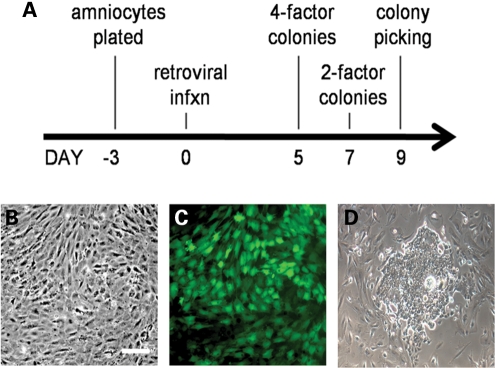
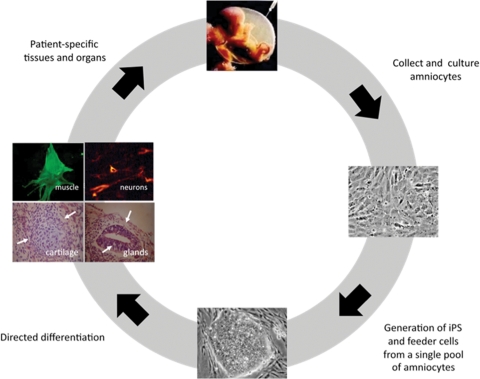
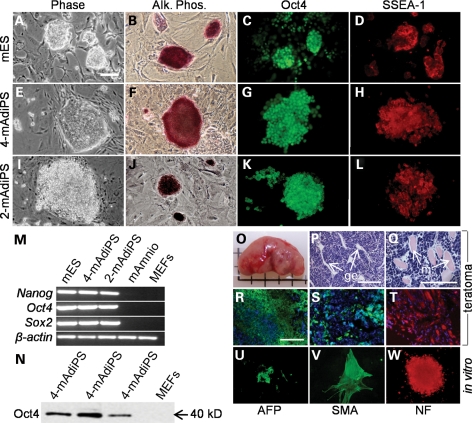
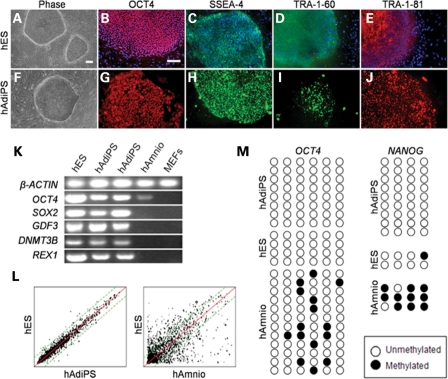
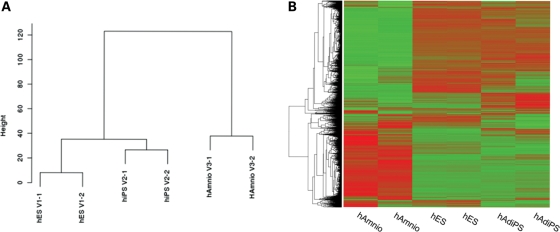
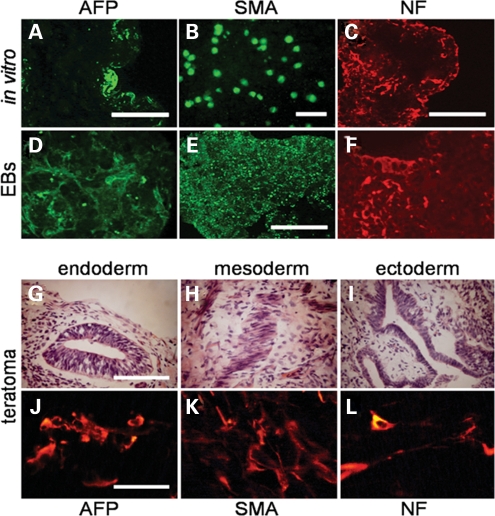
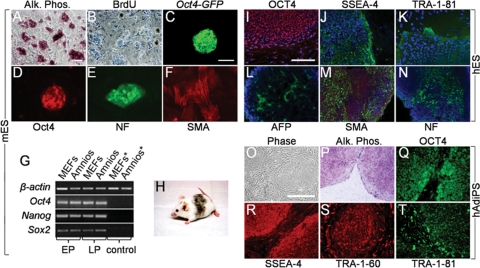
Clinical barriers to stem-cell therapy include the need for efficient derivation of histocompatible stem cells and the zoonotic risk inherent to human stem-cell xenoculture on mouse feeder cells. We describe a system for efficiently deriving induced pluripotent stem (iPS) cells from human and mouse amniocytes, and for maintaining the pluripotency of these iPS cells on mitotically inactivated feeder layers prepared from the same amniocytes. Both cellular components of this system are thus autologous to a single donor. Moreover, the use of human feeder cells reduces the risk of zoonosis. Generation of iPS cells using retroviral vectors from short- or long-term cultured human and mouse amniocytes using four factors, or two factors in mouse, occurs in 5-7 days with 0.5% efficiency. This efficiency is greater than that reported for mouse and human fibroblasts using similar viral infection approaches, and does not appear to result from selective reprogramming of Oct4(+) or c-Kit(+) amniocyte subpopulations. Derivation of amniocyte-derived iPS (AdiPS) cell colonies, which express pluripotency markers and exhibit appropriate microarray expression and DNA methylation properties, was facilitated by live immunostaining. AdiPS cells also generate embryoid bodies in vitro and teratomas in vivo. Furthermore, mouse and human amniocytes can serve as feeder layers for iPS cells and for mouse and human embryonic stem (ES) cells. Thus, human amniocytes provide an efficient source of autologous iPS cells and, as feeder cells, can also maintain iPS and ES cell pluripotency without the safety concerns associated with xenoculture.
临床干细胞治疗的障碍包括需要高效地从组织相容性干细胞中提取,以及在小鼠饲养细胞上进行异种人干细胞培养所固有的人畜共患病风险。我们描述了一种从人羊膜细胞和鼠羊膜细胞中高效提取诱导多能干细胞(iPS)细胞的系统,并描述了在从相同的羊膜细胞制备的有丝分裂失活饲养层上维持这些 iPS 细胞多能性的方法。该系统的两种细胞成分均来自单个供体的自体。此外,使用人饲养细胞降低了人畜共患病的风险。使用反转录病毒载体从短期或长期培养的人羊膜细胞和鼠羊膜细胞中生成 iPS 细胞,使用 4 种因子,或在鼠中使用 2 种因子,可在 5-7 天内以 0.5%的效率发生。这种效率高于使用类似病毒感染方法从鼠和人成纤维细胞中报告的效率,而且似乎不是由于 Oct4(+)或 c-Kit(+)羊膜细胞亚群的选择性重编程所致。通过活免疫染色,促进了羊膜细胞衍生的 iPS(AdiPS)细胞集落的生成,这些集落表达多能性标记,并表现出适当的微阵列表达和 DNA 甲基化特性。AdiPS 细胞还在体外生成胚状体,并在体内生成畸胎瘤。此外,鼠和人羊膜细胞可作为 iPS 细胞和鼠和人胚胎干细胞(ES)的饲养层。因此,人羊膜细胞为自体来源的 iPS 细胞提供了高效的来源,并且作为饲养细胞,还可以维持 iPS 和 ES 细胞的多能性,而不会产生与异种培养相关的安全问题。