Center for Epigenetics and Department of Medicine, Johns Hopkins University School of Medicine, 570 Rangos, 725 N. Wolfe St., Baltimore, Maryland 21205, USA.
Nature. 2010 Sep 16;467(7313):338-42. doi: 10.1038/nature09367. Epub 2010 Aug 15.
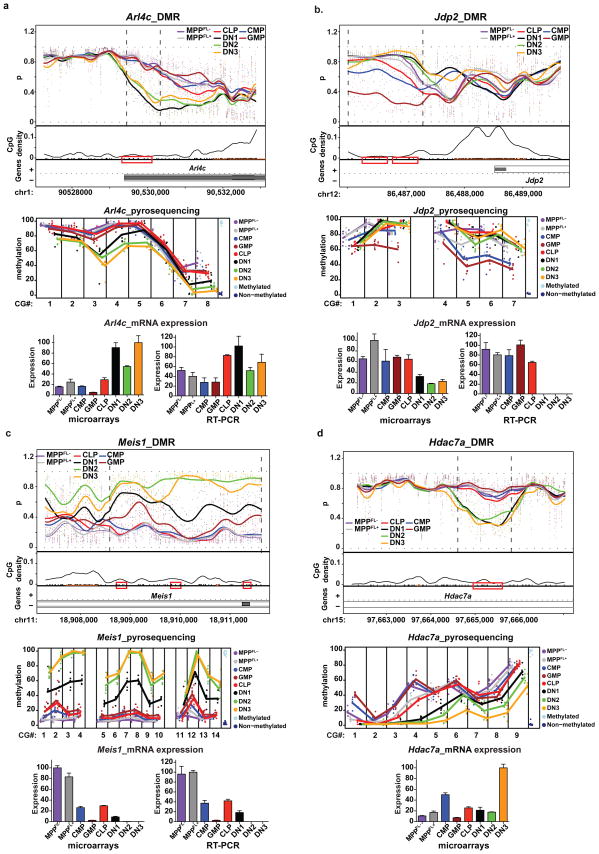
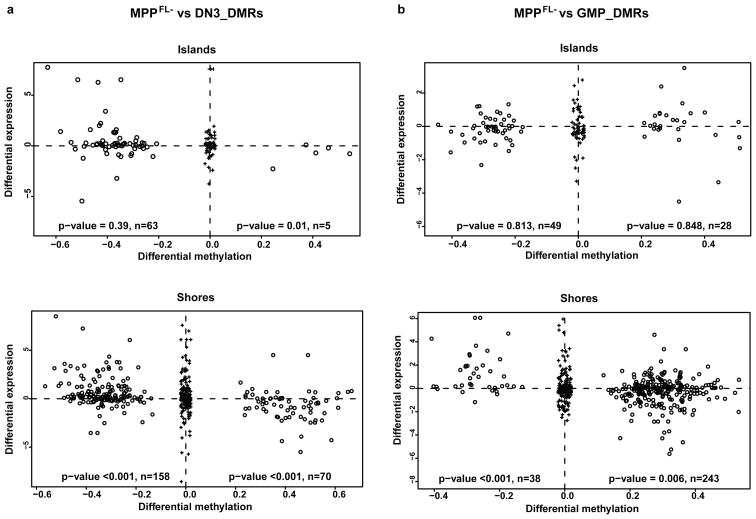
Epigenetic modifications must underlie lineage-specific differentiation as terminally differentiated cells express tissue-specific genes, but their DNA sequence is unchanged. Haematopoiesis provides a well-defined model to study epigenetic modifications during cell-fate decisions, as multipotent progenitors (MPPs) differentiate into progressively restricted myeloid or lymphoid progenitors. Although DNA methylation is critical for myeloid versus lymphoid differentiation, as demonstrated by the myeloerythroid bias in Dnmt1 hypomorphs, a comprehensive DNA methylation map of haematopoietic progenitors, or of any multipotent/oligopotent lineage, does not exist. Here we examined 4.6 million CpG sites throughout the genome for MPPs, common lymphoid progenitors (CLPs), common myeloid progenitors (CMPs), granulocyte/macrophage progenitors (GMPs), and thymocyte progenitors (DN1, DN2, DN3). Marked epigenetic plasticity accompanied both lymphoid and myeloid restriction. Myeloid commitment involved less global DNA methylation than lymphoid commitment, supported functionally by myeloid skewing of progenitors following treatment with a DNA methyltransferase inhibitor. Differential DNA methylation correlated with gene expression more strongly at CpG island shores than CpG islands. Many examples of genes and pathways not previously known to be involved in choice between lymphoid/myeloid differentiation have been identified, such as Arl4c and Jdp2. Several transcription factors, including Meis1, were methylated and silenced during differentiation, indicating a role in maintaining an undifferentiated state. Additionally, epigenetic modification of modifiers of the epigenome seems to be important in haematopoietic differentiation. Our results directly demonstrate that modulation of DNA methylation occurs during lineage-specific differentiation and defines a comprehensive map of the methylation and transcriptional changes that accompany myeloid versus lymphoid fate decisions.
表观遗传修饰必须是谱系特异性分化的基础,因为终末分化细胞表达组织特异性基因,但它们的 DNA 序列不变。造血提供了一个很好的模型来研究细胞命运决定过程中的表观遗传修饰,因为多能祖细胞 (MPP) 分化为逐渐受限的髓系或淋巴祖细胞。虽然 DNA 甲基化对于髓系与淋巴系分化至关重要,如 Dnmt1 功能低下小鼠中的髓系偏向性所证明的那样,但不存在造血祖细胞或任何多能/寡能谱系的全面 DNA 甲基化图谱。在这里,我们检查了 MPP、普通淋巴祖细胞 (CLP)、普通髓系祖细胞 (CMP)、粒细胞/巨噬细胞祖细胞 (GMP) 和胸腺细胞祖细胞 (DN1、DN2、DN3) 整个基因组中的 460 万个 CpG 位点。明显的表观遗传可塑性伴随着淋巴系和髓系限制。髓系的承诺涉及比淋巴系承诺更少的全局 DNA 甲基化,这在 DNA 甲基转移酶抑制剂处理后祖细胞向髓系倾斜的功能上得到了支持。差异 DNA 甲基化与基因表达的相关性在 CpG 岛岸比 CpG 岛更强。已经确定了许多以前未知涉及淋巴/髓系分化之间选择的基因和途径的例子,例如 Arl4c 和 Jdp2。包括 Meis1 在内的几个转录因子在分化过程中被甲基化和沉默,表明它们在维持未分化状态中起作用。此外,表观遗传修饰表观遗传修饰似乎在造血分化中很重要。我们的研究结果直接表明,DNA 甲基化的调节发生在谱系特异性分化过程中,并定义了伴随髓系与淋巴系命运决定的甲基化和转录变化的全面图谱。