Botanical Garden-Center for Biological Diversity Conservation, Polish Academy of Sciences, ul Prawdziwka 2, 02-973 Warsaw, Poland.
Plant Cell Rep. 2011 Apr;30(4):565-74. doi: 10.1007/s00299-010-0970-1. Epub 2010 Dec 15.
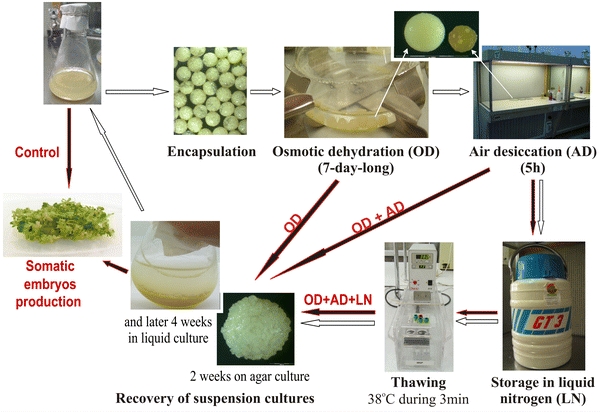
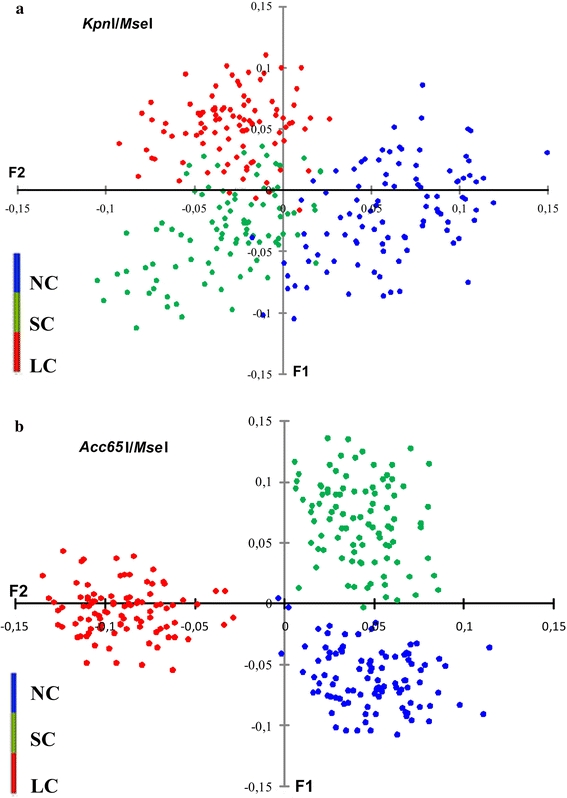
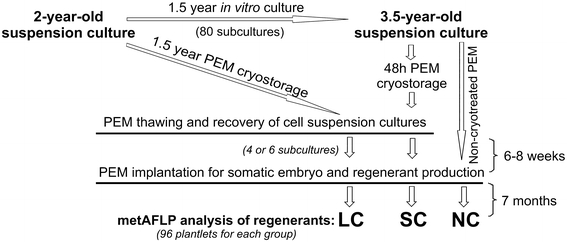
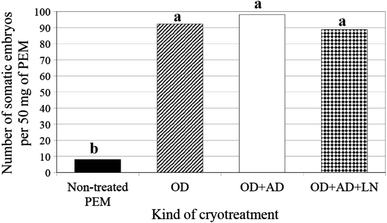
The embryogenic cell suspension culture of Gentiana cruciata, cryopreserved by the encapsulation/dehydration method, survived both short- (48 h) and long-term (1.5 years) cryostorage with more than 80% viability. To assess the influence of cryotreatments on the embryogenic potential, a proembryogenic mass was encapsulated and exposed to the following treatments: (1) osmotic dehydration (OD), (2) OD + air desiccation (AD) and (3) OD + AD + cryostorage (LN). The somatic embryogenesis efficiency increased ten times after osmotic dehydration. The AD and LN cryotreatments did not cause any significant alterations in somatic embryo production. We monitored the (epi)genetic stability of 288 regenerants derived from: non-cryotreated, short-term, and long-term cryostored tissue using metAFLP markers and ten primer combinations. Changes in the sequence and DNA methylation levels were studied by subjecting the DNA to digestion with two pairs of isoschisomer restriction enzymes (KpnI/MseI and Acc65I/MseI). Two new AFLP unique DNA fragments at the DNA sequence level, with no differences at the methylation level, were found between regenerants derived from cryopreserved tissue, compared with the non-cryotreated controls. The Acc65I/MseI methylation levels for the three groups of regenerants were not significantly different. Cluster analysis was capable of identifying a number of sub-clusters. Only one of the sub-clusters comprises almost all regenerants derived from non-cryotreated and short-term cryostored tissue. Plantlets derived from long-term cryostored tissue were grouped into separate clusters. The observed AFLP alterations did not appear to be associated with the use of cryopreservation, but were probably related to the process of in vitro culture.
獐牙菜属细胞悬浮培养物经包埋/脱水法冷冻保存,在短期(48 小时)和长期(1.5 年)冷冻保存后,存活率均超过 80%。为评估冷冻处理对胚胎发生潜能的影响,将原胚性愈伤组织包埋并进行以下处理:(1)渗透脱水(OD),(2)OD+空气干燥(AD)和(3)OD+AD+冷冻储存(LN)。渗透脱水后体细胞胚胎发生效率提高了十倍。AD 和 LN 冷冻处理对体细胞胚胎发生没有产生任何显著影响。我们使用 metAFLP 标记和十个引物组合监测了 288 个来自:未冷冻、短期和长期冷冻保存组织的再生体的(表)遗传稳定性。通过用两对同裂酶(KpnI/MseI 和 Acc65I/MseI)消化 DNA,研究了序列和 DNA 甲基化水平的变化。在冷冻保存组织衍生的再生体与未冷冻对照之间,在 DNA 序列水平上发现了两个新的 AFLP 独特 DNA 片段,在甲基化水平上没有差异。三组再生体的 Acc65I/MseI 甲基化水平没有显著差异。聚类分析能够识别出一些亚群。只有一个亚群几乎包含了所有来自未冷冻和短期冷冻保存组织的再生体。来自长期冷冻保存组织的植物被分为单独的集群。观察到的 AFLP 变化似乎与冷冻保存的使用无关,但可能与体外培养过程有关。