Lee Jong-Hyun, Woo Seung Hyo, Kim Eun Tak, Kim Dae Kyung, Park Jinsung
Department of Urology, Eulji University Hospital, Eulji University College of Medicine, Daejeon, Korea.
Korean J Urol. 2010 Nov;51(11):788-93. doi: 10.4111/kju.2010.51.11.788. Epub 2010 Nov 17.
We examined patient satisfaction with treatment outcomes after shock wave lithotripsy (SWL) and ureteroscopic removal of stone (URS) for proximal ureteral stones.
We evaluated 224 consecutive patients who underwent SWL (n=156) or URS (n=68) for a single radiopaque proximal ureteral stone. Stone-free rates, defined as no visible fragment on a plain X-ray; complications; and patient satisfaction were compared. Patient satisfaction was examined through a specifically tailored questionnaire that included overall satisfaction (5 scales) and 4 domains (pain, voiding symptoms, cost, and stone-free status).
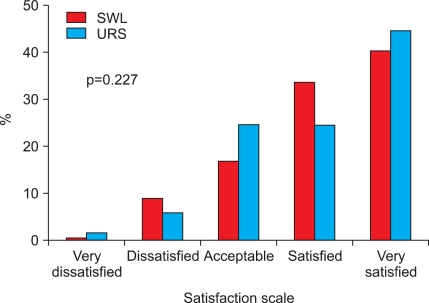
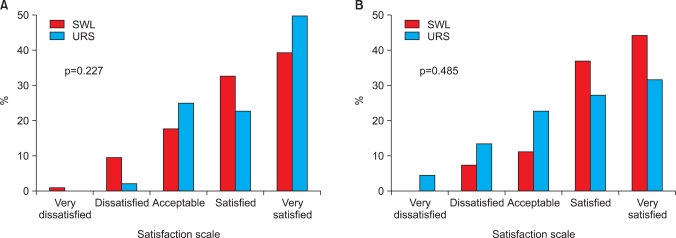
The stone-free rates after the first, second, and third sessions of SWL were 36.5%, 65.4%, and 84.6%, respectively. The overall stone-free rate of URS was 82.4%, which was comparable to that of the third session of SWL. Complications were similar between the two groups except for greater steinstrasse in the SWL group. Overall satisfaction and voiding symptoms, cost, and stone-free status showed no significant difference between the groups. In the pain domain, the SWL group had a relatively lower satisfaction rate than did the URS group (p=0.05). Subanalysis showed that the satisfaction rate of the URS group with stone-free status was significantly lower than that of the SWL group in patients with ≥10 mm stones (p=0.032).
Overall treatment outcomes and patient satisfaction were not significantly different between SWL and URS. However, patients undergoing URS for ≥10 mm proximal ureteral stones had lesser satisfaction with stone-free status, because of relatively lower stone-free rates due to upward stone migration. We suggest that factors regarding the subjective satisfaction of patients be included in counseling about treatment options for proximal ureteral stones.
我们研究了冲击波碎石术(SWL)和输尿管镜取石术(URS)治疗近端输尿管结石后患者对治疗结果的满意度。
我们评估了224例连续接受SWL(n = 156)或URS(n = 68)治疗单个不透X线近端输尿管结石的患者。比较了结石清除率(定义为在腹部平片上无可见碎片)、并发症和患者满意度。通过一份专门定制的问卷来检查患者满意度,该问卷包括总体满意度(5级评分)和4个领域(疼痛、排尿症状、费用和结石清除状态)。
SWL第一次、第二次和第三次治疗后的结石清除率分别为36.5%、65.4%和84.6%。URS的总体结石清除率为82.4%,与SWL第三次治疗的结石清除率相当。除SWL组的石街形成较多外,两组并发症相似。两组在总体满意度、排尿症状、费用和结石清除状态方面无显著差异。在疼痛领域,SWL组的满意度相对低于URS组(p = 0.05)。亚组分析显示,在结石≥10 mm的患者中,URS组结石清除状态的满意度显著低于SWL组(p = 0.032)。
SWL和URS的总体治疗结果和患者满意度无显著差异。然而,接受URS治疗≥10 mm近端输尿管结石的患者对结石清除状态的满意度较低,因为结石上移导致结石清除率相对较低。我们建议在近端输尿管结石治疗方案的咨询中纳入患者主观满意度相关因素。