Department of Molecular Virology, Immunology and Medical Genetics, The Ohio State University, 333 W. 10th Ave., Columbus, OH 43210, USA.
J Neuroinflammation. 2010 Dec 17;7:93. doi: 10.1186/1742-2094-7-93.
Interactions between fractalkine (CX3CL1) and fractalkine receptor (CX3CR1) regulate microglial activation in the CNS. Recent findings indicate that age-associated impairments in CX3CL1 and CX3CR1 are directly associated with exaggerated microglial activation and an impaired recovery from sickness behavior after peripheral injection of lipopolysaccharide (LPS). Therefore, the purpose of this study was to determine the extent to which an acute LPS injection causes amplified and prolonged microglial activation and behavioral deficits in CX3CR1-deficient mice (CX3CR1-/-).
CX3CR1-/- mice or control heterozygote mice (CX3CR1+/-) were injected with LPS (0.5 mg/kg i.p.) or saline and behavior (i.e., sickness and depression-like behavior), microglial activation, and markers of tryptophan metabolism were determined. All data were analyzed using Statistical Analysis Systems General Linear Model procedures and were subjected to one-, two-, or three-way ANOVA to determine significant main effects and interactions.
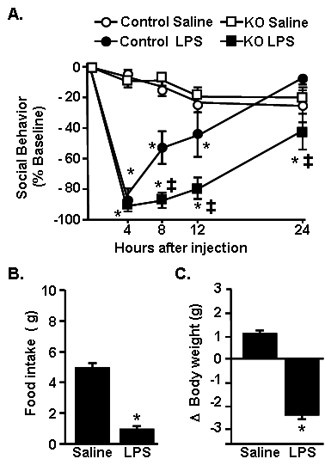
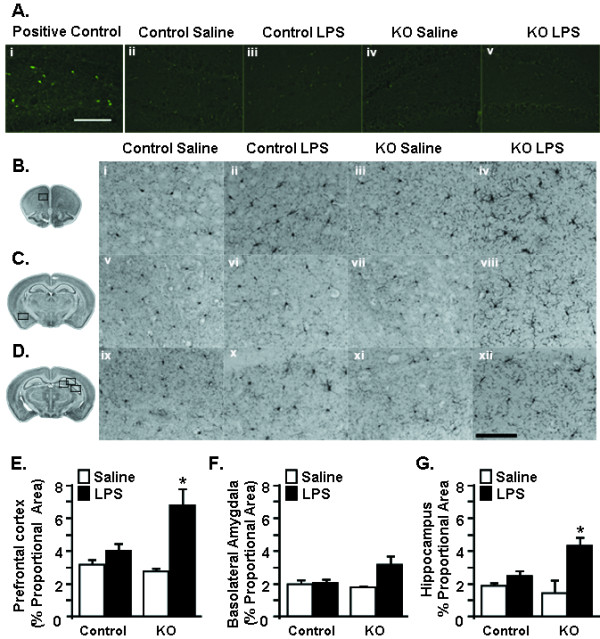
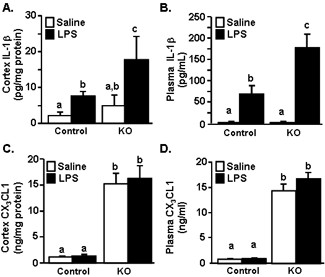
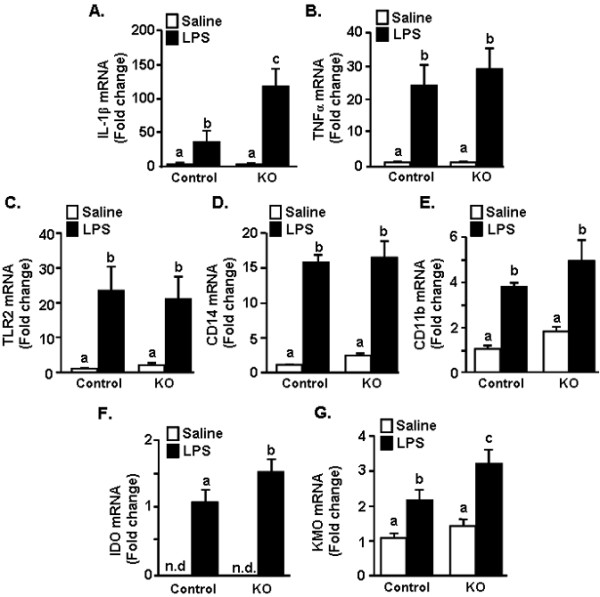
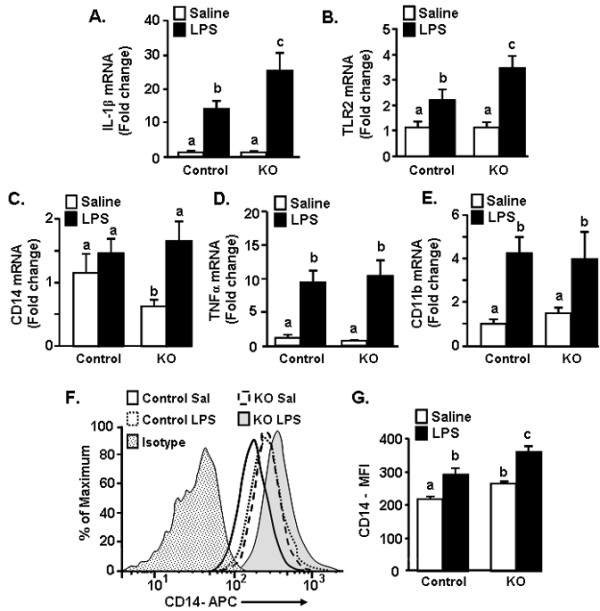
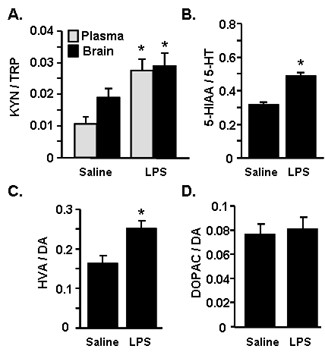
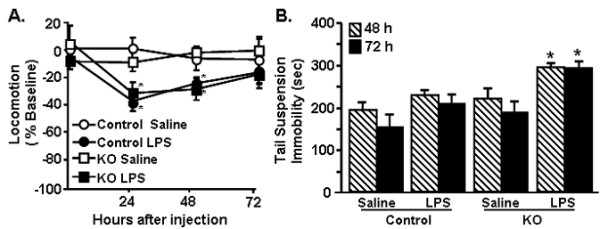
LPS injection caused a prolonged duration of social withdrawal in CX3CR1-/- mice compared to control mice. This extended social withdrawal was associated with enhanced mRNA expression of IL-1β, indolamine 2,3-dioxygenase (IDO) and kynurenine monooxygenase (KMO) in microglia 4 h after LPS. Moreover, elevated expression of IL-1β and CD14 was still detected in microglia of CX3CR1-/- mice 24 h after LPS. There was also increased turnover of tryptophan, serotonin, and dopamine in the brain 24 h after LPS, but these increases were independent of CX3CR1 expression. When submitted to the tail suspension test 48 and 72 h after LPS, an increased duration of immobility was evident only in CX3CR1-/- mice. This depression-like behavior in CX3CR1-/- mice was associated with a persistent activated microglial phenotype in the hippocampus and prefrontal cortex.
Taken together, these data indicate that a deficiency of CX3CR1 is permissive to protracted microglial activation and prolonged behavioral alterations in response to transient activation of the innate immune system.
趋化因子(CX3CL1)与趋化因子受体(CX3CR1)之间的相互作用调节中枢神经系统中小胶质细胞的激活。最近的研究结果表明,与年龄相关的 CX3CL1 和 CX3CR1 功能障碍与外周注射脂多糖(LPS)后小胶质细胞过度激活和疾病行为恢复受损直接相关。因此,本研究的目的是确定急性 LPS 注射在多大程度上导致 CX3CR1 缺陷型(CX3CR1-/-)小鼠中放大和延长的小胶质细胞激活和行为缺陷。
将 LPS(0.5mg/kg i.p.)或生理盐水注射到 CX3CR1-/- 小鼠或对照杂合子(CX3CR1+/-)小鼠中,测定行为(即疾病和抑郁样行为)、小胶质细胞激活和色氨酸代谢标志物。使用统计分析系统通用线性模型程序分析所有数据,并进行单、双或三因素方差分析,以确定显著的主效应和相互作用。
与对照小鼠相比,LPS 注射导致 CX3CR1-/- 小鼠的社交回避持续时间延长。这种延长的社交回避与 LPS 后 4 小时小胶质细胞中 IL-1β、吲哚胺 2,3-双加氧酶(IDO)和犬尿氨酸单加氧酶(KMO)的 mRNA 表达增强有关。此外,LPS 后 24 小时,CX3CR1-/- 小鼠的小胶质细胞中仍检测到 IL-1β和 CD14 的表达升高。LPS 后 24 小时,大脑中色氨酸、血清素和多巴胺的周转率也增加,但这些增加与 CX3CR1 的表达无关。当在 LPS 后 48 和 72 小时进行悬尾试验时,仅在 CX3CR1-/- 小鼠中观察到不动时间延长。CX3CR1-/- 小鼠的这种抑郁样行为与海马和前额叶皮质中小胶质细胞持续激活的表型有关。
综上所述,这些数据表明,CX3CR1 的缺乏允许对先天免疫系统短暂激活的反应中小胶质细胞的过度激活和行为改变的持续时间延长。