Department of Human Morphology and Applied Biology, Section of Histology and General Embryology, University of Pisa, Italy.
Med Sci Monit. 2011 Jan;17(1):SC1-5. doi: 10.12659/msm.881309.
Osteogenic growth peptide (OGP) is a 14-mer peptide found in relevant concentration in blood, and its carboxy-terminal fragment [OGP(10-14)] represents the active portion of the full-length peptide. In addition to stimulating bone formation, OGP(10-14) shows hematological activity. In fact, it highly enhances hematopoiesis-affecting stem progenitors. Moreover, OGP(10-14) reduces the growth and induces the differentiation of the hematological tumour cell line trombophoietin(TPO)-primed M07-e by interfering with RhoA and Src kinase pathways. In the present report, we went deeper into this mechanism and evaluated the possible interference of the OGP(10-14) signal pathway with TGFβ1 and TPO receptor Mpl.
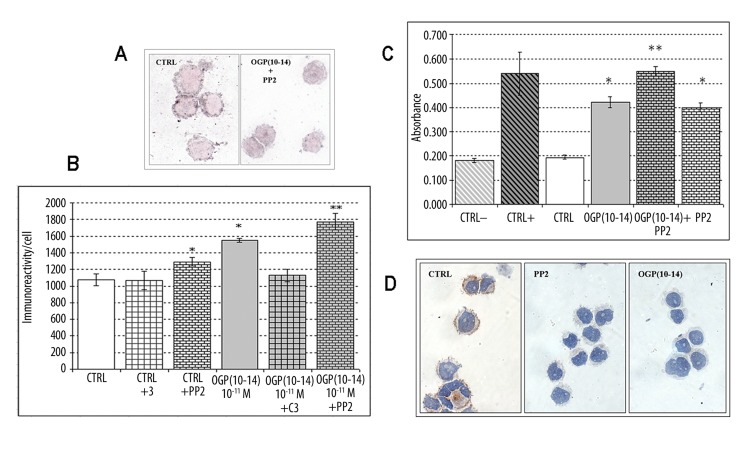
MATERIAL/METHODS: In OGP(10-14)-treated M07-e cells cultured with or without RhoA and Src kinases inhibitors (C3 and PP2), expression of TGFβ1, Mpl, and Src kinases was analyzed by immunoperoxidase technique. Activated RhoA expression was studied using the G-LISA™ quantitative test.
In M07-e cells, both OGP(10-14) and PP2 activate RhoA, inhibit Src kinases, reduce Mpl expression and increase TGFβ1 expression. OGP(10-14) and PP2 show the same behavior, causing an additive effect when associated.
OGP(10-14) induces TPO-primed M07-e cells differentiation through RhoA/TGFβ1/SFKs signalling pathway. In particular OGP(10-14) acts as a Src inhibitor, showing the same effects of PP2.
成骨生长肽(OGP)是一种在血液中以相关浓度存在的 14 肽,其羧基末端片段[OGP(10-14)]代表全长肽的活性部分。除了刺激骨形成外,OGP(10-14)还具有血液学活性。事实上,它高度增强造血影响干细胞祖细胞。此外,OGP(10-14)通过干扰 RhoA 和 Src 激酶途径,减少生长并诱导血小板生成素(TPO)引发的 M07-e 造血肿瘤细胞系的分化。在本报告中,我们深入研究了这一机制,并评估了 OGP(10-14)信号通路与 TGFβ1 和 TPO 受体 Mpl 之间可能的干扰。
材料/方法:在用或不用 RhoA 和 Src 激酶抑制剂(C3 和 PP2)培养的接受 OGP(10-14)处理的 M07-e 细胞中,通过免疫过氧化物酶技术分析 TGFβ1、Mpl 和 Src 激酶的表达。使用 G-LISA™定量试验研究激活的 RhoA 表达。
在 M07-e 细胞中,OGP(10-14)和 PP2 均激活 RhoA,抑制 Src 激酶,降低 Mpl 表达并增加 TGFβ1 表达。OGP(10-14)和 PP2 表现出相同的行为,当它们联合使用时会产生附加效果。
OGP(10-14)通过 RhoA/TGFβ1/SFKs 信号通路诱导 TPO 引发的 M07-e 细胞分化。特别是 OGP(10-14)作为 Src 抑制剂,表现出与 PP2 相同的作用。