Ragon Institute of Massachusetts General Hospital, Harvard and MIT, Boston, Massachusetts, United States of America.
PLoS One. 2010 Dec 8;5(12):e15084. doi: 10.1371/journal.pone.0015084.
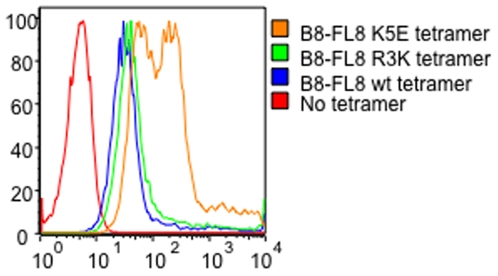
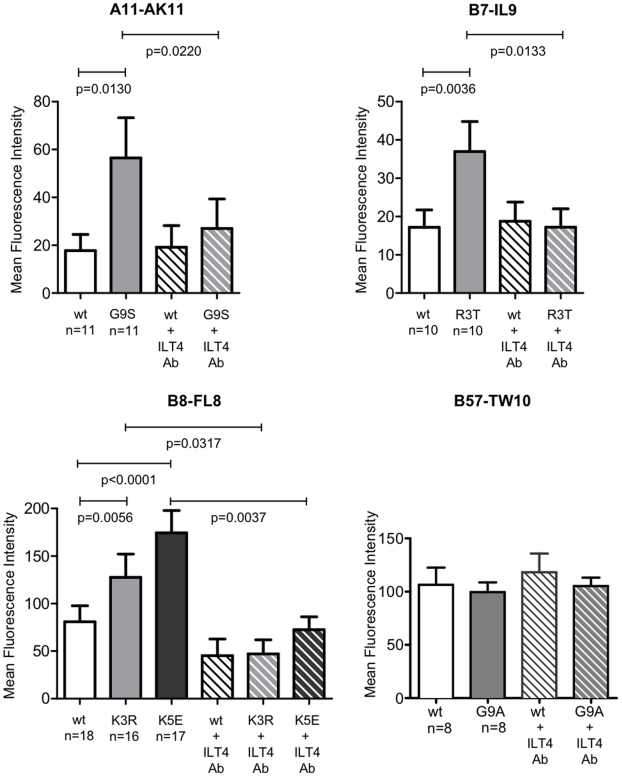
Escape mutations in HIV-1 cytotoxic T cell (CTL) epitopes can abrogate recognition by the TCR of HIV-1-specific CD8+ T cells, but may also change interactions with alternative MHC class I receptors. Here, we show that mutational escape in three HLA-A11-, B8- and B7- restricted immunodominant HIV-1 CTL epitopes consistently enhances binding of the respective peptide/MHC class I complex to Immunoglobulin-like transcript 4 (ILT4), an inhibitory myelomonocytic MHC class I receptor expressed on monocytes and dendritic cells. In contrast, mutational escape in an alternative immunodominant HLA-B57-restricted CTL epitope did not affect ILT4-mediated recognition by myelomonocytic cells. This suggests that in addition to abrogating recognition by HIV-1-specific CD8 T cells, mutational escape in some, but not all CTL epitopes may mediate important immunoregulatory effects by increasing binding properties to ILT4, and augmenting ILT4-mediated inhibitory effects of professional antigen-presenting cells.
HIV-1 细胞毒性 T 细胞(CTL)表位的逃逸突变可使 HIV-1 特异性 CD8+ T 细胞的 TCR 无法识别,但也可能改变与其他 MHC Ⅰ类受体的相互作用。在这里,我们发现三种 HLA-A11、B8 和 B7 限制的免疫优势 HIV-1 CTL 表位的突变逃逸一致增强了各自肽/MHC Ⅰ类复合物与免疫球蛋白样转录物 4(ILT4)的结合,ILT4 是一种表达在单核细胞和树突状细胞上的抑制性骨髓细胞 MHC Ⅰ类受体。相比之下,替代免疫优势 HLA-B57 限制的 CTL 表位的突变逃逸并不影响 ILT4 介导的骨髓细胞的识别。这表明,除了使 HIV-1 特异性 CD8 T 细胞的识别失效外,一些 CTL 表位(而非所有 CTL 表位)的突变逃逸可能通过增加与 ILT4 的结合特性,并增强专业抗原呈递细胞的 ILT4 介导的抑制作用,从而介导重要的免疫调节效应。