Department of Nuclear Medicine, Radboud University Nijmegen Medical Centre, Nijmegen, The Netherlands.
Eur J Nucl Med Mol Imaging. 2011 Apr;38(4):623-32. doi: 10.1007/s00259-010-1685-9. Epub 2010 Dec 18.
Radiolabelled peptides used for peptide receptor radionuclide therapy are excreted mainly via the kidneys and are partly reabsorbed and retained in the proximal tubular cells. The resulting high renal radiation dose can cause nephrotoxicity, limiting the maximum activity dose and the effectiveness of peptide receptor radionuclide therapy. The mechanisms of kidney reabsorption of these peptides are incompletely understood, but the scavenger receptor megalin has been shown to play a role in the reabsorption of (111)In-octreotide. In this study, the role of megalin in the renal reabsorption of various relevant radiolabelled peptides was investigated.
Groups of kidney-specific megalin-deficient mice and wild-type mice were injected with (111)In-labelled somatostatin, exendin, neurotensin or minigastrin analogues. Single photon emission computed tomographic (SPECT) images of the kidneys were acquired and analysed quantitatively, or the animals were killed 3 h after injection and the activity concentration in the kidneys was measured.
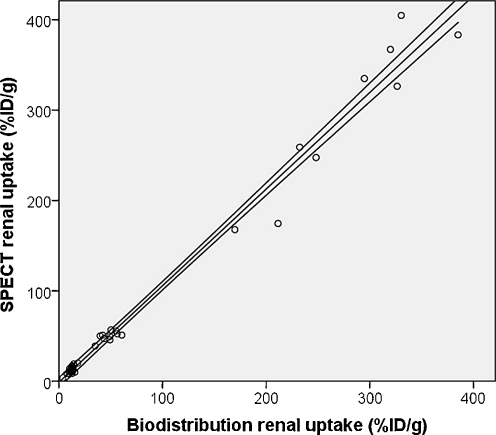
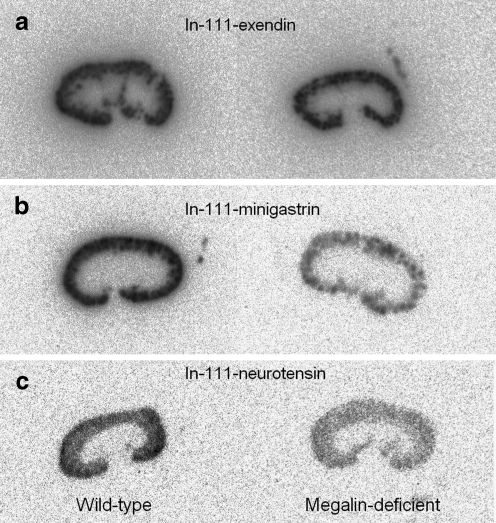
Megalin-deficient mice showed significantly lower uptake of all studied radiolabelled peptides in the kidneys, ranging from 22% ((111)In-octreotide) to 65% ((111)In-exendin) of uptake in wild-type kidneys. Quantitative analysis of renal uptake by SPECT and ex vivo measurements showed a very good correlation.
Megalin is involved in the renal reabsorption of radiolabelled octreotide, octreotate, exendin, neurotensin and minigastrin. This knowledge may help in the design of strategies to reduce this reabsorption and the resulting nephrotoxicity in peptide receptor radionuclide therapy, enabling more effective therapy. Small-animal SPECT is an accurate tool, allowing in vivo quantification of renal uptake and serial measurements in individual mice.
用于肽受体放射性核素治疗的放射性标记肽主要通过肾脏排泄,部分被重吸收并保留在近端肾小管细胞中。由此产生的高肾辐射剂量会导致肾毒性,限制了肽受体放射性核素治疗的最大活性剂量和疗效。这些肽的肾脏重吸收机制尚不完全清楚,但已表明清道夫受体 megalin 在(111)In-奥曲肽的重吸收中起作用。在这项研究中,研究了 megalin 在各种相关放射性标记肽的肾脏重吸收中的作用。
一组肾特异性 megalin 缺陷型小鼠和野生型小鼠分别注射(111)In 标记的生长抑素、exendin、神经降压素或 minigastrin 类似物。采集肾脏单光子发射计算机断层扫描(SPECT)图像并进行定量分析,或在注射后 3 小时处死动物,测量肾脏中的放射性活度浓度。
与野生型肾脏相比,megalin 缺陷型小鼠肾脏对所有研究的放射性标记肽的摄取明显降低,范围从 22%((111)In-奥曲肽)到 65%((111)In-exendin)。SPECT 定量分析和离体测量的肾脏摄取显示出非常好的相关性。
megalin 参与放射性标记的奥曲肽、奥曲肽、exendin、神经降压素和 minigastrin 的肾脏重吸收。这一知识可能有助于设计减少肽受体放射性核素治疗中这种重吸收和由此产生的肾毒性的策略,从而实现更有效的治疗。小动物 SPECT 是一种准确的工具,允许在体定量测量肾脏摄取并对单个小鼠进行连续测量。