Department of Vitreoretinal Surgery, Center for Ophthalmology, University of Cologne, Cologne, Germany.
Graefes Arch Clin Exp Ophthalmol. 2011 May;249(5):645-52. doi: 10.1007/s00417-010-1588-2. Epub 2010 Dec 18.
To assess the time interval to recurrent choroidal neovascular membrane (CNV) activity in eyes with neovascular age-related macular degeneration (AMD) after intravitreal anti-VEGF therapy.
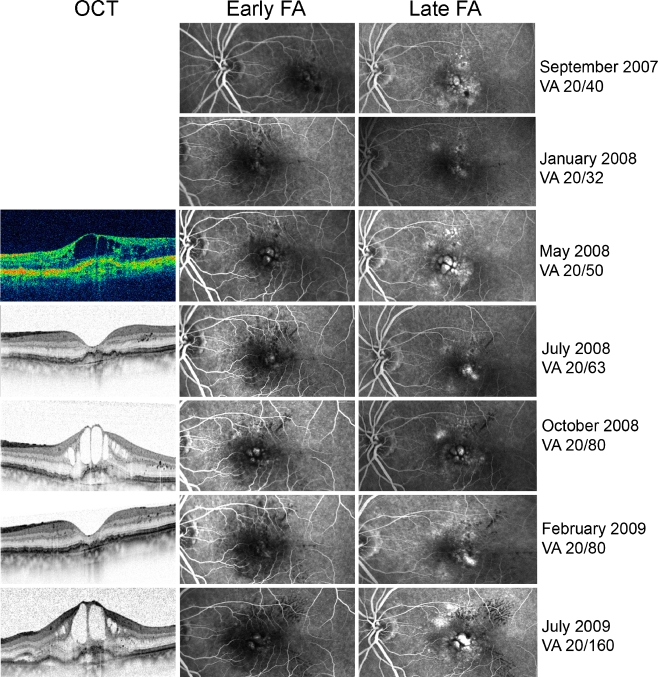
Data from all patients who received intravitreal ranibizumab injections for neovascular AMD at the University of Cologne prior to February 2009 were retrospectively reviewed. Patients were treated on a pro re nata (PRN) basis and eyes with active CNV received three consecutive monthly injections. Recurrence of CNV activity was defined as recurrence of intra- or subretinal fluid on optical coherence tomography (OCT) or leakage on fluorescein angiography (FA) after initial resolution of fluid and leakage following anti-VEGF therapy. All eyes showing at least two documented recurrences of CNV activity during follow-up were included in this analysis. Recurrence intervals were calculated and were deemed to be regular or periodical if the difference between recurrence interval times was less than 50 days.
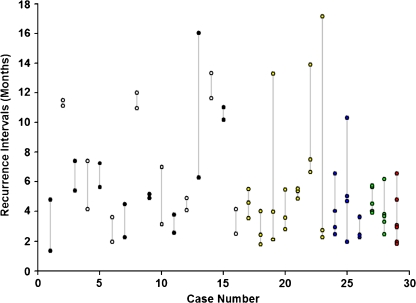
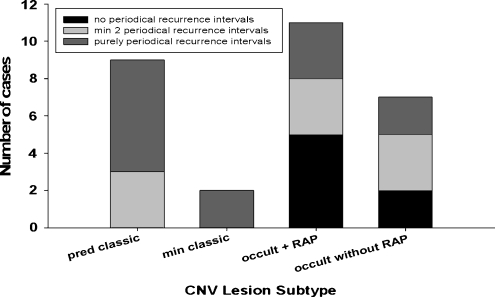
Twenty-nine eyes of 28 patients met the inclusion criteria. Two to six recurrences were detected per case (mean 2.8 ± 1.1 recurrences). Recurrence intervals ranged from 41 days to 523 days (mean 5.5 ± 3.4 months, median 4.5 months). Twenty-two eyes (76%) showed at least two periodical recurrence intervals. In 12 eyes (41%), all recurrences occurred at regular intervals (2-4 recurrences, mean 2.3 ± 0.6 recurrences). Seven eyes (24%) showed irregular recurrence intervals (2-3 recurrences, mean 2.1 ± 0.4 recurrences). All 11 eyes with a classic CNV lesion component showed at least two periodical recurrence intervals. Eyes with occult CNV lesions showed periodical recurrence intervals in 11 out of 18 cases (61%).
Preliminary data indicate that periodical recurrences of CNV activity may be seen in eyes with neovascular AMD undergoing anti-VEGF therapy. Knowledge of individual recurrence interval times may allow for the development of an individualized treatment plan and prophylactic therapy.
评估接受抗 VEGF 治疗后新生血管性年龄相关性黄斑变性(AMD)患者的脉络膜新生血管(CNV)活动复发的时间间隔。
回顾性分析了 2009 年 2 月前在德国科隆大学接受抗 VEGF 治疗的新生血管性 AMD 患者的所有数据。患者接受按需治疗(PRN),有活动 CNV 的眼睛接受连续三个月的每月注射。CNV 活动的复发定义为在抗 VEGF 治疗后初始液体和渗漏消退后,光学相干断层扫描(OCT)上出现视网膜内或下积液或荧光素血管造影(FA)上出现渗漏。所有在随访中至少有两次记录的 CNV 活动复发的眼睛均纳入本分析。计算复发间隔时间,如果复发间隔时间的差异小于 50 天,则认为是规则或周期性的。
28 例患者的 29 只眼符合纳入标准。每个病例检测到 2 到 6 次复发(平均 2.8 ± 1.1 次复发)。复发间隔时间从 41 天到 523 天不等(平均 5.5 ± 3.4 个月,中位数 4.5 个月)。22 只眼(76%)显示至少有两个周期性复发间隔。在 12 只眼(41%)中,所有复发均发生在规则间隔(2-4 次复发,平均 2.3 ± 0.6 次复发)。7 只眼(24%)显示不规则复发间隔(2-3 次复发,平均 2.1 ± 0.4 次复发)。所有 11 只具有典型 CNV 病变成分的眼均显示至少有两个周期性复发间隔。18 例隐匿性脉络膜新生血管病变中有 11 例(61%)显示周期性复发间隔。
初步数据表明,接受抗 VEGF 治疗的新生血管性 AMD 患者可能会出现 CNV 活动的周期性复发。了解个体复发间隔时间可能有助于制定个体化治疗计划和预防性治疗。