Department of Neurological Surgery, Washington University School of Medicine, St Louis, Missouri, USA.
Muscle Nerve. 2011 Jan;43(1):120-6. doi: 10.1002/mus.21807.
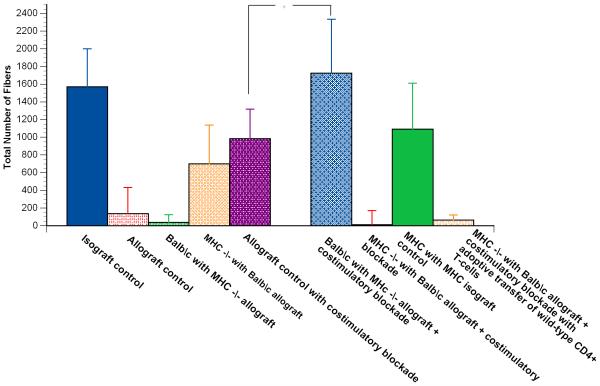
Nerve allografts provide a temporary scaffold for host nerve regeneration. The need for systemic immunosuppression limits clinical application. Characterization of the immunological mechanisms that induce immune hyporesponsiveness may provide a basis for optimizing immunomodulating regimens. We utilized wild-type and MHC class II-deficient mice, as both recipients and donors. Host treatment consisted of triple costimulatory blockade. Quantitative assessment was made at 3 weeks using nerve histomorphometry, and muscle testing was performed on a subset of animals at 7 weeks. Nerve allograft rejection occurred as long as either the direct or indirect pathways were functional. Indirect antigen presentation appeared to be more important. Nerve allograft rejection occurs in the absence of a normal direct or indirect immune response but may be more dependent on indirect allorecognition. The indirect pathway is required to induce costimulatory blockade immune hyporesponsiveness.
同种异体神经移植物为宿主神经再生提供了临时支架。但由于需要全身免疫抑制,限制了其临床应用。对诱导免疫低反应性的免疫机制进行特征分析,可能为优化免疫调节方案提供基础。我们利用野生型和 MHC Ⅱ类缺陷型小鼠作为供体和受体。宿主的治疗方法包括三重共刺激阻断。在 3 周时使用神经组织形态计量学进行定量评估,并在 7 周时对部分动物进行肌肉测试。只要直接或间接途径有功能,同种异体神经移植物就会发生排斥反应。间接抗原呈递似乎更为重要。在缺乏正常的直接或间接免疫反应的情况下,同种异体神经移植物排斥仍会发生,但可能更依赖于间接同种异体识别。间接途径是诱导共刺激阻断免疫低反应性所必需的。