Center of Excellence for Health Disparities Research: El Centro, University of Miami School of Nursing and Health Studies, Coral Gables, FL 33126, USA.
J Fam Psychol. 2010 Dec;24(6):746-55. doi: 10.1037/a0021638.
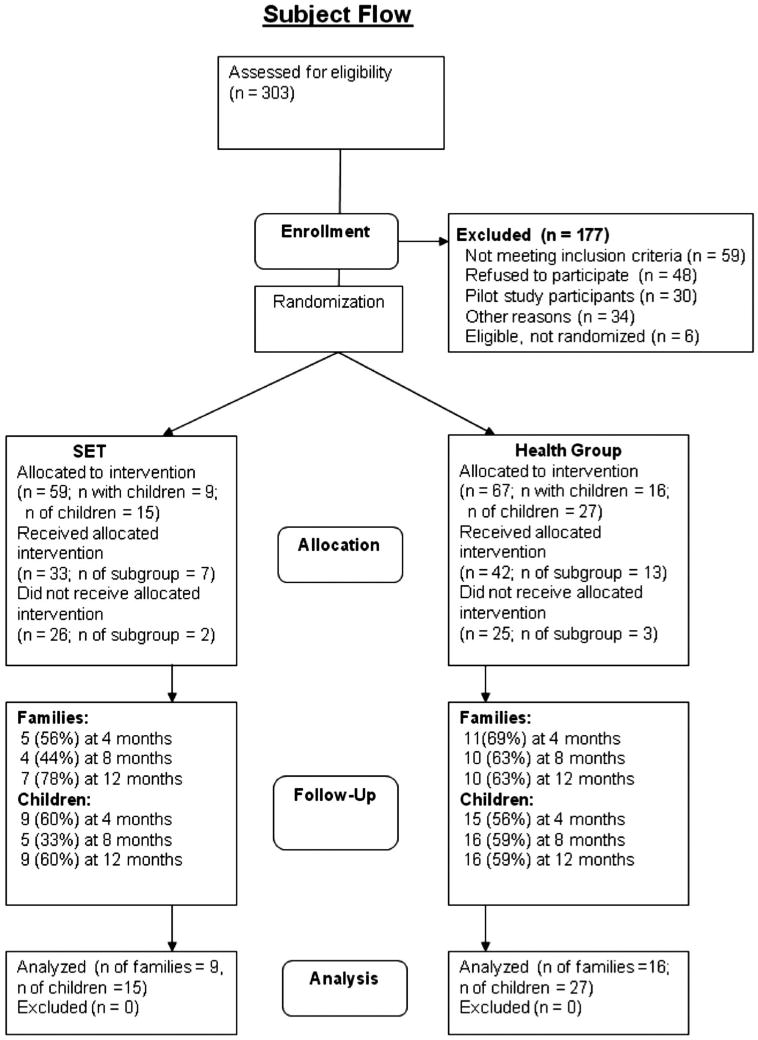
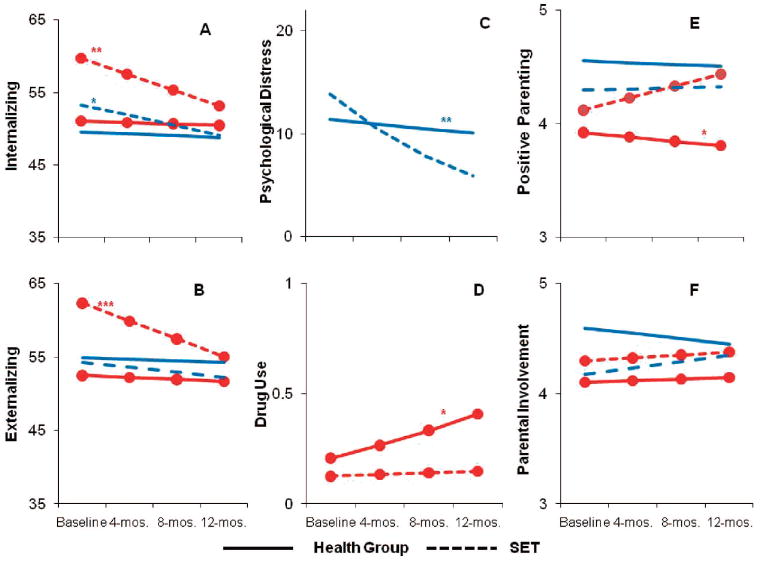
This study presents results of a subgroup analysis from a randomized trial to examine whether Structural Ecosystems Therapy (SET), a family intervention intended to improve medication adherence and reduce drug relapse of HIV-seropositive (HIV+) women recovering from drug abuse, provided benefits for families with children. Data from 42 children and 25 mothers were analyzed at baseline, and 4, 8, and 12 months post-baseline. Results of longitudinal Generalized Estimating Equations analyses suggested that SET was more efficacious than the Health Group (HG) control condition in decreasing children's internalizing and externalizing problems and reducing mothers' psychological distress and drug relapse. Children in SET reported improvements in positive parenting as compared to the children in HG, but there were no differences in mother-reported positive parenting, or parental involvement as reported by either the children or mothers. These findings suggest that family interventions such as SET may be beneficial for mothers and children. An adaptation of SET specifically for families with children could further enhance benefits and improve acceptability and cost-effectiveness.
本研究报告了一项随机试验的亚组分析结果,旨在检验结构性生态系统治疗(SET)是否对正在康复中的吸毒的 HIV 阳性(HIV+)妇女改善药物依从性和减少药物复吸有所帮助,尤其是对于有孩子的家庭。在基线、基线后 4 个月、8 个月和 12 个月时,对 42 名儿童和 25 名母亲的数据进行了分析。纵向广义估计方程分析的结果表明,SET 比健康组(HG)对照条件更有效,可以减少儿童的内化和外化问题,降低母亲的心理困扰和药物复吸。与 HG 组的儿童相比,SET 组的儿童报告称积极的育儿方式有所改善,但 HG 组的母亲报告的积极育儿方式、儿童或母亲报告的父母参与度方面没有差异。这些发现表明,SET 等家庭干预措施可能对母亲和儿童有益。为有孩子的家庭专门改编的 SET 可以进一步增强其益处,并提高可接受性和成本效益。