Laboratorio de Virología Molecular, CMBC, IVIC, Caracas, Venezuela.
PLoS One. 2010 Dec 13;5(12):e14315. doi: 10.1371/journal.pone.0014315.
The subtype diversity of the hepatitis C virus (HCV) genotypes is unknown in Venezuela.
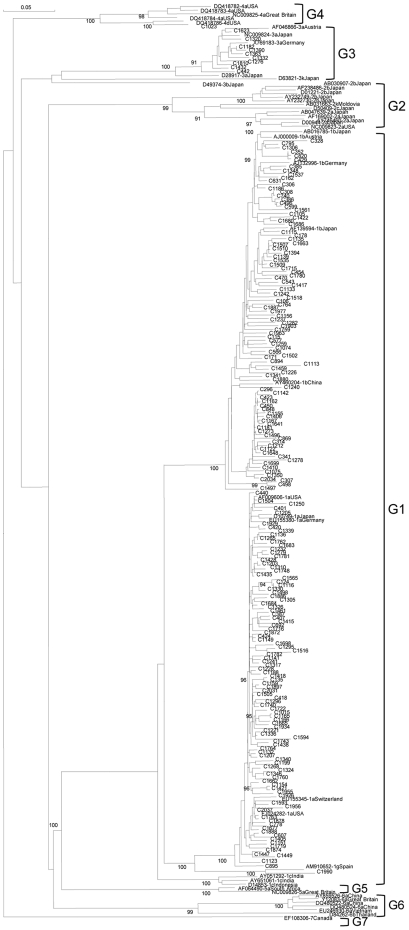
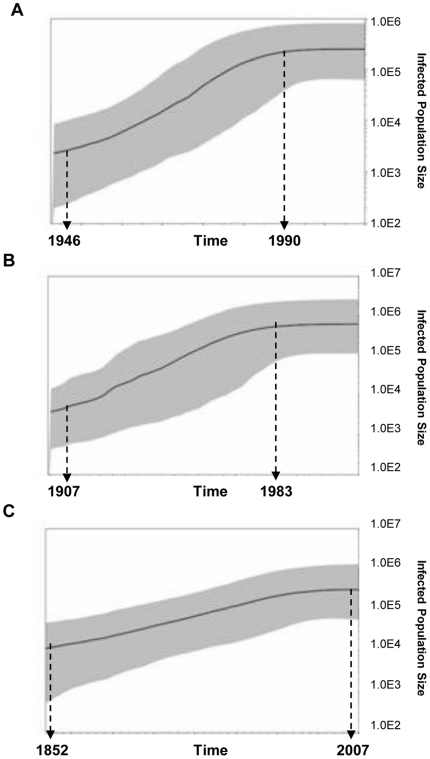
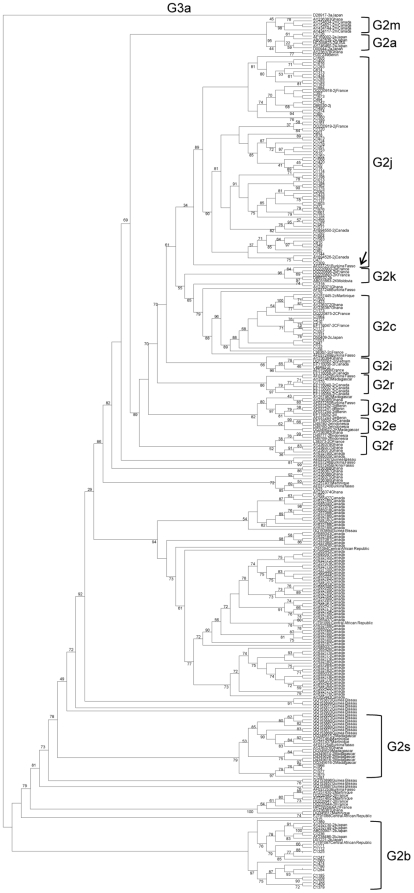
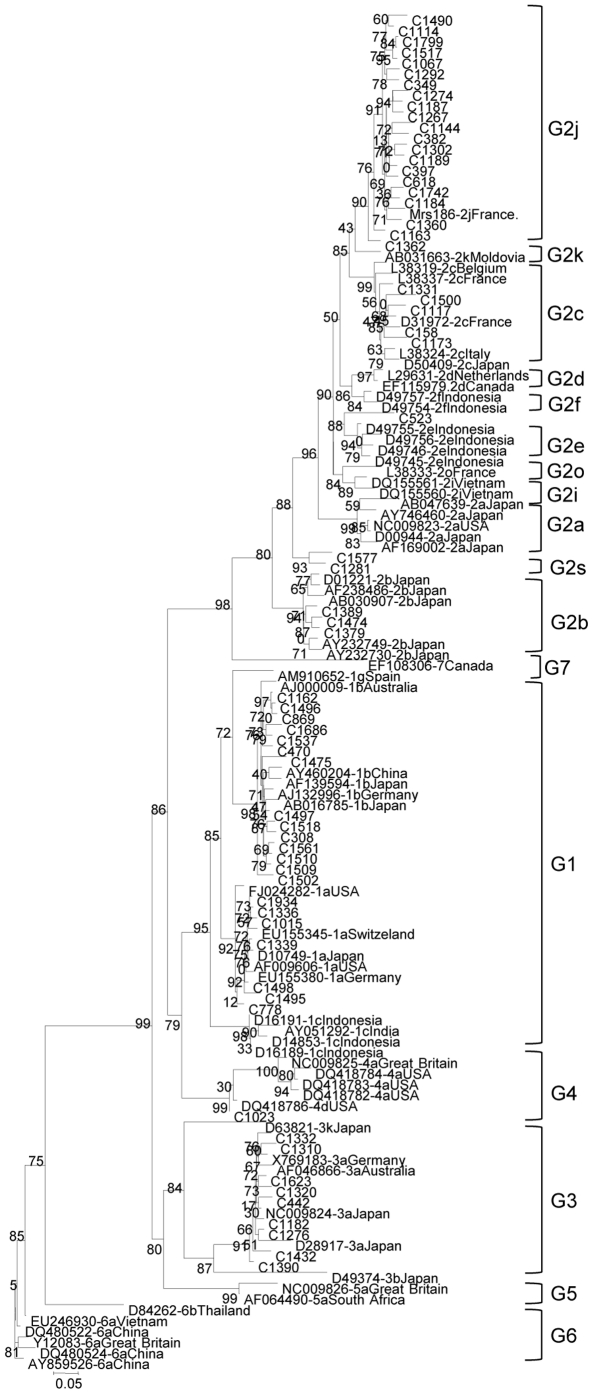
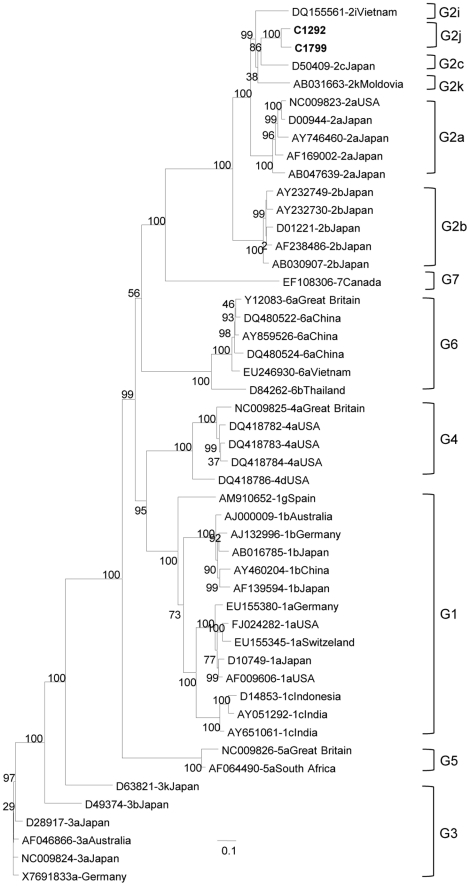
METHODOLOGY/PRINCIPAL FINDINGS: Partial sequencing of the NS5B region was performed in 310 isolates circulating in patients from 1995 to 2007. In the samples collected between 2005 and 2007, HCV genotype 1 (G1) was the most common genotype (63%), composed as expected of mainly G1a and G1b. G2 was the second most common genotype (33%), being G2a almost absent and G2j the most frequent subtype. Sequence analysis of the core region confirmed the subtype assignment performed within the NS5b region in 63 isolates. The complete genome sequence of G2j was obtained. G2j has been described in France, Canada and Burkina Fasso, but it was not found in Martinique, where several subtypes of G2 circulate in the general population. Bayesian coalescence analysis indicated a most recent common ancestor (MRCA) of G2j around 1785, before the introduction of G1b (1869) and G1a (1922). While HCV G1a and G1b experienced a growth reduction since 1990, coincident with the time when blood testing was implemented in Venezuela, HCV G2j did not seem to reach growth equilibrium during this period.
CONCLUSIONS/SIGNIFICANCE: Assuming the introduction of G2j from Africa during the slave trade, the high frequency of G2j found in Venezuela could suggest: 1- the introduction of African ethnic groups different from the ones introduced to Martinique or 2- the occurrence of a founder effect. This study represents an in-depth analysis of the subtype diversity of HCV in Venezuela, which is still unexplored in the Americas and deserves further studies.
委内瑞拉的丙型肝炎病毒 (HCV) 基因型的亚型多样性尚不清楚。
方法/主要发现:对 1995 年至 2007 年期间患者中传播的 310 个分离株的 NS5B 区进行了部分测序。在 2005 年至 2007 年期间采集的样本中,HCV 基因型 1 (G1) 是最常见的基因型(63%),主要由 G1a 和 G1b 组成。G2 是第二常见的基因型(33%),几乎不存在 G2a,而 G2j 是最常见的亚型。核心区域的序列分析证实了在 63 个分离株中 NS5b 区域内进行的亚型分配。获得了 G2j 的完整基因组序列。G2j 已在法国、加拿大和布基纳法索描述过,但在马提尼克岛没有发现,在那里,G2 的几种亚型在普通人群中传播。贝叶斯合并分析表明,G2j 的最近共同祖先(MRCA)大约在 1785 年左右,早于 G1b(1869 年)和 G1a(1922 年)的引入。虽然 HCV G1a 和 G1b 自 1990 年以来经历了增长率的下降,与委内瑞拉开始进行血液检测的时间一致,但 HCV G2j 在这段时间内似乎没有达到增长平衡。
结论/意义:假设 G2j 是从奴隶贸易时期从非洲传入的,在委内瑞拉发现的 G2j 高频度可能表明:1- 引入了与马提尼克岛不同的非洲族群,或者 2- 发生了奠基者效应。本研究代表了对委内瑞拉 HCV 亚型多样性的深入分析,在美洲地区仍未得到探索,值得进一步研究。