Department of Engineering Science and Mechanics, Virginia Polytechnic Institute and State University, Blacksburg, Virginia, United States of America.
PLoS One. 2010 Dec 14;5(12):e15176. doi: 10.1371/journal.pone.0015176.
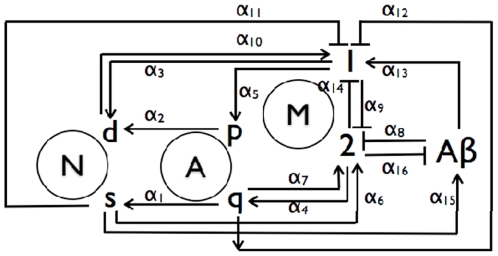
Despite extensive research, the pathogenesis of neurodegenerative Alzheimer's disease (AD) still eludes our comprehension. This is largely due to complex and dynamic cross-talks that occur among multiple cell types throughout the aging process. We present a mathematical model that helps define critical components of AD pathogenesis based on differential rate equations that represent the known cross-talks involving microglia, astroglia, neurons, and amyloid-β (Aβ). We demonstrate that the inflammatory activation of microglia serves as a key node for progressive neurodegeneration. Our analysis reveals that targeting microglia may hold potential promise in the prevention and treatment of AD.
尽管进行了广泛的研究,但神经退行性阿尔茨海默病(AD)的发病机制仍然难以理解。这主要是由于在衰老过程中,多种细胞类型之间发生的复杂和动态的串扰。我们提出了一个数学模型,该模型基于代表涉及小胶质细胞、星形胶质细胞、神经元和淀粉样蛋白-β(Aβ)的已知串扰的微分率方程,有助于根据定义 AD 发病机制的关键成分。我们证明小胶质细胞的炎症激活是进行性神经退行性变的关键节点。我们的分析表明,针对小胶质细胞可能有希望预防和治疗 AD。