Aix-Marseille Université, Centre d'Océanologie de Marseille, Station marine d'Endoume-CNRS UMR 6540-DIMAR, Marseilles, France.
PLoS One. 2010 Dec 14;5(12):e14290. doi: 10.1371/journal.pone.0014290.
Homoscleromorpha is the fourth major sponge lineage, recently recognized to be distinct from the Demospongiae. It contains <100 described species of exclusively marine sponges that have been traditionally subdivided into 7 genera based on morphological characters. Because some of the morphological features of the homoscleromorphs are shared with eumetazoans and are absent in other sponges, the phylogenetic position of the group has been investigated in several recent studies. However, the phylogenetic relationships within the group remain unexplored by modern methods.
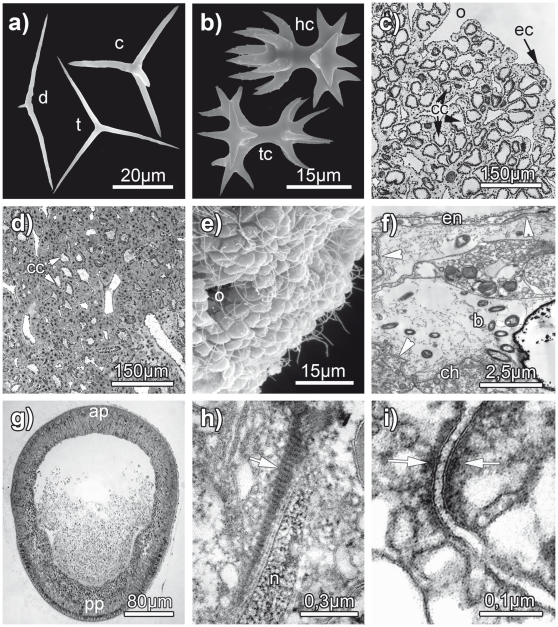
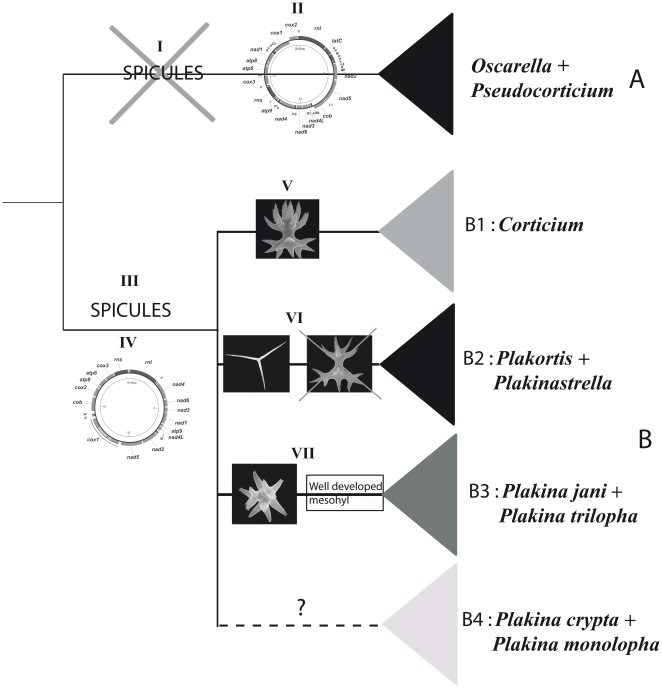
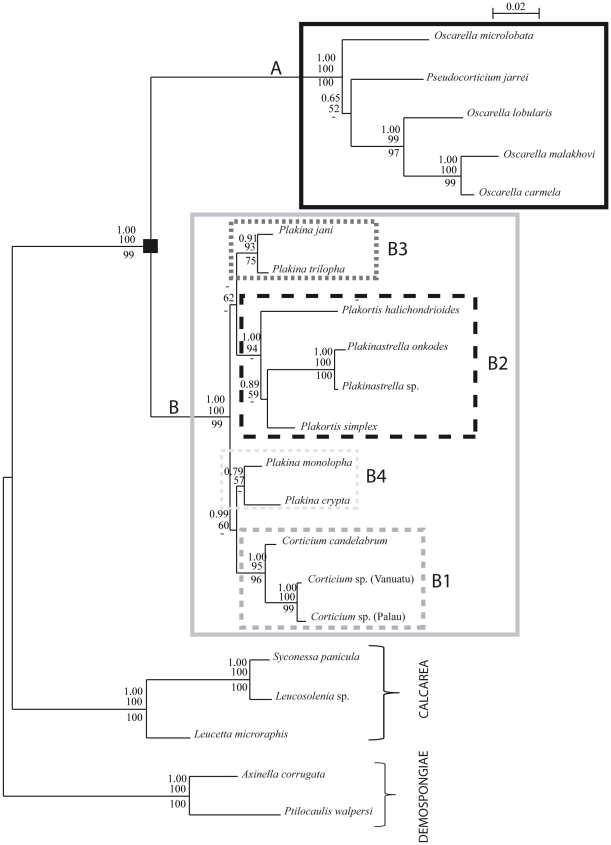
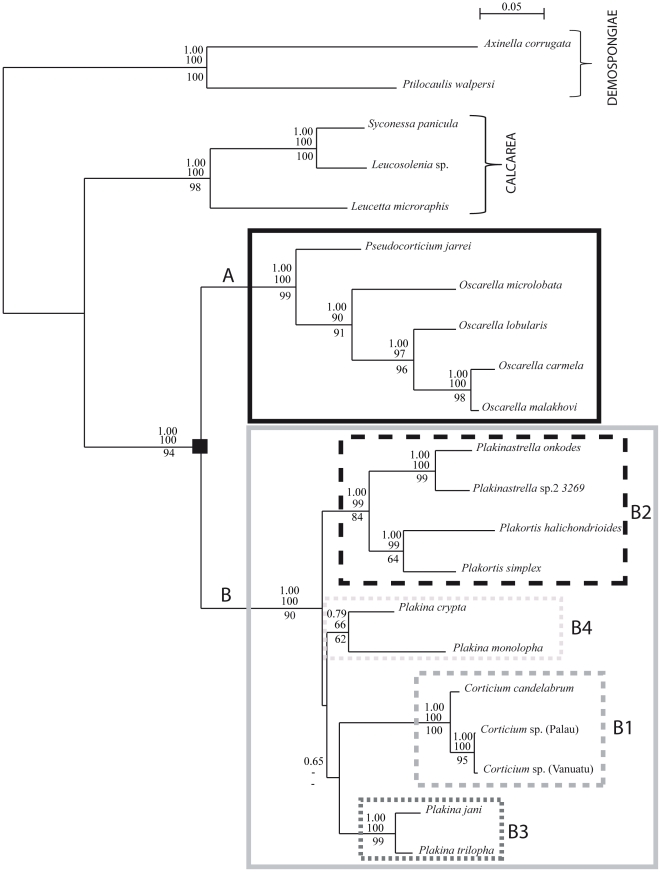
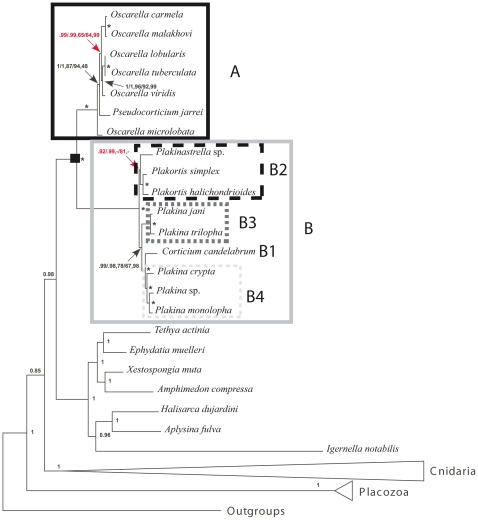
METHODOLOGY/PRINCIPAL FINDINGS: Here we describe the first molecular phylogeny of Homoscleromorpha based on nuclear (18S and 28S rDNA) and complete mitochondrial DNA sequence data that focuses on inter-generic relationships. Our results revealed two robust clades within this group, one containing the spiculate species (genera Plakina, Plakortis, Plakinastrella and Corticium) and the other containing aspiculate species (genera Oscarella and Pseudocorticium), thus rejecting a close relationship between Pseudocorticium and Corticium. Among the spiculate species, we found affinities between the Plakortis and Plakinastrella genera, and between the Plakina and Corticium. The validity of these clades is furthermore supported by specific morphological characters, notably the type of spicules. Furthermore, the monophyly of the Corticium genus is supported while the monophyly of Plakina is not.
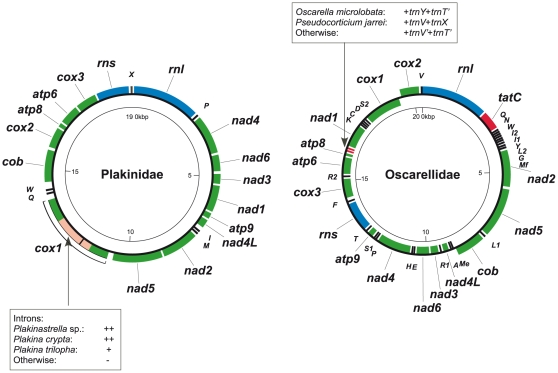
CONCLUSIONS/SIGNIFICANCE: As the result of our study we propose to restore the pre-1995 subdivision of Homoscleromorpha into two families: Plakinidae Schulze, 1880 for spiculate species and Oscarellidae Lendenfeld, 1887 for aspiculate species that had been rejected after the description of the genus Pseudocorticium. We also note that the two families of homoscleromorphs exhibit evolutionary stable, but have drastically distinct mitochondrial genome organizations that differ in gene content and gene order.
同源多孔动物是第四大海绵谱系,最近被认为与寻常海绵动物不同。它包含<100 种仅在海洋中发现的海绵物种,这些物种传统上基于形态特征分为 7 个属。由于同源多孔动物的一些形态特征与后生动物共有,而在其他海绵中不存在,因此该群体的系统发育位置在最近的几项研究中进行了调查。然而,该群体内部的系统发育关系仍未通过现代方法进行探索。
方法/主要发现:本文首次基于核(18S 和 28S rDNA)和完整的线粒体 DNA 序列数据描述了同源多孔动物的分子系统发育,重点关注属间关系。我们的研究结果揭示了该群体中的两个强大分支,一个分支包含有刺的物种(Plakina、Plakortis、Plakinastrella 和 Corticium 属),另一个分支包含无刺的物种(Oscarella 和 Pseudocorticium 属),从而排除了 Pseudocorticium 和 Corticium 之间的密切关系。在有刺的物种中,我们发现 Plakortis 和 Plakinastrella 属之间以及 Plakina 和 Corticium 之间具有亲缘关系。这些分支的有效性还得到了特定形态特征的支持,尤其是骨针的类型。此外,Corticium 属的单系性得到了支持,而 Plakina 属的单系性则没有得到支持。
结论/意义:由于我们的研究结果,我们建议恢复 1995 年前将同源多孔动物分为两个科的分类:Plakinidae Schulze,1880 用于有刺的物种,Oscarellidae Lendenfeld,1887 用于无刺的物种,该分类在 Pseudocorticium 属描述后被拒绝。我们还注意到,同源多孔动物的两个科具有进化稳定的,但具有截然不同的线粒体基因组组织,在基因内容和基因顺序上存在差异。