Department of Clinical Pharmacy, University of California San Francisco, San Francisco, California, United States of America.
PLoS One. 2010 Dec 16;5(12):e14349. doi: 10.1371/journal.pone.0014349.
During the first two decades of the U.S. AIDS epidemic, and unlike some malignancies, breast cancer risk was significantly lower for women with human immunodeficiency virus (HIV) infection compared to the general population. This deficit in HIV-associated breast cancer could not be attributed to differences in survival, immune deficiency, childbearing or other breast cancer risk factors. HIV infects mononuclear immune cells by binding to the CD4 molecule and to CCR5 or CXCR4 chemokine coreceptors. Neoplastic breast cells commonly express CXCR4 but not CCR5. In vitro, binding HIV envelope protein to CXCR4 has been shown to induce apoptosis of neoplastic breast cells. Based on these observations, we hypothesized that breast cancer risk would be lower among women with CXCR4-tropic HIV infection.
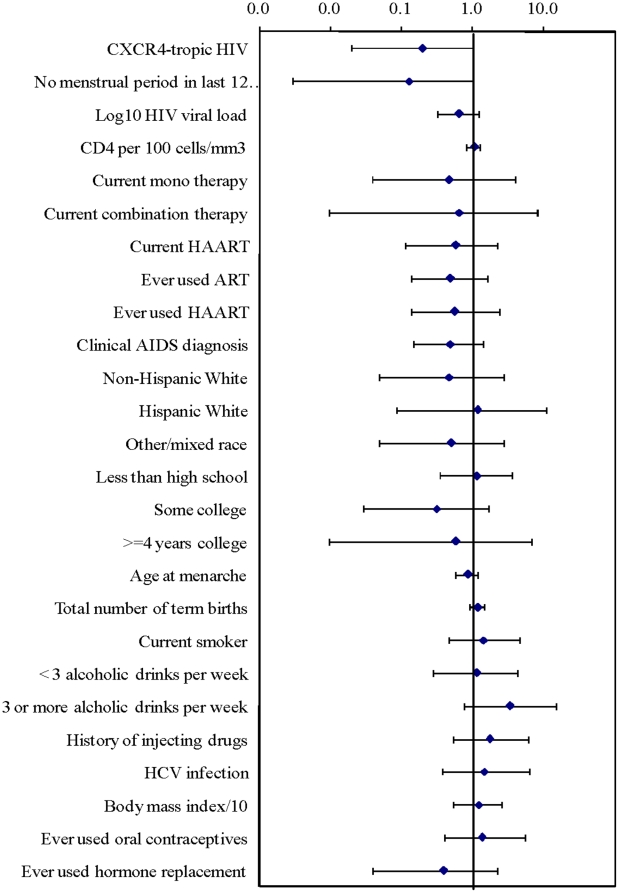
We conducted a breast cancer nested case-control study among women who participated in the WIHS and HERS HIV cohort studies with longitudinally collected risk factor data and plasma. Cases were HIV-infected women (mean age 46 years) who had stored plasma collected within 24 months of breast cancer diagnosis and an HIV viral load≥500 copies/mL. Three HIV-infected control women, without breast cancer, were matched to each case based on age and plasma collection date. CXCR4-tropism was determined by a phenotypic tropism assay. Odds ratios (OR) and 95% confidence intervals (CI) for breast cancer were estimated by exact conditional logistic regression. Two (9%) of 23 breast cancer cases had CXCR4-tropic HIV, compared to 19 (28%) of 69 matched controls. Breast cancer risk was significantly and independently reduced with CXCR4 tropism (adjusted odds ratio, 0.10, 95% CI 0.002-0.84) and with menopause (adjusted odds ratio, 0.08, 95% CI 0.001-0.83). Adjustment for CD4+ cell count, HIV viral load, and use of antiretroviral therapy did not attenuate the association between infection with CXCR4-tropic HIV and breast cancer.
Low breast cancer risk with HIV is specifically linked to CXCR4-using variants of HIV. These variants are thought to exclusively bind to and signal through a receptor that is commonly expressed on hyperplastic and neoplastic breast duct cells. Additional studies are needed to confirm these observations and to understand how CXCR4 might reduce breast cancer risk.
在美国艾滋病流行的头二十年中,与某些恶性肿瘤不同,与普通人群相比,感染人类免疫缺陷病毒(HIV)的女性罹患乳腺癌的风险显著降低。HIV 相关乳腺癌的这种不足不能归因于生存差异、免疫缺陷、生育或其他乳腺癌危险因素。HIV 通过与 CD4 分子以及 CCR5 或 CXCR4 趋化因子共受体结合感染单核免疫细胞。肿瘤性乳腺细胞通常表达 CXCR4,但不表达 CCR5。体外研究表明,HIV 包膜蛋白与 CXCR4 结合可诱导肿瘤性乳腺细胞凋亡。基于这些观察结果,我们假设 CXCR4 嗜性 HIV 感染的女性乳腺癌风险较低。
我们对参加 WIHS 和 HERS HIV 队列研究的女性进行了一项乳腺癌巢式病例对照研究,这些研究具有纵向收集的危险因素数据和血浆。病例为感染 HIV 的女性(平均年龄 46 岁),在乳腺癌诊断后 24 个月内收集了储存的血浆,并且 HIV 病毒载量≥500 拷贝/ml。基于年龄和血浆采集日期,每例病例匹配了 3 名未患乳腺癌的感染 HIV 的对照女性。通过表型嗜性测定法确定 CXCR4 嗜性。通过精确条件逻辑回归估计乳腺癌的比值比(OR)和 95%置信区间(CI)。在 23 例乳腺癌病例中,有 2 例(9%)为 CXCR4 嗜性 HIV,而在 69 例匹配对照中,有 19 例(28%)为 CXCR4 嗜性 HIV。与 CXCR4 嗜性相关的乳腺癌风险显著降低(调整后的 OR,0.10,95%CI 0.002-0.84),与绝经相关(调整后的 OR,0.08,95%CI 0.001-0.83)。调整 CD4+细胞计数、HIV 病毒载量和抗逆转录病毒治疗后,感染 CXCR4 嗜性 HIV 与乳腺癌之间的关联并未减弱。
HIV 相关的低乳腺癌风险与 CXCR4 利用的 HIV 变体特异性相关。这些变体被认为仅与广泛表达于增生和肿瘤性乳腺导管细胞的受体结合并发出信号。需要进一步研究来证实这些观察结果,并了解 CXCR4 如何降低乳腺癌风险。